
Continuing with the tradition from last two years, I occasionally post interviews with some of the participants of the ScienceOnline2010 conference that was held in the Research Triangle Park, NC back in January 2010. See all the interviews in this series here. You can check out previous years’ interviews as well: 2008 and 2009.
Today, I asked Steve Koch to answer a few questions.
Welcome to A Blog Around The Clock. Would you, please, tell my readers a little bit more about yourself? Where are you coming from (both geographically and philosophically)? What is your (scientific) background?
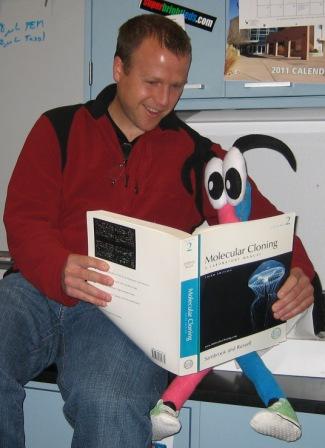 I was raised in Ann Arbor, Michigan, USA, a town that embraces the University of Michigan’s Athletic and Academic programs (in that order probably!). I remain a huge fan of Michigan and, sadly, Detroit professional sports teams. My mom and dad adopted me when I was about two months old and raised my sister and me in this house. My parents were very encouraging of my love of science. I remember many trips with my mom to the bookmobile to get the science books that the driver had found for me in the library. It boggles my mind to think of what I could have learned if I had the internet and Wikipedia around when I was young! My dad was an audiologist and helped me with all my science fair projects and taught me to be a good experimentalist. One project I remember the best was when he brought home an audiometer and I tested the noise reduction capabilities of various ear plugs. He helped me with the title too and “Stick it in your ear!” won my 9th grade science fair. Yes, I am bragging about that.
Mr. Mastie was our earth science teacher in junior high school, but more importantly, he was our leader for Science Olympiad. He had a spectacular amount of energy and enthusiasm for science and launched science careers for quite a few of us, I’d expect. Richard Taylor, my physics teacher in 12th grade was another outstanding teacher that played a huge part in my career.
After high school graduation, I asked my friend Liz if she could ask her dad, Francis Collins, if I could work in his lab that summer. He said yes! So, my first research job at Michigan (where I did my undergraduate degree in physics) was in a genetics lab. I LOVED it and wrote a bit about it in a blog post, Assistant to Robot, Promoted to Robot. I worked in a lab every semester I was at Michigan, working for professors doing genetics (Collins), granular systems (Nori), atomic physics (Bucksbaum), and high energy physics. I also did an internship in non-destructive evaluation with Bill Ellingson at Argonne National Lab – probably the first time I saw my research in a lab produce results that people outside the lab were actually excited about.
Tell us a little more about your career trajectory so far: interesting projects past and present?
After my undergraduate work, I went to the Cornell physics Ph.D. program. Why did I choose Cornell? At the time, Bose-Einstein condensation had recently been achieved. I was accepted at MIT and dying to work in atomic physics with the Ketterle and Pritchard labs. However, my best friend had already decided to go to Cornell for MechE Ph.D. At the time, it was a tough decision, but I finally decided that I was sure it would be fun to be at the same school as my friend, whereas it was less certain that I’d thrive in atomic physics or MIT in general. In retrospect, it’s clear I made the right decision. Nowadays, when I talk with undergraduates who are choosing graduate schools, I make it a point to discuss factors besides the science: distance from family or boyfriends/girlfriends, climate, etc. Cornell did not have any atomic physics, which I was in love with at the time. Even so, it still took me two years to realize that biology is the science I love the most. It’s so obvious in retrospect. But back then, I spent half a year in low temperature physics with Jeevak Parpia. The science and the experiments were very cool. And Jeevak was a terrific advisor. But I eventually realized that biophysics was where I belonged, so I switched to a single-molecule / optical tweezers lab.
What is taking up the most of your time and passion these days? What are your goals?
I have a wonderful five-year-old son and a wonderful three-year-old daughter. One of my goals is to succeed at being a scientist to serve as an example for my kids. Without a doubt, for me it’s a huge challenge to switch mental gears between being a scientist and being a dad. And I can only imagine how much tougher this is for scientist moms. I need to get better at it. Last spring, I coached tee ball, which was surprisingly rewarding (and time-consuming). Before starting, I assumed I just wanted to have fun watching my own son play ball. But it turns out that I really enjoyed it when any of the children learned a new skill. And they were like sponges and got better every game, so it was a ton of fun and I will do it again next spring. If you’re going to click on one link in this interview, check out the photo of my son in the Wikipedia tee ball article. Looks like a great catcher!
The rest of my time is taken up by teaching and managing our research lab and talking science with the students in our lab. I have non-talents that impede my grant writing and paper writing. Definitely I am not passionate about those tasks. I love thinking up experiments, looking at data, thinking of data analysis algorithms, coding, and seeing unexpected and / or new results. So, I still have a strong passion for being an experimentalist. And the lab has really taken off since getting our first big grant a year and a half ago. We are having a lot of fun in the lab, but it also takes more and more time the better the students get at generating and analyzing the data…so it’s a bit crazy, and one of my goals is to survive. 🙂 What are my specific goals? For my lab, I want my students to learn a lot about their talents during their time in the lab. And I want them to succeed after leaving the lab and I want to get vicarious happiness from that. For my family, I want to show my kids that you can succeed while having fun. I will be happy whatever my kids do as long as they strive for excellence.
What’s the worst thing about being a professor?
I don’t like how many jobs I have that I am not good at and how often I have to switch from one task to another. In graduate school, after completing my required courses, I loved being able to focus on a single task for 20 hours straight, and then come right back to it the next day. Especially if it were a computer programming / data analysis problem. Well, those days are gone and now I have to constantly switch from teaching to advising to grant writing to committee work to paper writing to friendfeed to… Yes, I know that’s reality for most of us, I’m just sayin’ I don’t like it. I also don’t like the pressure of having graduate students depend on me obtaining research grants for their livelihood. Not the kind of stress I thrive on.
What’s the best thing about being a professor?
By far it’s being able to interact with students – both in teaching and in the research lab. I’ve been here about four years, and have interacted with hundreds of students. I’d say I know close to a dozen very well and dozens remain in touch. I have one strong talent necessary for teaching / managing students, and that is that I get true enjoyment out of seeing students succeed, both now and later in their careers. I think that’s an essential talent for this career, which I fortunately have. Of course, I get to know the students best when they’re in our research lab. I have been so lucky to have many outstanding students contribute to our lab’s success. We’ve had some students in our lab who are now or soon will be in graduate school elsewhere—Diego Ramallo Pardo (Stanford), Caleb Morse, Pat Jurney (UT Austin), Nas Manole (UNM Med.), Linh Le (UNM), Brandon Beck. Currently we have four graduate students—Andy Maloney, Pranav Rathi, Anthony Salvagno, and Nadia Fernandez-Oropeza—and one undergraduate—Brian Josey. All of these students are carrying out Open Notebook Science, inspired by Jean-Claude Bradley and many others. And, big news: We just graduated our first Ph.D. student, Larry Herskowitz! And he even got a job already!!! The students are what I love the most, and I am continually regretting that I don’t spend enough time with them. Maybe 2011 will be the year I can fix that??? We’ll see…
How does (if it does) blogging figure in your work? How about social networks, e.g., Twitter, FriendFeed and Facebook? Do you find all this online activity to be a net positive (or even a necessity) in what you do?
I think social networking is now a necessity for me and my students. I enjoy blogging but have not been able to keep it up consistently. For the past couple years, FriendFeed has been a wonderful resource—so many clever, dedicated, and supportive people to interact with.
What was the best aspect of ScienceOnline2010 for you?
By far the best part of ScienceOnline2010 was getting to meet in-person many of the people whom I’d only previously known electronically. I had great conversations over lunch, dinner, and at the bar. By the time the conference was over, I had serious insomnia from so many inspiring ideas. At the time I blogged a little about them, along with some resolutions. It’s been over half a year now, and I’m happy to see that I’ve made progress on the resolutions, even if very slowly. I talk with the students in the lab frequently about how we can continue to make our lab notebooks better and easier to manage, and we’re making some progress. I’ve started a collaboration with a new library scientist at UNM, Rob Olendorf. So, hopefully within a year we’ll have figured out a lot about how our library can host our open data. Research in the lab is going really well and we’ve recently submitted two papers to PLoS ONE.
It was so nice to meet you in person and thank you for the interview. I will see you again very soon!



 A Blog Around The Clock