Category Archives: Science Reporting

Stories: what we did at #WSF11 last week

As you probably know, I spent last week in New York City, combining business with pleasure – some work, some fun with friends (including #NYCscitweetup with around 50 people!), some fun with just Catharine and me, and some attendance at the World Science Festival.

My panel on Thursday afternoon went quite well, and two brief posts about it went up quickly on Nature Network and the WSF11 official blog.

But now, there is a really thorough and amazing piece on it, combining text by Lena Groeger (who also did a great job livetweeting the event) with comic-strip visualization of the panel by Perrin Ireland – worth your time! Check it out: All about Stories: How to Tell Them, How They’re Changing, and What They Have to Do with Science

More about the trip and the Festival still to come…

Update: See also coverage at Mother Geek.

Is education what journalists do?

We had a great discussion this afternoon on Twitter, about the way journalists strenuously deny they have an educational role, while everyone else sees them as essential pieces of the educational ecosystem: sources of information and explanation missing from schools, or for information that is too new for older people to have seen in school when they were young. Also as sources of judgement in disputes over facts.

While journalists strongly deny their educational role, as part of their false objectivity and ‘savvy’, everyone else perceives them as educators – people who should know and then tell, what is true and what is false, who is lying and who is not. People rely, as they cannot be in school all their lives, on the media for continuing education, especially on topics that are new. And people are then disappointed when, as usually happens, journalists fail in that role by indulging in false balance, He-Said-She-Said reporting, passionately avoiding to assign the truth-value to any statement, or self-indulgent enjoyment of their own “skill with words” in place of explaining the facts.

Fortunately for you all, you do not have to wade through all the tweets to see the entire discussion, as Adrian Ebsary has collected it all using Storify – read the whole thing (keep clicking “Load more” on the bottom of the page until you get to the end):

Informer or Educator: Defining the Journalist’s Role

As you can see, while there is some snark and oversimplification here and there due to short format, the discussion was pretty interesting and constructive. This is also a demonstration that useful discussions can be had on Twitter.

Whenever someone says “you cannot say anything in 140 characters” I respond with “who ever said that you only have 140 characters?”. To their quizzical look, I add “You are not limited to one tweet per lifetime – if you need 14,000 characters, you can write 100 tweets”. But, by writing 100 tweets, and making sure that each tweet – not just the collection of 100 – makes sense, has punch to it, and is hard to misunderstand or misquote out of context, one has to write and edit each tweet with great care. Twitter does not allow for sloppy writing!

Picking a theme for a few hours or days, and tweeting a whole lot about it during that period, is usually called ‘mindcasting‘. But it is even better when a bunch of other people join in and mindcast together – everyone learns something from the experience.

Now read the Storify and, if you have time and energy, respond with an essay on your own blog, as a continuation of the mindcasting process.

Update: And the first responses are in:

Whose Job is Public Science Education?

Are Journalists Educators? Does It Even Matter?

Scientific Communication all-you-can-eat Linkfest

About a week ago, Catherine Clabby (editor at American Scientist), Anton Zuiker and I did a two-day workshop on science communication with the graduate students in the Biology Department at Wake Forest University in Winston-Salem, NC. Here are some of the things we mentioned and websites we showed during those two days.

Links shown by Anton for the personal web page session:

Official homepage of Aaron Martin Cypess, M.D., PH.D.
Stanford Medicine faculty profiles
Web Pages That Suck
Anton Zuiker (old homepage)
Biology: Faculty at Wake Forest
Official homepage of Thomas L. Ortel, MD, PhD
Official homepage of Matthew Hirschey
About.me
Joe Hanson’s About.me page
Jakob Nielsen’s Utilize Available Screen Space
Official homepage of Jacquelyn Grace
Laboratory and Video Web Site Awards
Web Style Guide

Link to the step-by-step page for creating a WordPress blog:

Simple exercises for creating your first blog

Links shown during the social media session:

Anton’s Prezi presentation
Delicious link sharing
Twitter and a tweet
Facebook – you know it, of course. Here’s the fish photo
LinkedIn
Tumblr
Posterous
Bora’s take on Tumblr and Posterous

==========================

From Cathy Clabby:

References:

Good books on writing well:

Writing Tools: 50 Essential Strategies for Every Write by Roy Peter Clark
On Writing Well by William K. Zinsser
Eats Shoots & Leaves by Lynne Truss.
The Elements of Style by William Strunk and E.B. White

Excellent articles on how to avoid gobbledygook when writing about science:

Deborah Gross and Raymond Sis. 1980. Scientific Writing: The Good, The Bad, and The Ugly. Veterinary Radiology
George Gopen and Judith Swan. 1990 The Science of Scientific Writing. American Scientist

Web resources for good-writing advice:

Websites with smart writing advice:

Roy Peter Clark from the Poynter Institute offers these 50 “quick list” writing tools.
Purdue University’s OnLine Writing Lab
Carl Zimmer’s banned words (updated regularly on The Loom, his Blog)

You are what you read:

Newsstand magazines with excellent science writing:

The New Yorker
Discover
National Geographic
Scientific American
American Scientist
Outside

Books featuring clear, vivid science writing:

The Beak of a Finch by Jonathan Weiner
The Map that Changed the World by Simon Winchester
Lives of a Cell: Notes of a Biology Watcher by Lewis Thomas
Galileo’s Daughter by Dava Sobel
The Making of the Atomic Bomb by Richard Rhodes
The Emperor of All Maladies by Siddhartha Mukherjee
The Best American Science Writing (a yearly anthology with a changing cast of guest editors)
The Best American Science and Nature Writing (another yearly anthology)

==========================

From Bora:

Workshop on conferences in the age of the Web:

How To Blog/Tweet a Conference:
How To Blog a Conference
On the challenges of conference blogging
What a difference a year makes: tweeting from Cold Spring Harbor

How to present at a conference mindful of Twitter backchatter:

How the Backchannel Has Changed the Game for Conference Panelists
On organizing and/or participating in a Conference in the age of Twitter

Icons to put on your slides and posters:

Creating a “blog-safe” icon for conference presentations: suggestions?
CameronNeylon – Slideshare: Permissions
Andy and Shirley’s new ONS Logos

A good recent blog post about the changes in the publishing industry (good links within and at the bottom):
Free Science, One Paper at a Time

Open Notebook Science:
Open Notebook Science
UsefulChem Project
Open Science: Good for Research, Good for Researchers?

A little bit of historical perspective on science, science journalism, blogging and social media (and you can endlessly follow the links within links within links within these posts):
The line between science and journalism is getting blurry….again
Why Academics Should Blog: A College of One’s Own
The Future of Science
Visualizing Enlightenment- Era Social Networks
“There are some people who don’t wait.” Robert Krulwich on the future of journalism
A Farewell to Scienceblogs: the Changing Science Blogging Ecosystem
New science blog networks mushroom to life
Science Blogging Networks: What, Why and How
Web breaks echo-chambers, or, ‘Echo-chamber’ is just a derogatory term for ‘community’ – my remarks at #AAASmtg
Is education what journalists do?
All about Stories: How to Tell Them, How They’re Changing, and What They Have to Do with Science
Telling science stories…wait, what’s a “story”?
Blogs: face the conversation
Identity – what is it really?
Books: ‘Reinventing Discovery: The New Era of Networked Science’ by Michael Nielsen
#scio12: Multitudes of Sciences, Multitudes of Journalisms, and the Disappearance of the Quote.

Where to find science blogs (and perhaps submit your own blog for inclusion/aggregation):
ScienceBlogging.org
ScienceSeeker.org
ResearchBlogging.org

A blog about science blogging, especially for scientists – well worth digging through the archives:
Science of Blogging

A blog post about science that was inspired by a previous post on the same blog:
1000 posts!

A blog post about the way a previous blog post put together a researcher and a farmer into a scientific collaboration:
Every cell in a chicken has its own male or female identity
In which I set up a collaboration between a biologist, a farmer and a chimeric chicken

A blog post demonstrating how to blog about one’s own publication:
The story behind the story of my new #PLoSOne paper on “Stalking the fourth domain of life”
Comments, Notes and Ratings on: Stalking the Fourth Domain in Metagenomic Data: Searching for, Discovering, and Interpreting Novel, Deep Branches in Marker Gene Phylogenetic Trees

Another example:
Comments, Notes and Ratings on: Order in Spontaneous Behavior
Paper explained in video at SciVee.tv
Author’s blog and site. See some more buzz.

Collection of links showing how Arsenic Life paper was challenged on blogs:
#Arseniclife link collection

A blog post about a scientific paper that resulted from a hypothesis first published in a previous blog post:
Does circadian clock regulate clutch-size in birds? A question of appropriateness of the model animal.
My latest scientific paper: Extended Laying Interval of Ultimate Eggs of the Eastern Bluebird

A post with unpublished data, and how people still do not realize they can and should cite blog posts (my own posts have been cited a few times, usually by review papers):
Influence of Light Cycle on Dominance Status and Aggression in Crayfish
Circadian Rhythm of Aggression in Crayfish

Good blogs to follow the inside business of science and publishing:
Retraction Watch
Embargo Watch
DrugMonkey and DrugMonkey

Who says that only young scientists are bloggers (you probably studied from his textbook):
Sandwalk

My homepage (with links to other online spaces) and my blog:
Homepage
Blog
Twitter
Facebook

How to find me on Scientific American:
A Blog Around The Clock

Scientific American and its blogs (new blog network, with additional blogs, will launch soon) and social networks:
Scientific American homepage
Scientific American blogs
Scientific American Facebook page
Scientific American official Twitter account
Scientific American MIND on Twitter
Scientific American blogs on Twitter

Cool videos:
Fungus cannon
Octopus Ballet
The Fracking Song

Why blog?
Science Blogs Are Good For You
To blog or not to blog, not a real choice there…
Bloggers unite
Scooped by a blog
Scientists Enter the Blogosphere
“Online, Three Years Are Infinity”
Studying Scientific Discourse on the Web Using Bibliometrics: A Chemistry Blogging Case Study
The Message Reigns Over the Medium
Networking, Scholarship and Service: The Place of Science Blogging in Academia

Great series of post about scientists using blogs and social media by Christie Wilcox:

Social Media for Scientists Part 1: It’s Our Job
Social Media for Scientists Part 2: You Do Have Time.
Social Media for Scientists Part 2.5: Breaking Stereotypes
Social Media For Scientists Part 3: Win-Win

Why use Twitter?

What is Twitter and Why Scientists Need To Use It.
Twitter: What’s All the Chirping About?
Social media for science: The geologic perspective
Why Twitter can be the Next Big Thing in Scientific Collaboration
How and why scholars cite on Twitter
Researchers! Join the Twitterati! Or perish!
Twitter for Scientists
PLoS ONE on Twitter and FriendFeed

Some good Twitter lists and collections/apps:
Attendees at ScienceOnline2012
Scientific American editors, writers and contributors
SciencePond
The Tweeted Times

Some interesting Twitter hashtags:
#scio12 (chatter about ScienceOnline conference, and discussions within that community)
#scio13 (people already talking about next year’s event)
#SITT (Science In The Triangle, NC)
#madwriting (writing support community)
#wherethesciencehappens (pictures of locations where science happens)
#icanhazpdf (asking for and receiving PDFs of papers hidden behind paywalls)
#scimom – scientists and mothers and scientist-mothers.
#scienceblogging
#sciwri – science writing
#sciart – science and art
#histsci – history of science
#IamScience – a great initiative, see: original blog post, Storify, Tumblr, Kickstarter – and see the related Tumblr: This Is What A Scientist Looks Like

The Open Laboratory anthology of science blogging:
The Open Laboratory – what, how and why
The Open Laboratory at Lulu.com
The Open Laboratory 2011 updates
A couple of Big Announcements about The Open Laboratory

ScienceOnline conferences:
ScienceOnline2011
ScienceOnline2012
ScienceOnline2011 programming wiki
ScienceOnline2012 programming wiki
ScienceOnline2012 homepage
ScienceOnline2012 official blog
ScienceOnline2012 coverage blog
ScienceOnline2012 organizing wiki
ScienceOnline2012 blog and media coverage
ScienceOnline2013 organizing wiki
ScienceOnline participants’ interviews

Probably the best and most current book on science communication for scientists is ‘Explaining Research‘ by Dennis Meredith – see the book homepage and the associated blog for a wealth of additional information and updates.

Probably the best book for preparing oral (and to a smaller degree poster) presentations is Dazzle ‘Em With Style: The Art of Oral Scientific Presentation by Robert Anholt.

For posters, dig through the archives of this blog:
Better Posters

On Peer Review Radio

If you missed it earlier this week (i.e., if you do not follow me on Twitter or Facebook), you can catch up now. Adrian Ebsary interviewed Marie-Claire Shanahan, Greg Gbur, Chris Gunter and me for the Peer Review Radio Episode 20: Go Sing it On the Mountain – Communicating Science Online, about science blogging, science writing, teaching, open science and more. Worth a listen (at least for the other three guests – great stuff!).

Web breaks echo-chambers, or, ‘Echo-chamber’ is just a derogatory term for ‘community’ – my remarks at #AAASmtg

As you probably know, I was in D.C. last week, attending the annual AAAS meeting. This was my second one (funny, back when I was a member of AAAS I was still in grad school and I could never afford to go – now that I am out of science, invitations are finally happening). It is an enormous meeting (about 8200 people this year, I hear) and I missed even seeing some of the friends as the space was so enormous and the program so rich.

Unlike last year, when I was in a session that made quite a splash, this year I was a part of a much more academic panel on Social Networks and Sustainability.

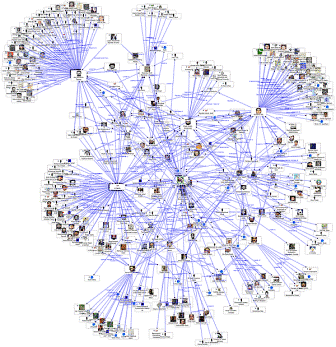
Organized by Thomas Dietz of Michigan State University, the panelists were Mrill Ingram (University of Wisconsin), Ken Frank (Michigan State University) and Adam D. Henry (West Virginia University). These are people from areas like sociology, people who make graphs like this one and understand how to properly interpret it:

My role on the panel was as a ‘discussant’, i.e., someone who does not give a separate talk but comments, at the end, on what the other panelists have said.

I am glad I got the materials from the panelists in advance as this was quite dense stuff.

Every scientific discipline invents new words – the terminology (or jargon) with precise meaning that is necessary for practitioners to talk to each other. For the most part, natural sciences tend to stick to agreed definitions, and counter-examples are relatively rare thus usually quite well known (e.g., the different use of the term “gene” by population geneticists vs. molecular geneticists).

Social sciences, on the other hand, tend to appropriate words from the existing English vocabulary and give those words new, precise definitions. Thus, possibility of misunderstanding by non-experts is greater. Also, some of the terms are defined differently by different sub-disciplines, research communities or even individuals, which makes it even harder to be sure one got the meaning correctly.

This all made reading the materials, as well as listening to the panel, quite challenging for me, the outsider in this field. I am also not a researcher of social networks – I am a user and observer, perhaps an amateur student of them. My thoughts could not be supported by numbers and graphs, but had to, by necessity, be more impressionistic – what I learned from my experiences using, living in, and running online social communities.

As all the speakers went substantially over their allotted times all I had left was seven minutes. Fortunately for me, I had all seven (not 3.5) as the other discussant’s flight into D.C. was canceled. Also fortunately for me, this was the very last time-slot of the meeting, so nobody was in a rush to go to another session and thus everyone let me talk a few minutes longer and then remained in the room asking even more questions.

As I tend to do, and in this case particularly, I decided not to prepare too much (OK, at all) in advance. Instead, I listened to the panelists carefully and made the decision what to say only once I climbed onto the podium in the end and knew how much time I had at my disposal. I decided what to say in the first couple of sentences – the rest came out on its own, pure improvisational theater.

As I was reading the materials and listening to the talks, I realized that a couple of examples were clearly discussing real-world, meat-space, offline social networks, but that all the other examples were ambiguous: I could not figure out if those were online, offline, or combined/hybrid social networks.

So, I decided to use my seven minutes to compare and contrast online and offline social networks, how they differ (more important than how they are similar, which is the default thinking), and how they interact and potentially strengthen each other due to such differences.

This is, roughly, what I said – or at least what I meant to say but had to speed up, i.e., this is an (very) expanded version:

Social norms build and enforce echo-chambers

You want to remain in a friendly relationship with the people you see (or potentially can see) often: neighbors, family, colleagues and friends. Nothing makes for a more unpleasant interaction than discussion of politics, ideology or religion with the people you disagree with.

Thus, there is a social norm in place: politics and religion are taboo topics in conversation. It is considered bad manners to start such conversations in polite company.

This means that most people are not exposed to views other than their own in their day-to-day interactions with other people.

In a small tightly-knit community where everyone’s politics and religion are the same (and people tend to move to such places in order to feel comfortable, on top of most likely being born in such a community to begin with), there is no need to discuss these topics as everyone already agrees. If the topic is discussed, there are no other opinions to be heard – it’s just back-slapping and commiserating about the evil enemies out there.

In mixed communities, the taboo against discussing politics and religion is strongly enforced. Again, as a result, there is not much chance to hear differing opinions.

There is no more airtight echo-chamber than a small community which interacts predominantly within itself, and not so much with the outside world.

Mass media builds and enforces echo-chambers

If you are born and raised by parents with a particular set of beliefs, you will also inherit from them the notions of which media outlets are trustworthy. If you were raised in the reality-based community, you are unlikely to waste much time with the media of the fantasy-based community (and vice versa). If your parents read Washington Post, you are unlikely to read Washington Times. You’ll prefer New York Times and not New York Post. MSNBC rather than Fox News. NPR rather than Limbaugh show on the radio.

But it is even worse than that – the choice is really not as broad. The media shapes the public opinion by choosing what is and what is not respectable opinion, i.e., ‘sphere of legitimate debate’ – what opinions to cover as serious, what opinions to denigrate and what opinions to ignore. There are many ideas that people hold that you will never see even mentioned in the US mass media and some of those are actually very legitimate in the Real World.

Furthermore, the press then divides the ‘respectable opinion’ into two opposites, gives voice to each of the two, and will never actually tell you which of the two is more reasonable than the other – “we report, you decide”, aka, He Said She Said journalism.

By presenting every issue as a battle between two extremes (and the fuzzy, undefinable “middle” is reserved only for them, the wise men), the mainstream press makes every opinion something to be sneered at, both those they deem worthy of mentioning and the unmentionable ones.

By refusing to acknowledge the existence of many stands on any issue, by refusing to assign Truth-values to any, by looking down at anyone who holds any opinion that is not their own, the mainstream press fosters the atmosphere of a bipolar world in which enmity rules, and the wagons need to be circled – the atmosphere that is so conducive to formation and defense of echo-chambers and yet so devoid of airing of any alternatives.

The Web breaks echo-chambers

When an individual first goes online, the usual reaction is shock! There are people in the world who believe what!?!?

The usual first response is anger and strenuous attempts at countering all other ideas and pushing one’s own.

But after a while, unbeknown to the person, all those various novel ideas start seeping in. One is not even aware of changing one’s own mind from one year to the next. Many ideas take time to process and digest and may quietly get incorporated into one’s gradually enriching and more sophisticated worldview.

We all learn from encountering all those other opinions even if we vehemently disagree with them. And we cannot help bumping into them all the time. There are no taboo topics online, no social norms preventing people from saying exactly what they think.

Forming, finding or defending a vacuum-sealed echo-chamber online is extremely difficult, if at all possible.

Your Facebook friends will post stuff that reveals their politics is different than yours (and you did not even know that about them before – they seemed so nice in real life!). By the time you get around to blocking them…it’s too late – the virus has already entered your head [this one sentence added 2-27-11].

People you follow on Twitter because of some common interest (e.g., food or knitting or parenting or technology or geographic area) may be very different from you when concerning some other interest, e.g., religion, and will occasionally post links to articles that contain opinions you have never heard of before.

If you are, for example, a liberal and tend to read only liberal blogs, you will constantly see links to conservative sites that are being debunked by your favourite bloggers – thus you will be exposed to conservative ideas daily.

If your interest is science, you are even luckier. The mainstream media, if it links to anything at all, tends to link either to each other or to governmental sources (e.g., CDC, USDA, etc.). Political bloggers link a lot more, but again the spectrum of sources is pretty narrow – they link to MSM, to governmental pages, and to each other (including the “opposition” bloggers).

But science bloggers link to a vastly broader gamut of sources. If mass media is linked to at all, it is usually in order to show how bad the coverage was of a science story. Linking to each other is important (and that includes linking to anti-science sites when needed to counter them), but what science bloggers do that others do not is link to scientific papers, documents, databases, even raw data-sets (including some Open Notebook Science bloggers who pipe data straight from their lab equipment onto the web).

What echo-chamber? Contrary to what some uninformed op-eds in the mass media like to say, the Web breaks echo-chambers that the social norms and mass media have previously built.

The online and offline social networks can work synergistically to affect real change

Many curmudgeons like to say that the Web does not do anything on its own. They (unlike behavioral biologists) do not understand the distinction between Proximal Causes and Ultimate Causes. Web is a tool that allows, among other things, many more people in much shorter time to organize to do something useful in the real world.

Release of Tripoli 6 was an instance in which massive outpouring of support online forced the mainstream media to cover the story which then forced the hand of politicians to do something.

Likewise, in the case of resignation of George Deutsch from NASA, it was investigative work by a blogger, Nick Anthis, that energized the blogosphere, which pushed the MSM to finally report on the story, which forced the event to happen.

PRISM was an astroturf website built to counter the pro-open-access NIH bill in the US Senate. Outpouring of online anger at the tactics by the publishers’ lobby inundated the senatorial offices – as a result the bill passed not once, but twice (GW Bush vetoed the first version of the large omnibus bill it was a part of, then signed it with no changes in the language on this particular issue) and the Senate is now educated on this issue.

But probably the best example is the Dover Trial (Kitzmiller v. Dover Area School District) that made Intelligent Design illegal to teach in US public schools. The ruling by Judge Jones (pdf) is one of the most powerful texts in the history of judicial decisions I am aware of.

There are anti-evolution bills popping up somewhere in the country seemingly every week. But because of the Dover ruling, they are all illegal. Most don’t make it to the committee, let alone to the floor of the state legislatures. Others are soundly defeated.

Before Dover, both Creationist sites and pro-evolution sites, when linking to me, would bring approximately the same amount of traffic to my blog. After Dover, getting a link from PZ Myers, Richard Dawkins, Larry Moran or Jerry Coyne brings substantial new traffic. Links from Creationist sites? Essentially undetectable by traffic trackers – I discover them only when I search my blog URL to specifically see if there are new links out there. Creationism, while still popular with the people, is politically essentially dead. The Dover ruling castrated it.

But Dover Trial would not have gone that way, and would not result in such a gorgeously written document by the Judge, if it was not for a small army of bloggers who contribute to the blog Panda’s Thumb. A mix of scientists from different disciplines, lawyers, etc., this group has been online – first on Usenet, later on the blog – for a couple of decades before the trial.

This is a group of people who battled Creationists for many years, online and offline, in courtrooms and political campaigns, in classrooms and in print. They know all the characters, all the usual creationist “arguments” (and provided all the answers to them in one place), all the literature, etc.

It is one of them who discovered that the new Intelligent Design “textbook” is really just a reprint of an old Creationist book, in which the word “Creationists” was replaced by “Intelligent Design proponents” throughout the text….except in one place where they made a typo: “Cdesign proponentsists”.

Ooops – a huge piece of evidence that Intelligent Design Creationism is just a warmed-up version of the old-style Creationism masquerading as something new. The Panda’s Thumb bloggers were at the trial as expert witnesses who provided all the expert evidence that Judge Jones needed to make his decision. People who organized on the Web have helped a meatspace history come to pass.

The online and offline social networks can work synergistically if the ecology is right

When looking at the role of online communities and networks in meatspace events, counting the numbers of networked citizens (or ratio of networked to non-networked citizens) is not sufficient – one also needs to know their geographic distribution, and their connectiveness with non-networked citizens. The most fresh example are the so-called “Twitter revolutions” in the Arab world.

There are at least two possible scenarios (or thought experiments) that demonstrate the importance of ecological thinking about social networks:

1) There are 10 people on Twitter in a country. All in the same city, all in the same college dorm, good friends with each other. No communication with other people. No Twitterati in other cities. Nobody knows that other people in other cities have the same negative feelings toward the government.

2) There are 10 people on Twitter in a country. One each in 10 different cities. They communicate with each other via social networks continuously. Each is also a center of the local community of thousands of non-networked people using offline methods of communication. Through this connection, they become aware that there are millions of them, all over the country, and that a revolution is feasible.

In scenario 1, there are 10 buddies dreaming of revolution. In scenario 2, there are thousands of people in ten cities organizing revolution. In both, there are only 10 people on Twitter. Yet, the outcome is likely to be very different.

Thus, the ecology of the networkers, their spatial and temporal distribution, and their effectiveness in informing not just each other but many non-networked citizens, are important data one needs for this exercise.

‘Echo-chamber’ is just a derogatory term for ‘community’

I shamelessly stole this sub-heading from someone on Twitter (let me know who said it first if you know). Edit: Thank you – it was Chris Rowan,

A great example of a case where the Web produced a community (aka echo-chamber) but that was a good thing, is the case of American atheists.

Before the Web, each atheist in the USA thought he or she was the only one in the country. The social norms about the impoliteness of discussing religion, as well as the real fear of reprisals by the religious neighbors, made atheism completely invisible. No need to mention that the media never mentioned them – they were outside of the “sphere of legitimate debate”.

But then the Web happened, and people, often pseudonymously, revealed their religious doubts online. Suddenly they realized they are not alone – there are millions of atheists in the country, each closeted before, each openly so after! It is not a surprise that “no belief” is the fastest-growing self-description in questions about religion in various nation-wide polls and censuses.

President Bush Senior, himself not very religious, could say that atheists are not real American citizens. A decade later, his son GW Bush, himself a fundamentalist, could not say that any more – his speechwriters made sure he mentioned atheists in the listings of all the equally American religious groupings.

Not all online communities need to be politically active. Discovering people with the same interest in knitting is nice. Exchanging LOLcat pictures is fun. But such interactions also build ties that can be used for action in the real world if the need arises.

Without the Web, I would not know many people whose friendship I cherish. Without the Web I would not have this job. Without the Web, me and many of my friends would have never gone to a meeting like AAAS. There would be no such meetings as ScienceOnline, Science Online London, SciBarCamp, SciFoo, and others.

Every time I travel I make sure that people I know online – from blogs, Twitter, Facebook etc. – know I am traveling. I say on which date, at which time, I will be in which restaurant in which city. Twenty people show up. Most I have never met in real life before. But after sharing a meal, a beer, a handshake and a hug, our weak ties become strong ties. Superficial relationships become friendships. If there is a need to organize some real-world action – we can rely on each other to participate or help.

I have a separate Dunbar Number in each city I visited. And I try to connect them to each other even more than they are already connected via online communication. Which is one of the reasons we organize conferences and one of the reasons I am online all the time.

Related:

As Science Bloggers, Who Are We Really Writing For? by Emily Anthes.

Are science blogs stuck in an echo chamber? Chamber? Chamber? by Ed Yong.

Sigma Xi pizza lunch lecture – Science in the current media environment

Next Tuesday at Sigma Xi:

Hi all. Normally we aim to hold pizza lunch on the 3rd Tuesday of each month. In November, that date conflicts with the ship date of the January-February 2011 issue of American Scientist. So we’ll convene a week later. Still, I think you’ll find the session—something different this time—worth the wait.

Join us on Tuesday, Nov. 23 to hear one of our own, veteran science blogger Bora Zivkovic, talk about the shifting ecosystems within his craft. Zivkovic has had a front seat to much of that change, as author of the influential A Blog Around The Clock, as co-founder (with Anton Zuiker) of the international conference ScienceOnline in RTP, as the former online community manager at Public Library of Science and, now, as the new blog and community editor for Scientific American magazine. For a long time, people spoke of the day when print and online media would converge. In a growing share of the publishing world, that convergence has occurred. And Bora, when it comes to science journalism, has been a catalyst in that change.

Thanks to a grant from the N.C. Biotechnology Center, American Scientist Pizza Lunch is free and open to science journalists and science communicators of all stripes. Feel free to forward this message to anyone who might want to attend. RSVPs are required (for the slice count) to cclabby@amsci.org

Directions to Sigma Xi, the Scientific Research Society in RTP, are here: http://www.sigmaxi.org/about/center/directions.shtml

ScienceWriters2010 – NASW/CASW meeting this week

ScienceWriters2010 is starting on Friday afternoon at Yale University in New Haven, CT. This is a joint meeting of the National Association of Science Writers (NASW) and the Council for the Advancement of Science Writing (CASW).

I am not exactly sure, but I think most sessions will be recorded in some fashion and made available online later.

It is much better, if you want to follow live, to bookmarks the official ScienceWriters2010 blog where recipients of the travel grants – mostly science journalism students or young freelancers – will cover all the sessions in as close to real-time as is possible.

The fellows will also tweet from the meeting, and you can follow them by subscribing to this Twitter list. Or you can follow everyone from the conference by saving a Twitter search for the #sciwri10 hashtag.

I will be on a panel Rebooting science journalism: Adapting to the new media landscape, put together by David Dobbs. My co-panelists are Emily Bell and Betsy Mason. That should be fun!

Definitely check out the rest of the schedule – it is awesome. Everyone’s biggest problem is that all those great sessions are happening simultaneously, so we’ll all also have to wait for recordings of our colleagues’ sessions afterward.

And if you are there and you see me, please come and say Hi!

Science Journalism at Skeptically Speaking

This Friday at 6pm MST (8pm EST) I will be a guest on the Skeptically Speaking radio show. The topic is Science Journalism. Send your questions in advance and tune in on Friday.

Journal of Science Communication

Issue 03, september 2010 of Journal of Science Communication is out – always full of articles interesting for further discussion by science bloggers:

Road maps for the 21st-century research in Science Communication:

This is an introduction to the essays from the Jcom commentary devoted to the statute and the future of research in science communication. The authors have a long experience in international research in this domain. In the past few years, they have all been committed to the production of collective works which are now the most important references for science communication research programmes in the next few years.
What topics should science communication research focus on and why? What is its general purpose? What is its real degree of autonomy from other similar fields of study? In other words, is science communication its ‘own’ field? These are some of the questions addressed by the in-depth discussion in this Jcom issue, with the awareness that science communication is a young, brittle research field, looking for a shared map, but also one of the most stimulating places of the contemporary academic panorama.

Notes from some spaces in-between:

Science communication is less a community of researchers, but more a space where communities of research coexist to study and deal with communities of researchers. It is, as a field, a consequence of the spaces left between areas of expertise in (late) modern society. It exists to deal with the fragmentations of expertise in today’s society. In between those fragments is where it lives. It’s not an easy position, but an awareness of this unease is part of how science communication scholars can be most effective; as we examine, reflect, debate and help others manage the inescapable cultural gaps of post/late modern knowledge communities.

Science communication, an emerging discipline:

Several publications have sought to define the field of science communication and review current issues and recent research. But the status of science communication is uncertain in disciplinary terms. This commentary considers two dimensions of the status of discipline as they apply to science communication – the clarity with which the field is defined and the level of development of theories to guide formal studies. It argues that further theoretical development is needed to support science communication’s full emergence as a discipline.

From analogue to digital scholarship: implications for science communication researchers:

Digital media have transformed the social practices of science communication. They have extended the number of channels that scientists, media professionals, other stakeholders and citizens use to communicate scientific information. Social media provide opportunities to communicate in more immediate and informal ways, while digital technologies have the potential to make the various processes of research more visible in the public sphere. Some digital media also offer, on occasion, opportunities for interaction and engagement. Similarly, ideas about public engagement are shifting and extending social practices, partially influencing governance strategies, and science communication policies and practices. In this paper I explore this developing context via a personal journey from an analogue to a digital scholar. In so doing, I discuss some of the demands that a globalised digital landscape introduces for science communication researchers and document some of the skills and competencies required to be a digital scholar of science communication.

Coming of age in the academy? The status of our emerging field:

Science communication is certainly growing as an academic field, as well as a professional specialization. This calls to mind predictions made decades ago about the ways in which the explosion of scientific knowledge was envisioned as the likely source of new difficulties in the relationship between science and society. It is largely this challenge that has inspired the creation of the field of science communication. Has science communication become its own academic subdiscipline in the process? What exactly does this entail?

Open science, a complex movement:

Science must be open and accessible, and diffusion of knowledge should not be limited by patents and copyrights. After the Open Science Summit held in Berkeley, some notes about sharing scientific data and updating the social contract for science. Against the determinist view on technological and legal solutions, we need an explicit reflection on the relation between science and society. Both academic and industrial science seem unable to fulfill open science needs: new societal configurations are emerging and we should keep asking questions about appropriation, power, privatisation and freedom.

Greek students’ images of scientific researchers:

Public images of scientific researchers –as reflected in the popular visual culture as well as in the conceptions of the public- combine traditional stereotypic characteristics and ambivalent attitudes towards science and its people. This paper explores central aspects of the public image of the researcher in Greek students’ drawings. The students participated in a drawing competition held in the context of the ‘Researcher’s Night 2007’ realized by three research institutions at different regions of Greece. The students’ drawings reveal that young people hold stereotypic and fairly traditional and outdated views of scientists and scientific activity. Research institutions are faced with the challenge of establishing a sincere and fertile dialogue with society to refute obsolete and deceiving notions and to promote the role of researchers in society.

The rhetoric of computer simulations in astrophysics: a case study:

This article is a case study and rhetorical analysis of a specific scientific paper on a computer simulation in astrophysics, an advanced and often highly theoretical science. Findings reveal that rhetorical decisions play as important a role in creating a convincing simulation as does sound evidence. Rhetorical analysis was used to interpret the data gathered in this case study. Rhetorical analysis calls for close reading of primary materials to identify classical rhetorical figures and devices of argumentation and explain how these devices factor in the production of scientific knowledge. This article describes how abduction, dilemma, compensatio, aetiologia, and other tactics of argumentation are necessary in creating the simulation of a supernova. Ultimately, the article argues that rhetorical mechanisms may be responsible for making some simulations better and more sound than others.

Pandemic on the air: a case study on the coverage of new influenza A/H1N1 by Brazilian prime time TV news:

In this paper we analyze the coverage of the pandemic influenza caused by the A (H1N1) virus by the main Brazilian TV news. Jornal Nacional (JN) – which can be roughly translated with National News – reaches an average of 25 million people throughout the country daily. We have observed that the attention cycle given to the new flu by JN lasted approximately five months with significant space given to the disease. Most of the news highlighted the number of illness cases and the health measures to control the infection. Only a small amount of news dealt with issues related to research and scientific development, and included scientists as interviewees or as information sources. We believe that the coverage made by JN may have contributed to the dissemination of what some authors refer to as a “pandemic of panic”.

Origins of Science Writers…but am I one?

The other day, Ed Yong asked science writers, journalists, bloggers and communicators to write their ‘origin stories’, i.e., how they got into science writing plus advice to people who are interested in pursuing this line of work. He received 100 comments so far which is (almost) 100 responses, from some of the top science writers in the world. I find the entire thread fascinating!. In the end I could not resist, so I posted my own comment, reproduced (with mild edits) here:

I think I need to look at the influence of my family. My grandmother was Czech. She got a degree in Philosophy at the University of Prague (at the same time as Franz Kafka and Max Brod). My grandfather came to Prague from Sarajevo, Bosnia. He received two degrees at the University of Prague: in architecture and in civil engineering. The two met at the University, fell in love, and upon graduating got married and settled in Sarajevo where my grandfather designed and built a number of buildings, some of which (including the first skyscraper in the Balkans) are now under protection as cultural and historical monuments. Being a part of elite circles of Sarajevo, they lived under the illusion they were safe. Thus, unlike their siblings who fled the city (and even the country) at the beginning of WWII, they were caught by the Nazis and placed in the concentration camp where they perished close to the end of the war.

Through smart and fast action of some friends and relatives, their daughter (my Mom) was saved and many years later she wrote a wonderful piece about her memories of the War which was published in a book. At the end of the WWII, at the age of twelve, she was adopted by her uncle (her father’s brother) and brought to Belgrade (then Yugoslavia, now Serbia). Thus it is my great-uncle and great-aunt who were the “grandparents” I actually knew and grew up with. They both had a profound influence on me. She was a Czech-born ballerina, a world-famous ballet choreographer, and the founder of the first and (still to this day) most influential ballet school in Yugoslavia, in Belgrade. He was an Army colonel, with two degrees from the University of Prague: chemistry and chemical engineering. They were both world travelers and fluent in several languages.

My parents met at the University of Belgrade. My mother was studying English, and my father was studying Philology. They both also studied a variety of foreign languages. My mother taught English for a while, but spent most of her working career working in the depths of the Serbian government. My father, together with a few friends, owned the only printing press in Serbia right after the War. After it was nationalized, he worked as editor and copy-editor for various technical publications. Occasionally he would take me with him to the printers, where they treated him like God (“one of the last old-school copy-editors who does it right” they would tell me) and where I could stare for hours at the printing presses, marveling at the engineering, enjoying the sounds and the smells and smudges of ink on my fingers.

Needless to say, both our house and grandparents’ house were full of books (as is my house today). We were all big readers of books (I swallowed massive doses of science fiction as a teenager). And we were all big readers of newspapers and magazines as well. When I was very little, I would just read the comics page, the weekly kids section, the weekly nature section, perhaps the movie and TV schedules, but as I was growing up, I made sure to turn every page and read whatever piques my interest, which was more and more as I was getting older.

My father was a language perfectionist and he made sure my brother and I learned to speak and write perfect, grammatically correct Serbian. My mother made sure we were started on English as a foreign language early on (when I was about 5). My father was also a choir singer and taught us proper diction, which is why my favorite medium is radio.

Both our house and our grandparents’ house were always full of fascinating people. Theater people, of course, from opera singers to ballet dancers to directors to composers to conductors. Artists. Art photographers. Linguists. Mining engineers. Gay couples. Writers. Physicians. Journalists. A professor of anatomy at the vet school. A food scientist who spent her entire career doing research on chocolate. A philosophy professor who later got elected into Serbian Parliament and ran for President. Many an evening the guests stayed late into the night discussing politics and all sorts of other topics, with my brother and me allowed to stay up late and listen and soak up all of that interesting intellectual discourse.

I always loved animals and planned to do something with them, perhaps become a biologist or a veterinarian of some sort. But I was also always reading and writing and discussing stuff, so a career that involved the use of language was not an unthinkable proposition. And I had a brief stint in journalism – in my middle-school newspaper where my job was to draw doodles and line-drawings (usually of animals) as fillers of empty spaces. I translated two equestrian manuals from English to Serbian. And I bought hay and oats for my horse for a year using the money I earned translating Disney comic strips (Mickey, Donald…) for a weekly.

Life interfered – I was in vet school when the war broke out in 1991. I escaped the country a week before, on one of the last trains out before the borders closed, sanctions were imposed, and the country descended into a decade of chaos. I found myself in North Carolina and, after a couple of years of getting my bearings, decided not to pursue veterinary medicine any more, but to go back to basic science – biology at North Carolina State University.

After ten years of grad school, I realized that things I was good at – thinking, connecting ideas from disparate research traditions, designing clever experiments, observing animal behavior, animal surgery, discussing, teaching, placing my work in historical and philosophical context – were going out of fashion. Instead, biology was becoming more and more an exercise in things I was bad at – pipetting all day and running gels, following recipes, doing what I am told to, working at the bench in complete silence for 13 hours a day seven days a week, getting all secretive and competitive.

So I bailed out. While I was still finishing up my last experiments, I started blogging politics. When the Kerry/Edwards ticket lost in 2004, I switched to blogging about science. The rest is history.

While much of what I do these days has something to do with writing and publishing and the media, I still find it strange to think of myself as a science journalist. I don’t even blog about recent scientific papers very often any more. I write more meta-stuff, e.g., about science communication, science blogging, science journalism, science publishing, science education, media in general etc. I have not published any articles in legacy media and while I am open to that possibility, I am not actively doing anything to make that happen – I feel at home on the Web.

Yet just last week I was granted membership in the National Association of Science Writers (my initial application was rejected as they had to follow their old “printed on paper only” rules, but this prompted them to revisit and revise their rules to allow for online-only publications). So I guess I am now officially a science writer (and will be on a panel at the NASW meeting in November).

Advice? No idea what to say. I write what I feel the urge to write, and it seems some people like it and appreciate it. Perhaps that can work for others as well, I wouldn’t know.

Science Blogging Networks: What, Why and How

Continuing with the theme from my ‘farewell to scienceblogs‘ post, I want to do some more thinking, out in public, about the current changes in the science blogging ecosystem. This post is probably going to end up being just a set of meandering thoughts and I hope people continue the discussion in the comments.

So, let’s start with history and then see how it may illuminate the present.

Inception of the Scienceblogs.com model

In 2006, Scienceblogs.com grew from initial 14 to about 45 blogs. At the time, there were only a couple of hundred science blogs written in English. Thus, the proportion of science blogs that were on Sb was huge, perhaps as many as 10% of them all were hosted on the network.

In 2006, one could argue that blogs on Scienceblogs.com included some or most of the “best” blogs, as well as a representative sample. Seed certainly targeted blogs that were well written and reliable. And Seed definitely tried to collect a diversity of topics, formats, styles and voices.

But Seed also biased their sample in two important ways:

First, they, initially at least, invited bloggers who already, for the 2006 standards, had large traffic. This was definitely a good strategy – the one that made them an instant success in comparison to other (some even older) networks who tried to get non-bloggers to become bloggers (and popular at that) over night. By joining the Seed’s network, these already popular bloggers brought their readers with them, immediately increasing the visibility of the network and immediately increasing the readership of the other blogs on the network. In 2006, some (though not all) science bloggers with the largest traffic, got to be popular by regularly tackling controversial topics (medical woo, pseudoscience, creationism, politics, religion, global warming, etc.) or by giving voice to groups that were up till then invisible in the society and mainstream media (e.g., female scientists, graduate students and postdocs revealing how the world looks like from their perspective, atheists, etc.). Those topics are very important, but are not representative of the broader science blogosphere any more.

Second, Seed initially invited the bloggers who posted frequently. It is not a bad idea, when starting a new network, to make sure there will be plenty of new content appearing all the time. But that kind of frequent blogging style is more of an exception than the norm. Very few bloggers naturally post with the frequency of PZ Myers, Ed Brayton, Grrrlscientist, Greg Laden or myself. And especially in science blogging, writing a detailed, high-quality post about science takes some time, research and effort which most of us cannot summon every day, let alone multiple times a day.

The popularity and visibility of Sb led many people to think “Hey, I can do this” and today there are thousands of science blogs out there. This means that even with 80+ blogs on the network (as of couple of weeks ago, now around 60), the SciBlings represented only a tiny sliver of the science blogosphere, perhaps around 0.1% (totally inventing the numbers here, but these things – what is an active science blog, for example – are very difficult to define, track and calculate).

Over the four years, the science blogging ecosystem changed. Many of us blogging at Scienceblogs.com also changed. Some noticeably reduced their posting frequency (perhaps moving some of the formerly bloggy material over to Twitter or Facebook). Others changed their interests and topics – this is normal as people change and their blogs evolve. These days I blog about scientific papers quite rarely, but blog often about the ways the Web is changing the world of scientific publishing, science journalism, science communication and science education. I completely understand that people who were reading my blog four years ago may not find my current blogging interesting any more (and vice versa).

Thus, in 2010, the Scienceblogs.com stable is even less representative than in 2006. And with thousands of science blogs out there, many of them excellent, nobody can claim that the blogs on Sb are “the best” any more. Some are among the best, but there are many more “best blogs” in the world not on Sb. But as the Scienceblogs.com network was huge, and hugely visible, and hugely respected, and hugely watched by MSM, all those wonderful science blogs outside the network were essentially invisible, living in the shadow of Sb and hoping we’d link to them sometimes (which we tried to do often, but that is not enough). It is like in the Mesozoic – all those tiny little shrew-like mammals hiding in underground burrows and foraging for seeds at night, being unable to spread into any other niches because the big, dangerous dinosaurs are roaming around the land.


[Image source]

But as the ecosystem was changing, the dinosaurs started feeling a little ill (at least for the past year or so). And then at one point, a giant asteroid (with a Pepsi logo on it) hit the Earth and the giant dinosaurs went extinct.

Now, looking at what is happening at Sb today, I feel that the network will survive, at least for a while. But it will be a smaller, more nimble network in which bloggers have a much bigger voice. The series of defections, followed by the blogger strike, and the management’s response to it suggest that from now on bloggers will be very much calling the shots, as they are the only viable part of the enterprise. Bloggers on the network are all experts in (self)promotion or they would never have ended on Sb in the first place. They can come up with fascinating ideas how to promote the network – and themselves as a part of it – that no traditionally trained PR person can even imagine. So, if the new model for Scienceblogs.com will be more along the lines of Workers’ self-management (also see), then we may see a continued evolution and continued high relevance of this network in the future – after all, dinosaurs are still around us, and they are very beautiful and nimble, though small: we now call them ‘Birds’.

But in the meantime, while Sb is rethinking itself, it is obvious that its size and reputation is smaller. This suddenly opened up the space for many other players to come in. An adaptive radiation of mammals after the K-T boundary, if you will….


[Image source]

The Present

So, there is an awful lot of evolutionary experimentation going on right now. Existing networks are expanding and changing their technological architecture to accommodate the growth. Individual blogs are turning into group blogs. Group blogs are turning into blogging networks. Brand new networks are being built. There will be successes and there will be failures, but when everything settles down, we will probably see a very different environment. Instead of one large island, there will be an entire archipelago of smaller islands. And the new ecosystem requires a new behavior in it, and a new way of thinking about it.

Take a look at my Blogroll on the right – most of that list are various science blogging networks. Some are run by big newspapers (The Guardian), several by popular magazines (National Geographic, Wired, Scientific American, Psychology Today, as well as Burda in Germany), some by university programs for science journalism (Scienceline, Elements), some by scientific publishers (Nature), some by scientific societies (American Chemical Society) and several are self-governing blogger cooperatives (interestingly, often aggregated around a single topic). Each of these networks thus has a somewhat different goal, and a different ‘business model’.

What worries me is that so many of these networks are trying to copy what Seed did in 2006. Now, don’t get me wrong – as I stated in my farewell post, Seed did many things right. Christopher Mims who conceptualized, started and then ran the network for the first six months was a visionary – some of the things he did with scienceblogs.com are now so “normal” that nobody can think how it could possibly be done any differently. It is certainly a good idea for all the other networks to analyze what Seed did right and what Seed did wrong, then to apply those lessons to their own goals and concepts. But they should also realize it is not 2006 any more. Four years are a millennium in Internet Time. The world has changed.

What is the overall goal?

My assumption is that most science blogs are tools for communication, popularization and education of science. The goal is to turn the world (including the individual nations in it) into a “scientific” world, aka, into a reality-based world.

If you think of science communication as a series of concentric circles, at the center are data. The only readers capable of understanding raw data are computers. Once computers analyze and visualize data, those can be understood by experts. But just like dumping reams of data online by WikiLeaks does not make an impact, raw data in science also do not make an impact on their own. Just like WikiLeaks outsources story-telling to the Media, so data need someone to turn them into a story. Those stories, the next bigger concentric circles, are scientific papers, readable (as of now, but this may change) mainly by other people in the same scientific field. The discussions going on in the comments on the papers (and this will, over time, become more common-place as more journals adopt the practice and people get used to seeing it everywhere) are the next circle.

The next big step is to translate those papers and discussions into something that can be understood by people outside of the narrow discipline – the lay audience. That lay audience is also stratified. A scientist in one field is lay audience for another field, but is highly educated and tends to think like a scientist. Then there are generally well educated people who are interested in science. And then there are people who don’t even know if they would be interested in science. Thus, there need to be several different levels of presenting science to the lay audience. And there need to be both “pull” (for interested audience) and “push” (for not yet interested audience) strategies for disseminating scientific information.

The “pull” outlets are science-specific, e.g., dedicated science pages in newspapers, science channels on cable TV, science programs on radio, popular science magazines, popular science books, and science blogs. They are seen by people with interest in science, and easily avoided by those who don’t care. Such outlets span a range of levels, from kids to scientists in other fields. Communication in this outlets is generally pretty good, with bloggers doing a great job at pitching to somewhat higher levels – the educated audience that is very interested in science (including scientists in other fields). This is also the level that is not at all covered by any of the legacy media, and has been missing until recently.

The “push” outlets are general media that may throw a science story into the mix. Such stories can be in papers, magazines, radio, TV, movies, eclectic websites, etc. Such stories tend to be written by general reporters, not specialist science journalists, and thus tend to be awful. But it is the bloggers who do a great job correcting such stories and ‘schooling’ journalist who make mistakes (who may, if their egos allows them, listen and learn and get better).

Both the push and pull versions of the traditional media have a large audience. But bloggers still don’t. Congregating into networks is what turns bloggers into Media, makes them highly visible to the legacy media that will spread stories (or correct their own) and make their spread and reach much wider. Building blogging networks is an application of the use of the ‘network effect’ to make this effort more efficient, by giving the bloggers greater visibility both to casual Web surfers and to the traditional media. Just like WikiLeaks is a global, non-national, crowd-sourced media organization that needs legacy media to make an impact with their stories, so blogging networks are also global, non-national (usually), crowd-sourced media organizations that need to be visible by legacy media in order to have their stories spread widely enough to make an impact.

The mindset that the world is a competitive place, where one company or organization will win and the others will go bankrupt (think of VHS beating Betamax and V2000), is a 20th century mindset. Yes, Google is the best and most popular search engine, but there are others and those others still are used by millions of people who have their own, often good, reasons for making that choice. Today, an ecosystem in which multiple, perhaps many, producers of the same thing, coexist, collaborate, co-depend, is becoming more and more of a reality in more and more areas of life, from globalization of the world (One Remaining Superpower model is gone, if you have not noticed), to industry, to publishing, to the Web. And so it is with science communication, which includes, among else, science blogging networks – many, not just one.

Instead of one huge network, there will be a couple of dozen smaller ones. Sharing similar goals, the networks should be collaborative, not competitive. Each network should display widgets showcasing the most recent posts from all the other networks. There should be a central place that sends people to all the networks. There should be common offline events. There should be actions that all networks participate in. Any network that decides to stay out of these things would self-isolate. And just like the world itself is now interconnected and being isolated does not work for you very well (think: North Korea), so blogging networks are interconnected and being isolated will not work for you either – nobody pays attention to you, and when they do they do not say nice things about you, you cannot control your own message and cannot respond to other people’s messages.

What does it mean to be a blogger these days?

Four years ago, one’s blog was the main and probably only way to communicate online. Blogging networks being blogging networks made perfect sense.

But today, there are many other ways to communicate online. One may exchange information on Twitter, discuss it on FriendFeed, keep social connections alive with friends (and blog fans) on Facebook, post shorter ideas on Posterous, cartoons and videos and quotes on Tumblr, upload videos on YouTube, podcasts on Imeem, slideshows on Slideshare, travel photos on Flickr or Picassa, art on DeviantArt, sell art on Etsy or swag on Zazzle (or CafePress), publish books on Lulu.com, submit scientific manuscripts to PLoS journals, edit Wikipedia, review books on Amazon or Shelfari, and use the blog only for longer, original, well-researched or more thoughtful pieces.

Different people will use their blogs in different ways, for different purposes, but in most cases the blog is not the only means of communication. If you go to an independent blog, you will often see not just the content of the blog but also a whole host of buttons and widgets showing that person’s online (and offline, including professional) activities elsewhere. I just started playing with WordPress, but you can already see on the right sidebar my latest tweets, the FriendFeed widget, links to ScienceOnline and to the Open Laboratory books, and to the homepage where you can find all sorts of buttons leading you to other places I can be found online.

For some people, their blog is their central place and all the other activity is satellite. For others, the focus may be on their MSM work, or their books, or activity on Twitter, and blog is just one of many “other places” where they sometimes do something interesting.

I think new blogging networks have to take this reality into consideration. Be networks of interesting people, whatever they do, not just networks of blogs. Help them showcase everything they do, not just blogging. And if, for technological or managerial reasons, an individual blogger is not capable of showing exactly where the blog sits in their own online work, they will not like it, and they will leave. No way to put all those widgets on the sidebar? The blog then feels isolated from the rest of that person’s work instead of as an integral part of it. The person will feel as giving up too much of their own personal ecosystem for the good of the network’s ecosystem.

Accommodate people who are infrequent bloggers, but do other interesting stuff (i.e., no frequency requirements at all). Promote their videos, podcasts, photography, art, books… Have an easy-to-find list of all of your bloggers’ Twitter feeds.

But serious content, the kind people put on blogs, still needs to be central to the project. Otherwise, it is just another social network (one of several dozen failed “facebooks for scientists”). While networking is important, good content is more than important: it is essential. I am watching Science 3.0 these days – less than a month old, thus no established blogs there as yet, but an interesting concept of putting together everything the members do.

Also, consider a way to preserve some of the content longer than the fleeting moment of a blog post. Collect “Basics” posts in one place, or have the bloggers collaborate on building so-called “explainers” on various topics. Such explainers would contain material at different levels – from kids to expert and everything in-between, including raw data and scientific papers, all clearly marked as to who the intended audience is. Such explainers would be updated (perhaps by editing, wiki-style, with preserved history of editing) as new information comes in. Such pages would also contain links to all the blog posts that the network has produced on that topic, and bloggers would likely send their readers to the Explainer page whenever they blog about that topic again. Build something more lasting out of the bloggers’ work.

Mobility and Exclusivity

This is a unique moment in the history of science blogging networks. This is the only time when people leaving a network are regarded as “hot property” and are actively courted by other networks. Being a SciBling has a certain element of reputation that other networks are now trying to capitalize on. At least six or seven networks have talked to me so far and I have yet to give a strong Yes or a strong No to any one of them. May even go solo for a little while longer.

Also, until now, it was difficult to leave the network – you leave Sb to go where? Into the dark abyss of anonymity and invisibility. Thus many people hung on….

But once there is an archipelago of networks, each roughly equally visible and respected, it will be easy to move from one to another. You join one, try it out for a month or two and, if you don’t like it, move on to another one. Networks should anticipate this, and implement a mechanism for easy move of bloggers in and out.

While networks will provide visibility and traffic, they will not automatically turn a blogger into a hot-shot any more. It is like good peer-review (or good editorial decisions in the media) – a blogger on a network has a seal of approval that s/he is OK, not spouting non-scientific nonsense, but there is no guarantee that the person is one of the elite best. For actual reputation, being a member of a network will not be sufficient any more – that, you will have to build for yourself, as an individual.

The exclusivity of the networks (“you can blog with us and nobody else”) has been eroding for quite a while now. At the beginnings of Scienceblogs.com we were expected to close our old blogs and move them to the network. Razib had quite a problem for continuing to run Gene Expression Classic. It is much more common now for bloggers to contribute to multiple personal, individual, corporate or group blogs, and even to have blogs on two or more networks. This will become even more common in the new ecosystem and any network that asks for exclusivity will not find many bloggers willing to join.

Building and Maintaining Community

With the ease of movement from one network to another, and with the ease of having a blog on multiple networks, how does any individual network get to keep anyone on board? How does one build loyalty? After all, each network is now just one node in the network, and many bloggers will feel a loyalty to the broader community but much less loyalty to the particular network they are on. It is also much easier to be a solo blogger today, as RSS is everywhere (no need to use Google Reader for it – RSS imports are on every social networking platform and more), social networking sites are busy, and multituded of networks will have to pay more attention to them now, if nothing else scouting for new talent.

One obvious way is money. If the business model allows it, and if finances allow it, pay more than the other networks, and this will persuade at least some people to come and to stay for quite a while. Bloggers on networks are media, thus they should be paid for their work, just as if they were journalists in a more traditional outlet.

Don’t pay by page-view. This creates internal hierarchies. This also creates pressures (even if there is no formal frequency minimum requirement in the contract) to post often and to post controversial stuff and to post silly stuff, diluting the science content on the network. Every month when you calculate the earnings and deduct the costs, share the rest equally among all members of the community, regardless of how much they contributed either by frequency of posting or by traffic.

Another obvious way is the opposite – promise never to have ads, never to have corporate interests involved, and never to pay anyone for anything. This is definitely appealing to some bloggers who draw salaries elsewhere and for whom complete editorial freedom and complete perception of ethical purity are essential.

Another way is to have kick-ass technical support. This is a big reason some bloggers like to be on the networks. They may have too large a traffic to be able to deal with it on their own. Or they may be too busy to deal with it. Or they may be great writers but with essentially zero technical skills. Reliable technology is a big plus. And rumors and gossip about the quality of tech support on various networks spread fast and wide.

Also, use platforms that are easy for bloggers to use and customize. These days, multi-blog WordPress seems to be in the lead. Drupal is great for developers and for making parts of the site that bloggers will not touch, but is non-intuitive and cumbersome for the non-techie users. MoveableType4 got clunky over time and requires tech support with high level of expertise and seems to be hard to be flexible with – you are building a site not just for 2010 but also a site that can nimbly change as the Web changes. One day Scripting2 will be available for everyone, and it is perfect for bloggers like me who write long posts – the asides, explanations of the basics, references, link-lists, things I inject into my posts as full paragraphs now can be hidden at first read and revealed by those who want to see them by a single click.

If you combine clunky tech-support, and no access to traffic data, with limits to editorial freedom, you get a revolt on your hands and people start leaving. If business ideas trump everything else, you’ll run afoul of the bloggers’ ethics and they willl leave really fast.

Make sure that blogs on your network have a good mobile version. Design good apps for iPhone and Ipad. Make sure your bloggers get them for free.

Provide cool swag. I have collected four Sb mugs over the past four years, one for each member of the family, and they are our favorites – I am actually drinking coffee from one of them right now. I have a t-shirt that says “Coturnix” on the back, with an Sb logo. Seed has provided, in the early years, swag for us to give to readers in contests. That is cool stuff.

Provide backchannel forums. Any platform will do, though I personally prefer Groupsite.com (formerly known as Collective X) as there is a possibility for exchanging large files, having rich profiles, having easy-to-find documents (e.g., How-To manuals for tech questions), having forums for organizing synchronized action, etc. Count on some members not participating there – there are some SciBlings who never logged into the back forums and thus never really felt like members of the community (and were also wildly uninformed about what is going on). Thus, if a network is too small (e.g., 10 or less), you’ll end up with three people chatting in the forums – that is not a community. Be a part of that forum yourself, regularly. Continuous conversation between bloggers and overlords is essential for developing trust, and thus loyalty.

Organize common actions. DonorsChoose drive every October was a great community-building activity on Scienceblogs.com, for an example.

See how your company/organization can help your bloggers’ careers. For example, if yours is a media company, you can help bloggers write for and get published in your magazine. If they publish a book, promote it. Promote the network and the individual bloggers in your promotional materials, in your magazine, on your website, etc. Also, ask bloggers to promote the network wherever they may be – especially if they go to conferences. Give them swag and let them spread the word about you.

Bloggers who come from a journalistic background want to learn how to use all these newfangled online tools. Bloggers who came from other (mainly scientific/academic) backgrounds want to widen their toolbox to include some of the traditional media. Help both groups as much as you can.

Organize offline events. Blogs are a means to finding people to do rhythmic things with. The two SciBlings meetups in 2007 and 2008 in NYC were amazing events! We gelled so well together as a group. We shared several meals, drank a lot, sang karaoke, met with our readers, met Adam Bly and others in the management, visited Seed offices, took group pictures, got tons of swag. It was a blast. It did wonders for our sense of identity as a group. Likewise, the 1.000,000th Comment parties were awesome – the NC event was at the Asheville Zoo with several SciBlings and several readers, followed by dinner.

And for the building of a broader community that includes all the networks, just come to ScienceOnline every January (the 2011 version is likely to be heavily invested in the building of the new ecosystem, so don’t miss it!), send your Overlords and a bunch of your bloggers, send swag, put up posters, moderate sessions, do a Demo of your network, promote Open Laboratory (and your own bloggers’ posts that made it into the latest edition) on your site, be a generous part of the new ecosystem and your own bloggers will love you for it.

Diversity

Make your network attractive to bloggers, feeling welcome there. If The Usual Suspects invite other Usual Suspects, A-listers invite other A-listers, a bunch of buddies who are all white men invite each other, you will have a problem. The first thing the blogosphere will notice, within the first millisecond of unveiling your network, is that there is no diversity on your network, just an Old Boys Club and an Old Clique. Instead of enjoying the attention, you will have to immediately switch into the PR disaster management mode.

Thus, make sure that at least 50% of your starting line-up are women. And hopefully not everyone’s white and middle-aged either. This will also change the internal dynamics of the community – male-dominated groups are much more competitive, and you want to foster a cooperative activity.

If you spent last few years mainly schmoozing with your buddies in science, or tech, or your neighbors in Silicon Valley, and you have no idea what women, minorities, seniors and youngsters to invite, you are a few years too late for this. If you decide to invite some of them to your network, they will probably be very polite in saying No, but to themselves they will be saying something like “Who the hell are you? What planet did you just fall from? I have never heard of you, you never read my blog, you never commented on my blog, so why this sudden interest in it, eh? You don’t follow me on Twitter, we are not Facebook friends, I am not on your blogroll, so why do you want me now? As a token to put on your pretty new network so you can add another notch on your “diversity” belt? Well, no, sirree!” And they will be perfectly correct in thinking that way.

But if you have started years ago, when science blogosphere was young, always looking around for new voices, reading the new blogs because they are fun, commenting not because it’s good for business but because you are personally motivated to say something, ask something, say Hello, than you are OK. Just by chance, half of these blogs will be written by women, some by older people, some by younger people, some by non-white people.

You would be reading them because their writing is great. You would be commenting, and blogrolling them, and linking to them, and promoting them because you love what they do, not for political motives. You would try to meet them in person when you travel, and you would invite them to conferences you organize. You would make fast friendships this way, without any ideas that this would potentially turn into anything like a business deal.

And then, if such an opportunity arises and you can start a new network, you will have a pool of hundreds or even thousands of cool bloggers to pick from, people with whom you already have a genuine friendship and mutual trust. And you would be VERY familiar with their work as you have followed it for years. Thus you will have plenty of choices who to invite in order to have a diversity of topics, formats, styles and voices – and pure statistics will ensure that about half of them will be female and a few of them non-white and non-middle-aged. No need to do anything artificial, or to do something out of the ordinary in order to get “proper balance” – it will just happen.

Later, once the network is live and kicking, you can do more stuff to promote diversity and especially to promote new and young bloggers. For example, you can make an “incubator” blog to which you invite a very new and young but talented blogger (or even a group, e.g., friends from a science journalism school) to guest-blog on for one month (Seed did that with a photoblog for a while). There is no guarantee, or even expectation that any of those guest-bloggers would ever be invited to join the network as individual bloggers, but that one month would be great training, great experience and great exposure to them, so once their month is over they can take their audience with them wherever they go, feeling confident in their blogging skills. You may specifically ask the readers to be “nice to the n00b” and ask your senior bloggers to keep an eye – be there to teach, to advise, and to defend against nasty commenters. And if an individual blogger really kicks butt, drawing a lot of traffic and comments with brilliant content, then you can certainly consider invitation for a more permanent slot on the network. In other words, be a factor in growing the community of science bloggers, not just defending your own turf.

Coda

There are many other ideas I have, and other people have. Each network will have to see what their goals are, what ambitions, what resources they have, etc.

I could have kept all of the above to myself, and charged a single network $100,000 to advise them and help them set up. But that would not work – it only works if most or all networks think about this the right way and do the right thing. A lone network doing it right cannot survive in the interconnectedness of the archipelago if all the other players adopt outdated ideas. It is a network or networks, and I hope that people who run or build networks right now read this, talk about it with each other, and come to ScienceOnline2011 to hatch a common strategy, because we have a common goal, and need to collaborate on reaching it.

On media articles linking to scientific papers (and other sources)

There are fascinating threads of comments developing on these two posts:
Science journalism pet peeve
and
Do arrogant, condescending, and dismissive attitudes contribute to the journalism crisis?
If you have bookmarked the quick guide to the maxims of new media you will easily find the origin of the phrase “Do what you do best and link to the rest.” – Jeff Jarvis in this 2007 post.
For the origin of the reluctance of MSM to link outside their own websites, watch this video.
For my own thoughts on this topic, informed by my experiences as “media tracker” for PLoS ONE, see Why it is important for media articles to link to scientific papers, the follow-up: Why is some coverage of scientific news in the media very poor?, and related: The Ethics of The Quote.
Discuss.

New edition of the Journal of Science Communication

June edition of the Journal of Science Communication is out. Focus seems to be on communication in physical space and democracy. Check out the table of contents:
Bringing the universe to the street. A preliminary look at informal learning implications for a large-scale non-traditional science outreach project:

“From Earth to the Universe” (FETTU) is a collection of astronomical images that showcase some of the most popular, current views of our Universe. The images, representing the wide variety of astronomical objects known to exist, have so far been exhibited in about 500 locations throughout the world as part of the International Year of Astronomy. In the United States, over 40 FETTU exhibits have occurred in 25 states in such locations as libraries, airports, nature centers, parks and college campuses. Based on preliminary evaluations currently underway, this project – a large-scale, worldwide astronomy outreach in non-traditional locations – has unique opportunities and implications for informal science learning. We present some early findings from the observational section of the exhibit’s formal evaluation in five selected locations in the U.S. and U.K., including emphasis on inter-organizational networking, visitor attention and participant make-up as well as generative aspects of the exhibit.

A game of democracy. Science museums for the governance of science and technology:

Luckily enough, more democracy is always called for. Even in countries that can truly be described as democratic. And democracy (which is a constant reference in these pages) is increasingly related to knowledge, be it about whether growing GMOs, starting nuclear energy production or allowing the choice of a child’s gender through IVF techniques. The need to make democratic decisions on controversial issues, which increasingly imply scientific and technological knowledge, comes from the bottom, as citizens voice – sometimes even vehemently – the desire to express themselves.

More than ‘mountain guides’ of science: a questionnaire survey of professional science communicators in Denmark:

This article sums up key results of a web-based questionnaire survey targeting the members of the Danish Science Journalists’ Association. The association includes not only science journalists but also other types of science communicators. The survey shows that science communicators have a nuanced and multidimensional view on science communication, science, and technology. Science communicators are thus more than the “mountain guides” of science, as a recent definition describes it. The survey respondents are not just interested in helping the public at large to a wider recognition of scientific knowledge, but also want to contribute to democratic debate and social legitimisation of science and technology. The respondents exhibit a certain amount of optimism in relation to science and technology, yet also take a sceptical stance when confronted with overly positive statements regarding science and technology. Finally they have a predominantly social constructivist perception of science and technology when it comes to external relations to society, while they lean towards a hypothetical-deductive science understanding when it concerns the internal dynamics of science

Transatlantic communication in the early years of the International Scientific Series (1871 to 1875):

The first 18 volumes of the International Scientific Series published in both London and New York were reviewed to assess their contribution to transatlantic communication of popular science. The dominant flow of ideas was westwards on topics such as science versus religion, empiricism in psychology, survival of the fittest, jurisprudence versus mental illness, economics and development of cinematography. There was an eastward flow in philology. The preparation of volumes was rushed and many authors merely expanded previous notes, articles and pamphlets. Commercial and idealistic motives conflicted. There were disagreements among authors. Despite all this, the series had a lasting effect on social thought.

Engagement tools for scientific governance:

Museums have a great potential to facilitate the political engagement of citizens, intended not in the sense of taking part to the “party politics”, but as full participation in the systems that define and shape society.

Changing standpoint on issues, by playing:

Sally Duensing previously worked at the Exploratorium in San Francisco and is now based in London where she carries out research on science communication. In this interview, she tells about her experience as an evaluator of the Decide project, one of the most successful discussion games ever designed. Years after its creation, Decide is still used nearly all over the world. Its main strong point is that it allows to grasp the standpoint of the others and, at the same time, to express your own standpoint in a mutual exchange of experience; in addition, the interface and the game rules allow to overcome any cultural and age gaps. However, sometimes the public expects a debate with an expert rather than a dialogue among peers, whereas on other occasions the debate was inhibited especially by the presence of a scientist. In museums, discussion games often clash with the needs of members of the public, who generally have limited time. However they can still be useful to the museum activities when the results of the discussions are used to program other activities: it is a way to gather valuable information on the public’s orientations which is often underrated.

When stories make the context disappear:

Barbara Streicher is the executive manager of the Austrian Science Center Netzwerk, a network grouping over ninety Austrian institutions committed to science communication activities. Barbara used discussion games on many different occasions, all of which were outside a museum, and took place in places such as cafés, libraries, schools, but also shelters for homeless people and prisons. The communication exchange among participants always proved to be very open and respectful at the same time, even when the topics dealt with were especially sensitive and in social distress conditions. The game experiences were generally positive, whatever the places they were set in. The negative aspects are totally irrelevant and basically concern the time limitation and, in some cases, language difficulties. However, in her experience, there is still not an involvement of decision makers, and therefore it can be said that participation games are a way to help people form an opinion on controversial issues rather than an instrument with an impact on democratic governance.

More scientists and less surrogates:

Frank Burnet, now an independent consultant, was the director of the unit of Science Communication at the University of the West of England, and his work and research experience has mainly focused on the communication relation between science and society. In addition, Frank contributed to the development of the project “Meet the Gene Machine”, a discussion format concerning topical science issues. The positive aspect of participation games is the increase in the participants’ awareness of important issues, provided that the game experience is followed by structured discussion. In this case a fundamental role is played not only by the mediator, but also by the scientist. The presence of an expert, and not so much of a communicator, is crucial if you really want to create a contact between scientific world and civil society. An unsolved issue is what the ideal place for effective formal discussion on scientific topics among adults would be: indeed, science centres appear to be heavily associated with the academic establishment on the one hand, and with children entertainment places on the other. Furthermore, real channels for connection and communication exchange with decision makers are still lacking.

Creating exhibitions from debates:

Guglielmo Maglio is Manager of Exhibitions at the science centre “Città della Scienza” of Naples. With “Città della Scienza” he took part in the creation of “Decide”, which he appreciates for its ability to create an informal atmosphere favouring discussion. As concerns the involvement of scientists and policy-makers in the debate, though desirable, it sometimes may influence negatively the spontaneity of the debate among non-experts. In the participants, the main differences can be ascribed to personal experience, rather than to other factors such as age, nationality or social groups. Though not the ideal places for the use of this kind of games, especially owing to time limits, science centres may exploit them to attract specific groups of interest and may obtain useful information on the attitudes of the public to subsequently develop exhibitions and events on the themes dealt with.

The Essence of Online Science Journalism

From a lecture by Miriam Boon

Best posts on Media, (Science) Journalism and Blogging at A Blog Around The Clock

Reposted, as I needed to add several of the most recent posts to the list – see under the fold:

Continue reading

Why is some coverage of scientific news in the media very poor?

Ever have one of those times when you have a cool new blog post all ready in your head, just needs to be typed in and published? Just to realize that you have already published it months ago? Brains are funny things, playing tricks on us like this. I just had one of such experiences today, then realized that I have already posted it, almost word-for-word, a few months ago. It’s this post. But something strange happened in the meantime: that post, in my head, got twice as long and changed direction – I started focusing on an aspect that I barely glossed over last time around. So perhaps I need to write this one anyway, with this second focus of emphasis and instead of retyping the first half all over again, just ask you to read the old post again as it provides background necessary for understanding this “Part II” post today. I’ll wait for you right here so go read it and come back….

Are you back?

OK, so, to reiterate, about four or so months ago, I started monitoring media coverage of PLoS ONE papers and posting weekly summaries and linkfests on the everyONE blog. In the previous post (the one you just read and then came back here) I focused on the importance of linking to the papers, and why bloggers tend to provide links while traditional media does not. There is also a good discussion in the comment thread there. Here, I’ll shift focus on the quality of coverage instead.

Expectations before I started:

Before I was given this task, I was already, of course, aware of a lot of coverage, just not in a systematic way. After all, I needed to read the coverage on science blogs in order to make my monthly pick.

Reading science blogs of repute, or those editorially approved by the editors of ResearchBlogging.org, or those editorially chosen to join the networks like Scienceblogs.com or Discover, I assumed that I was predominantly seeing the best of the best of bloggy coverage of science stories and that there is probably some lesser stuff out there that I just did not pay attention to. If I noted some really bad coverage, I usually discovered it via science blogs on posts that debunked them – such bad coverage I saw tended to come from specialized anti-science or pseudoscience blogs whose political agenda is to misrepresent scientific findings in a particular area of science (e.g., blogs of Creationists or Global Warming Denialists). I assumed that there was also a bunch of stuff in the middle, OK but not brilliant.

Likewise, without specifically looking for coverage in traditional media, such coverage would often find me, either if a blogger linked to it, or via TwitterFriendfeedFacebookverse. Again, it was either excellent coverage of a big story of the week, or such egregiously wrong explanation that it was the duty of science bloggers to do the fact-checking and correcting in a public place – their blogs – so the audience googling the topic would hopefully see those corrections. Again, I assumed I saw only the best and the worst and that there must be a lot of middlin’ stuff in-between.

So, if I designed a scale to measure the quality of reporting, ranging from Amazing to Excellent to Very Good to Good to Average to Meh to Poor to Atrocious, I expected to see both blog posts and MSM articles spanning the entire scale in pretty proportional distribution, more of a flat line than a bell curve.

That’s not what I found.

What I found surprised me….and depressed me.

So, let me classify coverage by quality:

1) Anti-coverage.

Anti-science and pseudoscience blogs actually rarely post about specific scientific papers. They are essentially political blogs, and thus most of their posts are broad, opinionated rants. When they do target a new paper, they tend not to link to the paper, which makes it difficult for me to find the post in the first place (my previous post describes detailed methodology I use to find the coverage).

There is plenty of anti-science and pseudoscience ranting in what goes under the heading of traditional media as well. Just like blogs, they tend to make broad opinionated rants and not focus on specific papers. HuffPo is notorious for pushing medical quackery and pseudoscientific NewAge-style woo. The things that look like media but are just well-funded AgitProp fronts for RightWing organizations sometimes focus on science they hate, especially Global Warming which they deny. Interestingly, unlike their cable counterpart which is pure ideological propaganda, the FoxNews website has relatively decent science coverage as far as traditional media goes.

It does not matter to me that many of those outlets are indexed in Google News – PLoS is a serious scientific organization and I will not reward anti-science forces with a link from our blog or legitimize them by mentioning them.

2) Non-coverage.

Some blogs are personal RSS-feed aggregators, automatically importing feeds from various sources, or with specific keywords. If those include links to the original, they are legitimate, if there are no links, they are splogs (spam-blog), but either way they are useless – that is not coverage of our papers, so I ignore it. In case of a very big story, sometimes I see a blogger who is not a science blogger post something about it – usually just a copy and paste of some text from ScienceDaily, rarely with any editorializing (e.g., a funny title, or a LOL-cat-ized picture) – also not to be considered original coverage, thus ignored safely by me.

Likewise, often dozens or hundreds of newspapers copy and paste (sometimes abbreviated) text coming from AP or Reuters or AFP or TASS. They are essentially equivalent to feed-blogs (since they usually say that this was from Reuters, etc.) or even splogs (since they never link to the original scientific paper) and only a technicality saves them from being considered outright plagiarism. Thus, I link to the Reuters original (which since recently started adding links to papers – Yay!!!) and safely ignore all the others – they are not considered coverage.

Sites like EurekAlert! and ScienceDaily collect barely modified press releases. If I can find the original press release on the University site I may link to it in my weekly post, but I do not link to these secondary sites – they are just aggregators, not sources of original coverage.

3) Poor-to-average coverage.

This comes 100% from the traditional media. Bloggers are either experts – scientists themselves (or science teachers or science writers) – and thus do a good job, or are not experts in which case they are not interested in science, do not blog about it, and certainly have nothing to say even if they copy+paste something sciencey from the MSM. So they don’t even try to write original blog posts with their own opinions. The middlin’ gray area just does not seem to appear on blogs. But there is tons of it in the MSM – the range of my quality scale from Average down to Atrocious is filled with MSM articles. They are bad, but they are “original reporting” at least to some extent (though probably warmed-up press releases, rewritten to use different words and phrases) so I include the links in my posts anyway.

4) Good to excellent coverage.

This is interesting. Many PLoS ONE papers get covered on blogs, and are usually covered wonderfully well. On the other hand, good MSM coverage happens only for the Big Papers, those that are covered everywhere (like Nigersaurus, Maiacetus, Green Sahara, Darwinius….). And then, those excellent MSM articles are written by well-known science writers in top media outlets (e.g., Guardian, London Times, NY Times….). Traditional media pull their Big Guns only for a rare Super-Paper, while bloggers cover everything well, big or small – whatever is their interest or area of expertise. Finally, I should point out that the websites of magazines and public radio (NPR or PRI) tend to cover science better than the websites of newspapers and TV outlets. At the latter, science is covered better by their resident bloggers than by the main news-site.

Why does PLoS treat bloggers as journalists, has bloggers on press list, and highlights the blog coverage? You can say we are nimble and ‘get it’, or that we want a perception of being cutting-edge, or that we’ll try to get whatever coverage we can get. But really, the most important reason we do this is because the coverage of our papers by bloggers is just plain better than MSM, and significantly more so.

So, when British Council only suggests science pages of newspapers for science coverage, or when KSJ Tracker puts together linkfests of coverage of science stories that is composed entirely of media organizations that existed 20 years ago, they are not just out-dated (and thus look like dinosaurs), they miss the very best coverage out there.

What is the difference between Good and Poor coverage?

I have been looking and looking and looking….and I think I finally figured it out. Scientific expertise or experience in covering science by the journalist (or blogger) is a relatively small factor in determining the quality of the article. Much more important is availability of space! Bad articles are short, good articles and blog posts are long.

A couple of inches is just not enough to cover a new scientific paper properly.

Let’s dissect this in more detail….piece by piece.

Lede – an MSM article will always start with it. But from a blogger’s sensibility, lede is weird. Strange. Artificial. Unnatural – nobody really talks like that! It is also superfluous – a fantastic waste of limited space. And it also feels so pretentious: if you are reporting on a scientific story, why start with a paragraph hinting you think you are some kind of Tolstoyevsky? Bloggers either jump straight into the story with a declarative introductory sentence, or start with providing context (including copious use of links) or occasionally start with a joke or personal story or a funny picture, then segue into the serious coverage (but bloggers have endless space so they can afford to waste some of it).

Human Interest paragraph – an MSM article always has it. Bloggers will have it if there is a strong human interest aspect to the story (though never interviewing Average Joe on the street to get a useless quote). Science stories are either “cool” or “relevant” or “fishy”. The latter two often have a human interest aspect to it which a good article and blog post with explore. But many ‘cool’ stories do not – the human interest starts in the reader’s mind while reading the story – the human interest is in reading the story about cool animal behavior or some wonder of the cosmos. There is no need to artificially invent a human interest aspect to such stories – those are often misleading, and always a waste of space.
Main conclusion of the paper paragraph – of course bad articles, good articles and good blog posts will have the main conclusion clearly spelled out. But good articles and blog posts have sufficient space to explain those conclusions – from methodology (is it trustworthy, novel, creative…), to authors’ conclusions (do they follow from the data, miss some important alternative explanation, or over-speculate). They have enough space to explain how those conclusions differ from similar conclusions reached by previous studies, etc. A brief article has no space for this, thus the summary conclusion is either too blunt and short to be accurate, or is too similar to conclusions that the reader has already encountered many times before.

Context – there is no space for context in a short article. Yet it is the context that is the most important part of science coverage, and of science itself – remember the “shoulders of giants”? Placing a new study within a historical, philosophical, theoretical and methodological context is the key to understanding what the paper is about and why it is important, especially for the lay audience. Even scientific papers all provide plenty of context in the Introduction portion (and often in the Discussion as well) which is sprinkled with references to earlier studies.

Quotes – even the shortest article will have a brief quote from one of the authors and/or another scientist in the field, as well as sometimes another scientist who is a naysayer or skeptical about the results. Names of these people who are quoted are usually completely unfamiliar to the lay reader, so invoking them adds no heft to their claims. This is pure HeSaidSheSaid journalism and, again, a colossal waste of space. Not to mention that there are no links to the homepages or Wikipedia pages of these quoted scientists for the audience to see who they are. And we know that a cherry-picked quote that does not link to the entire transcript or file of the interview is a huge red flag and sharply diminishes reputation and trust of the reporter and the media outlet.

Why don’t science bloggers quote other scientists? Why should they? A science blogger is simultaneously both a reporter and a source. If there is a new circadian paper that I find interesting enough to blog about, I am both reporting on what other scientists did AND am a source of expertise in evaluating that work. Why quote someone else when my entire post is essentially an interview with myself, the expert – not just a quote but the entire transcript? The chances I will get something wrong about a paper in my own field are tiny, but if it happens, other people in the field read my blog and they will be quick to correct me in the comments (or via e-mail, yes, it happened a couple of times and I made corrections to the posts). Why add redundancy by asking yet another expert on top of myself?

So, a brief article contains a lot of unnecessary stuff, while it leaves out the most important pieces: the details of methodology and the context. Those most important pieces are also most interesting, even to a lay reader – they situate the new study into a bigger whole and will often prompt the reader to search for more information (for which links would be really useful).

If you are a journalist whose editor gave you plenty of space to cover a Big Story, you can have all of the above in your article, which makes it good. If you are writing for a magazine, it is to be expected you will have plenty of space to give the study sufficiently complete coverage. If you are a blogger, space is not an issue so you just write until you are done. When the story is told, you just end the post and that is it.

But if you are a beat reporter with gazillions of stories to file each week, under tight deadlines, and a couple of inches for each story, then at least try to think how to best use the space you got – is that lede really necessary? The quotes? Can you squeeze in more context instead? And end with a URL to “more information on our website”? Then write (or have someone else write) a longer version on the website, with more multimedia, and with plenty of links to external sources, explainers, other scientific papers, bloggers who explained it better?

How to rethink the Space Restrictions

Once upon a time, buying a newspaper or magazine was an act of getting informed. What was printed in it was what information you got for the day.
Today, a newspaper is a collection of invitations to the paper’s website, a collection of “hooks” that are supposed to motivate the readers to come to the website. Different stories will hook different readers, but they will all end up online, on the site (where they may start clicking/looking around). Why? To see more!!!!

What a disappointment when they come to the website to see more…only to find exactly the same two inches they just read on paper!!!! Where is “more”? Where is the detailed explainer, the context, the useful links? Not there? What a disappointment! But the reader is still interested and will Google the keywords and will leave your site and end up on a wonderfully rich and informative science blog instead, never to come back to you and your poor offering.
Public radio folks – both NPR and PRI – have long ago realized this. Have you noticed how every program, and often every story, ends up with an invitation to the listeners to come to the website to see more – images, videos, documents, interactive games, discussion forums, even places where the audience can ask questions (and get answers) of the people they just heard as guests on the radio? Radio understands that their “space” (time) is limited and heavily rationed (seconds instead of inches) and they use their programing as a collection of hooks produced specifically to pique interest in people, as lures for the audience to go to the website to ‘see more’. And there is a lot of that “more” on their sites for people to keep coming back.

Very few newspapers have realized this yet – some have, but their online offerings are still not rich enough to be truly effective. Let’s hope they start doing more of that if they want to retain the trust and reputation of their brand names and to retain the audience that is loyal to their brand names.

ScienceOnline2010 – interview with Alex, Staten Island Academy student

Continuing with the tradition from last two years, I will occasionally post interviews with some of the participants of the ScienceOnline2010 conference that was held in the Research Triangle Park, NC back in January. See all the interviews in this series here. You can check out previous years’ interviews as well: 2008 and 2009.
Today, I asked Alex from Miss Baker’s Biology class at Staten Island Academy to answer a few questions. You can read about Alex’s experience at ScienceOnline2010 here.
Welcome to A Blog Around The Clock. Would you, please, tell my readers a little bit more about yourself? Where are you from?
Thank you! I’m Alex and I’m a freshman at Staten Island Academy in New York. I’ve lived in New York all my life and dream of living in Paris (though learning French might be necessary for that…). I’m completely invested in literature and music (I’ve played violin all my life), but now I am really embarrassingly involved in the online current events world. I’m beginning to become more reliable than Anderson Cooper.
As a freshman, I am really looking forward to taking Psych as soon as it’s available. I really just find perception, brain functioning, and behavior fascinating. But right now, I’m really enjoying biology where we’re doing a lab about genetics.
What is taking up the most of your time and passion these days? What are your goals?
I’ve always been really into writing, but I’ve lately been looking more into journalism over creative writing. Science journalism for the New York Times or Scientific American would be amazing. My main passion has always been and will probably always remain music, art and theater, but I’ve started to spread my horizons after Science Online. I was completely taken by Michael Specter’s speech. He really made science seem more personal, instead of a scary and distant compilation of numbers and statistics.
What particular use of the Web in science interests you the most?
Being perhaps the world’s biggest YouTube fanatic, I really enjoy the Ecogeek.com by Hank Green of the VlogBrothers. I’m also of course always on Ms. Baker’s site Extremebiology.net for updates and notes. Curiocity.ca has a lot of cool sections for kids who wouldn’t expect to like science (aka me pre-9th grade when science was just math with a different name). They have some sports related articles, but my personal favorite is 3D Makes a Comeback where they look into the engineering of 3D hits like “Avatar”. A site that merges science and breathtaking photography is my newest addiction Birdbook.org. There are some truly beautiful images on that site.
How does (if it does) blogging figure in your work and school? How about social networks, e.g., Twitter, FriendFeed and Facebook? Do you find all this online activity to be a net positive (or even a necessity) in what you do and want to accomplish?
I really think that online education is the new frontier. There are still a lot of people that need convincing, but I find it hard to believe that with all of the great innovations popping up every day that education would stay restricted to a piece of white chalk and a blackboard. A lot of kids aren’t into Twitter in my class (as some visitors to the Extreme Biology session at Sci Online may remember, 14-16 year-olds don’t see the importance), but I believe it’s mainly because Facebook seems to have all of the factors of Twitter along with a better layout. But I think it is most important to remember that kids like what other kids like. If these sites are introduced to students, it’s only a matter of time before FriendFeed is the new Facebook.
As Miss Baker, when teaching the Biology class, gives you a lot of creative freedom, how does that affect your own interest in the subject? Do you think you learn better this way? What would you suggest to do differently to make it even better? What are some of your own projects you did for the class?
Definitely! As someone who considers myself as a bit of a “free spirit”, I really think the entire class in general is really flourishing with this teaching style. This generation has a lower tolerance for traditional teaching methods. I think giving us freedom within the curriculum is liberating and effective. When the 9th grade went on a trip to London, we took 50 science related photos each and did descriptions and recorded our information. And then, of course, is the infamous blog project. After picking out topic, we wrote blog posts, and now most of them are on the website now. Instead of just writing and handing in an essay, it was so different from anything I’ve ever done in school. We got to comment on each other’s post and get involved in conversations/ debates about the topic at hand.
Do you read science blogs? If so, when and how did you first discover them? What are some of your favourites? Have you discovered any cool ones?
I’m guilty of being unimpressed by blogs. There are a lot of truly fascinating blogs, but I can’t find a way to get invested. I can’t help but feeling that answer was a cop out, so I feel I should mention my involvement in the world of podcasts! I’m trying to recruit some people for my own, but until then I love listening! ITunesU has some great podcasts from Universities like Cornell and MIT if you’re interested in those. Those are more recorded lectures, but are still really informative. Science Magazine Podcast is probably one of my favorites, but Science Podcast is also cool. As I mentioned before, Ecogeek is amazing for new green technology and has the best science podcast I’ve found so far. But my all time favorite is SmartMouths podcast. Although mostly political, they do venture into science sometimes. Plus, it’s guaranteed fun and information filled. They do some amazing debates too.
What was the best aspect of ScienceOnline2010 for you? Any suggestions for next year? Is there anything that happened at this Conference – a session, something someone said or did or wrote – that will change the way you think about science communication, or something that you will take with you to your job, blog-reading and blog-writing?
My favorite part was definitely presenting! The only suggestion I have for next year (besides an irrelevant request to bring back the same burger truck) is maybe to have a few more sample lectures. There were a few where instead of focusing on one general topic, there were about 3 presenters. I preferred this format, but overall it was such an incredible experience! And as I think I mentioned, my scientific enlightenment was Michael Specter’s speech, and the scientific journalism session. I can definitely see scientific journalism as a genre in its own right, and not just a boring collection of facts.
It was so nice to meet you in person and thank you for the interview. I hope to see you again next January.
Alex pic.jpg

Explaining Research with Dennis Meredith

Last week I went to Sigma Xi to hear Dennis Meredith speak about Explaining Research. I posted my summary of his talk over on Science In The Triangle blog so click on over…..

The New York Times Reader: Science & Technology

The New York Times Reader: Science & Technology by Holly Stocking is now out:

Science writing poses specific challenges: Science writers must engage their audiences while also explaining unfamiliar scientific concepts and processes. Further, they must illuminate arcane research methods while at the same time cope with scientific ignorance and uncertainty. Stocking’s volume not only tackles these challenges, but also includes extraordinary breadth in story selection, from prize-winning narratives, profiles and explanatory pieces to accounts of scientific meetings and new discoveries, Q&A’s, traditional trend and issue stories, reviews, essays and blog posts. These Times exemplars, together with Stocking’s guide to reading stories about science and technology, are perfect for science writers who aspire to diversify and hone their reporting and writing skills in a changing media climate. Holly Stocking is an experienced science writer, award-winning teacher, and a fellow of the American Association for the Advancement of Science.

This is a collection of best science-related articles from New York Times, including several articles from the NYTimes by Carl Zimmer, and a few blog posts by NYT bloggers Olivia Judson, John Tierney and Andy Revkin [corrected].
I have not bought the book yet, but it is my understanding that the last chapter, on additional Suggested Resources, has quite a lot about science blogs, as well as the Open Laboratory anthologies.

Stuff I showed on my panel at AAAS

Since I don’t do PowerPoint but use the Web for presentations instead, and since the recordings from AAAS are not free (yes, you can buy them, I won’t), and since some people have asked me to show what I showed at my panel there, here is the list of websites I showed there. I opened them up all in reverse chronological order beforehand, so during the presentation itself all I needed to do was close each window as I was done with it to reveal the next window underneath.
I started with http://www.scienceonline2010.com/ to explain the new interactive, collaborative methods in science journalism we discussed there.
Then I showed this series of tweets:
http://twitter.com/cassierodenberg/status/8119288328
http://twitter.com/BoraZ/statuses/8119311288
http://twitter.com/cassierodenberg/status/8120191410
http://twitter.com/BoraZ/statuses/8120374985
http://twitter.com/cassierodenberg/status/8120268454
http://twitter.com/cassierodenberg/status/8813079426
as an example of how that system can work:
http://scienceblogs.com/clock/2010/01/hints_on_how_science_journalis.php
I then showed how I filter my Twitter stream to eliminate much of it and only get to see what people I trust deem important:
http://twittertim.es/BoraZ
http://bora-science.hourlypress.com/
http://bora-media.hourlypress.com/
I pointed out that some people got jobs on Twitter:
http://younglandis.wordpress.com/2010/01/01/firstpost/
I showed how some people – including myself – got jobs on their blogs:
http://scienceblogs.com/clock/2007/04/i_want_this_job.php
http://scienceblogs.com/clock/2007/04/i_want_this_job.php#comment-410506
http://scienceblogs.com/clock/2007/05/its_official_1.php
Then I showed an example of a PLoS ONE paper, as a center of an ecosystem, and the comments and links as an outer shell of that ecosystem:
http://www.plosone.org/article/info:doi/10.1371/journal.pone.0005723
http://www.plosone.org/article/related/info%3Adoi%2F10.1371%2Fjournal.pone.0005723;jsessionid=2009BD9E7195AADA6D62474B19ABA3FE
I particularly showed the links to the blog posts aggregated on http://researchblogging.org/ to show the reputability of science blogging in the current science publishing ecosystem.
Then I discussed http://scienceblogs.com/clock/2009/04/new_journalistic_workflow.php
and as example showed how I collect important links about Dunbar Number from Twitter to FriendFeed for a future blog-post:
http://friendfeed.com/search?q=%22tag%3A+Dunbar%22
A blog-post or a series of them can lead to an MSM article, and perhaps a series of articles can lead to a book contract. But even without that, one can potentially have a blog post published in a book, e.g., in the Open Laboratory:
http://www.lulu.com/product/paperback/the-open-laboratory-the-best-science-writing-on-blogs-2007/2234830
Finally, if one gets a book published, there is nobody organizing the marketing and the book tours any more, so I showed how Rebecca Skloot organized it herself, by tapping into her online community:
http://scienceblogs.com/culturedish/
http://rebeccaskloot.com/events/

Best posts on Media, (Science) Journalism and Blogging at A Blog Around The Clock

As this blog is getting close to having 10,000 posts, and my Archives/Categories are getting unweildy (and pretty useless), I need to get some of the collections of useful posts together, mainly to make it easier for myself to find them. I did that by collecting my best Biology posts a couple of weeks ago. Today, I am collecting my best posts from the categories of Media, Science Reporting, Framing Science and Blogging. There are thousands of posts in these categories combined, most with excellent links or videos, but here are some of the posts that have substantial proportion of my own thinking in them.
It is also interesting to note – if you pay attention to the dates when the posts were published, going back to 2004 – how my thinking and attitude changed over the years, as well as how the world of media, blogs and science communication changed at the same time, forcing me to evolve with it:
Defining the Journalism vs. Blogging Debate, with a Science Reporting angle
What is Journalism?
What does it mean that a nation is ‘Unscientific’?
What is ‘Investigative Science Journalism’?
New science journalism ecosystem: new inter-species interactions, new niches
The Ethics of The Quote
‘Journalists vs. Blogs’ is bad framing
New Journalistic Workflow
Why good science journalists are rare?
Why is ‘scientists are bad communicators’ trope wrong
Push vs. Pull strategies in science communication
What is journalism and do PIOs do it? And what’s with advertising?
Why it is important for media articles to link to scientific papers
Using Twitter to learn economy of words – try to summarize your research paper in 140 characters or less!
North Carolina science journalism/blogging projects getting noticed
AAAS 2010 meeting – the Press Room….why?
Twittering is a difficult art form – if you are doing it right
Hints on how (science) journalism may be working these days….
Journalism wrap-up from ScienceOnline2010
Making it real: People and Books and Web and Science at ScienceOnline2010
Talkin’ Trash
Scientists are Excellent Communicators (‘Sizzle’ follow-up)
ScienceOnline’09 – Saturday 4:30pm and beyond: the Question of Power
The Shock Value of Science Blogs
Caryn Shechtman: A Blogger Success Story (an interview with Yours Truly)
Behold the Birth of the Giga-Borg
‘Bloggers’ vs ‘Audience’ is over? or, Will the word ‘blogger’ disappear?
I don’t care about business models of journalism/publishing.
The Perils of Predictions: Future of Physical Media
Graham Lawton Was Wrong
Science by press release – you are doing it wrong
Incendiary weekend post on bloggers vs. journalists
Who has power?
D.C. press corps dissed again – but this time for good reasons
Bloggers vs. Journalists Redux, part N
‘Newsworthy-ness’
Are we Press? Part Deux
Science vs. Britney Spears
Sizzle
Bloggers vs. Journalists morphs into Twitterers vs. Journalists
Elites? That’s somehow bad?
Will there be new communication channels in the Obama administration?
Smoke Signals, Blogs, and the Future of Politics
I inform people against their will!
To Educate vs. To Inform
Fair Use and Open Science
Talking To The Public
More than just Resistance to Science
One-Stop Shopping for the Framing Science Debate
Framing Science – the Dialogue of the Deaf
Framing ‘framing’
Did I frame that wrong?
Framing and Truth
Just a quick update on ‘framing science’
Joshua Bell and Framing Science
Framers are NOT appeasers!
Framing Politics (based on science, of course)
Everybody Must Get Framed
How to read a scientific paper
Blog Carnivals – what is in it for you?
Science Blogging – what it can be
Michael Skube: just another guy with a blog and an Exhibit A for why bloggers are mad at Corporate Media
Blog is software
What is a Science Blog?
False Journalistic Balance
The Inter-Ghost Connection
ConvergeSouth: creepies, domestic tranquility and amplification of serendipity
Proper Procedure For Shutting Down A Blog

For the millionth time: bloggers vs. journalists is over!

Science in the Media: Rude or Ailing Health? was a panel that recently convened in the UK, in a response to a recent UK government report on science in the media . You can watch the video of the entire thing at this link.
The panelists were Natasha Loder of the Economist, Andrew Jack of the Financial Times, Fiona Fox of Science Media Centre (and the author of the report) and Ed Yong of Not Exactly Rocket Science blog.
It is interesting to watch and there is much one can say. But it is unfortunate that there was a part of the panel proceedings that descended into the old tired journalists vs. bloggers trope. Most of us are over that. Have been over that for a few years now. But there are still people around, it seems, who just don’t get it. So, it is not surprising that there was a lot of reaction to this, especially to Fiona Fox’s repeat of the tired old idiocy that ‘bloggers cannot be journalists’ which she reiterated in her subsequent article blog post. See these excellent reports and reactions here (I wanted to have them all in one place, for archival purposes – one-stop shop, single link, to all of it – if I missed something, please let me know so I can add the link):
The Science Media Debate: Is this blog journalism or not? by Charlotte King.
When is a blogger/journalist/communicator not a blogger/journalist/communicator? by Harriet Vickers.
Bloggers vs. Journalists: A Response to Fiona Fox (and Richard Littlejohn) by Martin Robbins.
On the bowls versus ice-cream debate by Ed Yong.
Investigative science journalism by Christine Ottery.
Who is to Blame for Bad Health Journalism? by Le Canard Noir.
Bloggers, journalists, same difference? by Grant Jacobs.
Jack of Kent: Orwell Prize Shortlist – and why blogging is *not* the new journalismby Jack of Kent
More on Blogging vs Journalism by Martin Robbins.
An outbreak of crankiness – UPDATED by Dr Aus

Using Multimedia to Advance Your Research and Adventures in Self-Publishing

Science Communicators of North Carolina and Sigma Xi, The Scientific Research Society, present:

“Using Multimedia to Advance Your Research” — and – “Adventures in Self-Publishing”
By Dennis Meredith, author of Explaining Research: How to Reach Key Audiences to Advance Your Work (Oxford University Press)
April 26, 2010, 6:00 p.m.
Sigma Xi Center, RTP
Dennis Meredith drew a standing-room-only crowd when he talked at the 2010 AAAS meeting about the role of multimedia in research. We’ve prevailed on Dennis, formerly of Duke University, to reprise his presentation for the home-state crowd.
From the AAAS Annual Meeting guide:
“Creating video and Web explanations of research not only enhances the public’s understanding of science and technology; it also brings scientists practical benefits, such as content that helps funding agencies and legislators advocate for research budgets. And more personally, it teaches scientists an invaluable “visual vernacular” that they can use to enhance their communications with key audiences, including their colleagues, donors, institutional leaders, and students.”
Dennis will also discuss his experiences in publishing Explaining Research with Oxford and in self-publishing his supplemental booklet, Working with Public Information Officers. Although there are many caveats and pitfalls, it is possible to self-publish a science book and make money. Dennis will be signing copies of both books after the talk.
Food and drink will be available at 6:00. The seminar begins at 6:30.
RSVP to chapters@sigmaxi.org by Tuesday, April 20
Sigma Xi, The Scientific Research Society, 3106 East NC Highway 54, Research Triangle Park, NC

Weekend reads

Good stuff to keep you occupied over the next couple of days:
Systemic issues in science journalism – the reinforcing cycle of niche reporting
Investigative science journalism
The Bias of Veteran Journalists
Dangerous DNA: The truth about the ‘warrior gene’
The Language of Science – it’s ‘just a theory’
Should journalists report on unpublished research?
Joe McLaughlin will be an excellent journalist
Scientists Embrace Openness with a good vibrant discussion of both Open Science and Open Journalism on FriendFeed.
Home Libraries Provide Huge Educational Advantage
Why Do We Dream?
NSF governing board spikes evolution from science literacy report and A Response to Science on the Decision to Not Include Evolution in the NSB Science Indicators Report and There’s More to Science Than Evolution.
GPS backpacks identify leaders among flocking pigeons

Two good interviews about science journalism

In his ongoing series, Colin Schultz posted two excellent interviews, with Ferris Jabr and with Ed Yong. Both interviews are long-ish, and cover a lot of ground, e.g., about the importance of the “news hook” for science stories, the role of PIOs and press release sites, and the useless blogging vs. journalism wars.

Week in review

This was a busy, crazy week.
On Monday and Tuesday I was in Boston. You may remember I went to Boston last year as well and for the same reason – spending a day at the WGNH studios, helping with the World Science project that combines radio, podcasts and online forums. You have probably noticed I have posted announcements of these throughout the year.
A short story airs on the radio show The World, about some science-related topic with a global angle. The same scientist (or physician, or science journalist) who is interviewed for a couple of minutes on air is also interviewed for 20 minutes for the podcast, and then keeps coming back for another week, responding to the questions on the online forum. Last year, that was just an idea we helped turn into reality – the website went live about a month or so later.
This year, we had something to look at and analyze – how did it go, where the traffic came from, etc, and could make suggestions for improvements for the next year. I hope that the insights from us, the outside consultants, is useful to the crew there. I personally felt that this year’s meeting was better and more productive – perhaps because we had the website and the statistics already in front of us, instead of just visualizing in our minds how this should look like.
The composition of outside consultants also changed over the year. Only Rekha Murthy and I were there from the last year’s lineup (see the first two links in this post for last year’s list). The new folks in the room were C.C.Chapman, Andy Brack and Adnaan Wasey and we quickly ‘clicked’ with each other and with the World/SigmaXi/Nova/PRI people so the business of the day was pleasant and productive.
I will keep pointing out the new podcasts/forums over the year here (and on Twitter/FriendFeed/Facebook) and I hope you give them a listen/read. And I hope I get invited to Boston again next year. I really like this project and think it can become big and popular over time. You can follow World-Science on Twitter, FriendFeed and Facebook and download their podcasts on iTunes.
Unfortunately, unlike last year, I was staying in Boston only one night and did not have time for a meetup/dinner with friends, bloggers and twitterers. If only I knew I’d spend six hours at Logan airport waiting for my flight home, I could have organized one. Eh, perhaps next year….
Being in Boston, I had to miss both Pecha Kucha Raleigh and this month’s Monti. Can’t get everywhere!
You already know I spent some time struggling with my laptop. I am also in the middle of teaching my BIO101 course, lectures on Wednesday nights, labs on Saturday mornings.
And yesterday, for the third year in a row, Abel Pharmboy and I went to Misha Angrist’s class to talk about science blogging, social networks and media. Last two years, Sheril was the third part of the trio, but as she just moved to Texas, we went without her. We’ll need a replacement for her next year, I guess. This is always a fun thing to do – Misha always has interesting, engaged students.
And tonight, we are off to the Salon of Music, Poetry, and Theater at Common Ground Theatre in Durham.

Today’s must-reads on science communication/journalism

Journalism has always been communal
Top Google queries about scientists: should we be surprised?
Getting more out of scientific content
Telling tales…
The Science Reader: A Crowd-Sourced Profile
Journalism and the public understanding of how science works. A suggested remedy.
So what do the journalists and scientists think?
Evaluating science journalism – with a Matrix!
Ed Yong, Colin Schultz, & More: A bloggitty twitterview conversation on sci-journalism, awesomeness, dirt digging, and wonkiness.
Understanding push-pull market forces and promoting science to under-served audiences
Push vs. Pull strategies in science communication
More on ‘Science blogs and public engagement with science’
Best science writing from the blogosphere!
New blog on science journalism and communication
Engaging the public on science? Surely you’re joking!
Now put all of those ideas together and draw a single conclusion?

Push vs. Pull strategies in science communication

Danielle Lee, who just defended her PhD last week (her defense was livestreamed and livetweeted and liveblogged – Congratulations!!!!!!!!!) wrote a very thought-provoking post this morning – Understanding push-pull market forces and promoting science to under-served audiences. Go read it now.
If general public will not actively seek science content (‘pull’) than perhaps we can have the content come to them wherever they are (‘push’). But people are scattered over gazillions of media places! How do we get to them everywhere? One answer is to try to get many people to contribute science-y stories everywhere (or, as I said before, we don’t need one Carl Sagan, we need hundreds…. or thousands of them, each in a different media spot).
But the other important factor, and this is something that Danielle points out and I did not think of clearly before, is that the general population is not homogenous. There are groups that are not scattered all over the fragmented media but flock to specific media outlets that cater to them – media outlets they tend to own or run or work at or write for or have influence on.
Danielle goes into detail about the media consumption of the African American community, but her thoughts apply to other groups as well, e.g., Latinos, or gays, etc. This may also apply to various blogospheres, e.g., mommybloggers, atheist bloggers, feminist bloggers – all groups with strong group identity, congregating at a relatively limited number of media outlets on a regular basis.
One thing that Danielle noted is that media outlets that target African Americans prefer if the science stories are “Africo-Americanized”, i.e., that they specifically hook the audience with something that is directly relevant to that community (and supposedly no other community). Why? Cool science stories are cool for everyone. I suspect that this was more editor-think than the actual response of the audience to Danielle’s science articles that were cool without being ‘Africo-Americanized’.
And some of the communities are more inclined to be interested in science than others, especially those communities that see themselves as ‘reality-based’, thus inherently science-friendly. Thus progressive blogs like DailyKos have regular science coverage both on the main page and in the diaries – cool science stories, as well as science/political controversial topics. Atheist blogs are sometimes indistinguishable from science blogs. Feminist bloggers, like Lindsay Beyerstein, Jesse and Amanda at Pandagon and some of the community bloggers at Shakesville regularly touch on science topics (especially those with either public health concerns, or environmental concerns, or with political controversies associated with them).
But how do we get science stories, purely cool or group-targeted, in front of other audiences, e.g., those based on race/ethnicity, or gender/orientation? Are whites much more scattered across the media than minorities or do they also congregate around their various interests? Where do they congregate? How do we ‘push’ science there where they are? Not just online, but also in big corporate media, especially television?

What is journalism and do PIOs do it? And what’s with advertising?

Elia Ben-Ari, on her ‘To Be Determined’ blog, wrote an excellent, thought-provoking post on the fine distinctions between science journalists and Press Information Officers: More on the Science Journalism Ecosystem and What Is and Is Not Science Journalism

…And an understanding of the underlying science is certainly helpful in reporting the “something smells fishy” stories as well as the “wow, that’s neat” stories. I maintain that one person can and may do both types of science reporting, so it doesn’t make sense to separate “investigative journalism” from “science journalism.”…

Interesting comments there as well….
Michael Tobis wrote three relevant posts related to this question on ‘Only In It For The Gold’ recently: Long Strange Trip:

…Science journalism in the future will mostly be conducted by scientists….

Michael Tobis again: Does Science Even Matter?

My position is first, that science can no longer depend on the press, or the institutional press office, or pop science media to get important messages out. That much has become blazingly obvious. Second, that certain messages of science are necessary to sound governance, that science is a crucial component of collective decision making in modern society. As a conclusion, it is necessary for science as a culture to participate directly in public communication. It may not be possible for science as an institution to do so. Consequently science as a culture may need to create new institutions and certainly new career paths to more effectively participate in consequential public discourse.

Michael Tobis yet again: Loose Cannon in the Press Office?

If there are temptations about to misrepresent science, it is the responsibility of scientists to stop them. Looking at the matter from the point of view of the young career-seeker, apparently there are two career paths for “science writers”; one being science journalism and the other being the “PIO” or “Press Information Officer” for a scientific research institution. The failures of the first have been crucial to our recent problems, but we should spare a moment to consider the second group.

Of course, we can answer questions ‘is A or B journalism’ only if we agree on the definition of journalism. So, Mike Orcutt at ‘Meta-Morph It’, asks us to help define it: Explanation:

How can we have a discussion about the journalism’s role before we discuss what journalism — either in general or specifically within the context of science communication — is? A conversation between a scientist and journalist, about the journalist’s role in the communication of science, can be productive only if the interested parties work together to determine a mutually-held definition of the term in question.

Finally, Paul Raeburn at KSJT thinks that support for Charlotte Observer’s and Raleigh News&Observer’s science pages by Duke Energy is fishy: Questioning ‘NPR-like’ funding for newspaper science section:

Thames said he began a search for “someone in the local community” who would underwrite a science section. That helpful community resident turned out to be Duke Energy, one of the largest energy companies in the nation.

Strange! Newspapers have been lamenting that advertisers, their only source of income, have been leaving them in droves thus precipitating lay-offs and bankruptcies across the industry. And now that one of them decides to come back and throw some pennies, that’s a problem?
OK, let me try an analogy. This is like if my rich Uncle Joe was the only one giving me start-up money for my new business. Let’s say it’s a family newspaper. He writes me a nice, big check that can cover a year’s effort, and in return he wants me to place his ads in it for free. Uncle Joe is an interesting fella, like any family will have. He can be nice and generous. And then he can say something awful. Or he keeps voting for that other, wrong, party every election day….
So, funded for the year, I get started with my newspaper. Then, one day, I say something mean about Uncle Joe in my newspaper. He probably does not read it. If he does, he probably looks down at it and laughs, but thinks it is his duty as a rich member of the family to help out nieces and nephews get on their feet and become independent. If he goes mad, that is just bad business sense on his part – he cannot get his money back (that was the deal, signed by both) and if he says/does something nasty, he just gets slammed harder in the next issue. To which rich Aunt Matilda responds, with glee (she hates Uncle Joe), by promising money for my 2nd year in business ;-)
Duke Energy is local. It is like a funky rich Uncle around here. The first one to ask for money. If that does not work, there are other rich uncles around….

Science Journalism/Communication week in review

Lots of interesting stuff this week, so I decided to put everything in a single post – makes it easier for everyone….
First, there was a very nice article in Columbia Journalism Review (which someone subscribed me to – I guess because my name appeared there the other week….someone is trying to remind me how it feels to read stuff written on actual paper!) about the beginning of a resurgence of science journalism in North Carolina. The article covers all the bases, focusing mostly on the new Monday science pages produced collaboratively by The Charlotte Observer and the Raleigh News & Observer, including the history of how the project came about (which I did not know until now). It also mentions ScienceOnline2010 and then delves some into the new online project ScienceInTheTriangle.org (the website of which is about to undergo some nice redesign and renewed activity soon):

Colin Schultz is writing an interesting blog about science journalism – check out his archives for older posts. But specifically, I want to draw your attention to the interviews he recently conducted with some of the interesting people in science journalism, especially with Carl Zimmer, David Dobbs and Ed Yong (only John Timmer is missing to have a complete ‘Rebooting science journalism’ panel from ScienceOnline2010).
Speaking of interviews, my Scio10 series of interviews with people interested in science communication from various angles is growing fast and strong (I already have two more lined up for next week).
I was also busy myself, with three provocative blog posts on the topic: Why it is important for media articles to link to scientific papers, Science blogs and public engagement with science and New science journalism ecosystem: new inter-species interactions, new niches, all three of which received quite a lot of response around the blogo/twitter-sphere (mostly, surprisingly, quite positive!). The last one, especially, appears to fit in this week’s theme of The Future of Context.
NYTimes had a nice long feature about a mommyblogging conference, which is wonderful, but made me unhappy that a similar article never appeared in NYTimes for any of our four ScienceOnline conferences – don’t tell me there is absolutely NO audience for that!?
I would like to go to The Online News Association meeting but for that to happen, you need to vote for and comment on my panel.
Chris Brodie’s class on Explaining Science to the Public (introduced here) has posted several interesting blog posts analyzing three long newspaper articles by Carl Zimmer.
Dennis Meredith, author of the excellent Explaining Research book, has a new press release – Cultural Flaw Hampers Scientists in Public Battles, Says New Book. He was also a guest of Ernie Hood (current chair of SCONC) on his weekly science radio show Radio In Vivo and wrote a new blog post – Communicating Research in 3-D Virtual Worlds.
Also listen to the interview with Andrew Revkin – The Death of Science Writing, and the Future of Catastrophe.
Finally, Chris Perrien took that board (remember?) everyone signed at the end of ScienceOnline2010 and framed it. Yesterday he presented it to us during lunch at RTP and everyone pulled out the iPhones and took pictures – here is one (you can see more on my Facebook profile….):
scio10 placard2.jpg

New science journalism ecosystem: new inter-species interactions, new niches

Almost a year ago, Nature published a set of opinion articles, including Science journalism: Toppling the priesthood by Toby Murcott. I did not react at the time, but JR Minkel and Jessica Palmer did and got some interesting responses in the comments. The article was brought to my attention by Gozde Zorlu who is ruminating on the same ideas and will have a blog post about it shortly (and I will let you know when it’s up).
The article covers a lot of ground and has many layers. I finally read it and these are just some really quick thoughts, just to provoke discussion…..
First, Murcott is complaining about being essentially a lay-person outside of his own domain in biochemistry. That is true. Science reporters who don’t have any scientific background are in an even worse shape – they definitely have a handicap, but not something they cannot overcome with years of study. But for this, they need to have the freedom to focus on only one area of science, e.g., Andy Revkin focusing on climate, Carl Zimmer on evolution, etc. I wrote a little bit about this before.
If you have spent some time in science before moving into journalism, you understand that years of total immersion in the field are necessary to fully understand it – I mean a narrow field! And not just the purely scientific information, but also historical, philosophical and social context, who-is-who in the field, relative strengths of various hypotheses, etc. You understand that it is impossible for a single person to gain a full understanding of every area of science.
- Can you play violin?
- Sure, of course
- Have you ever played?
- No. But it looks easy, I’m sure I can do it.
This is how non-scientists often think about science. This includes some journalists, until they get started on science reporting and realize that it’s not as easy as it looks. But their editors do not grok it. Editors think of ‘science’ as a single thing – there is a sports-guy and a fashion-guy and a science-guy in the newsroom and they get assignments accordingly. Which means that the poor science reporter has to report on everything from cosmology to math to medicine to ecology with no time to actually study these areas sufficiently to understand them. Of course they get nervous and exhausted and touchy… ;-)
But in the era where newsrooms are firing in-house journalists and relying more and more on freelancers, this is an opportunity for freelance journalists to put a stake into a particular territory: specialize in one field and refuse to write stories outside it. That way, a journalist who has become, over years of study and reporting, an expert in field A, will only report on A, will be on rolodexes (I guess not virtual but real physical ones) of every editor in the country/world for stories on A and will be asked all the time by everyone to cover A. And will do it really well. Each editor will have a list of experts on A, B, C and every other area of science. With specialization, biochemists will not have to risk showing off their ignorance of astronomy, media organizations will know they have all topics covered by the best of the best, and the general quality of reporting science will increase.
In the next segment of the article, Murcott seems to want more investigative science journalism. But, compare this to this. Connie St.Louis and I have the opposite ideas what science journalism is. I am not specifically targeting Connie, it just happens that I am aware of her post that puts into words, very clearly, what many other journalists say or at least hint at.
Everything that I think is science journalism, she dismisses as not being ‘real’ science journalism: science reportage and explaining. And one aspect of it that she thinks is the real science journalism is the only one I think is really not – “investigative science journalism” is, in my book, just the regular investigative journalism in which the people under scrutiny just happen accidentally to be scientists. The former (science reporting and explaining) requires that the journalist understands science, the latter (investigating potential misconduct by people who happen to be scientists) does not. As I said before, if the investigation involves analysis of data, it is done by scientists and reported in specialized media: scientific journals (these can be then translated into lay language by journalists and reported to the general audience). If the investigation involves potential misconduct of humans who happen to be scientists, it is done by journalists, but it is not science journalism any more – it is more something like political journalism (as misconduct usually involves money and prestige).
Steve Mirsky (editor at Scientific American: here on Twitter ) once said, and I agree with him, that all of science journalism should be activist: evangelizing for truth (not capitalized). There is no mealy-mouthed HeSaidSheSaid, False-Balance, View-From-Nowhere tabulation of opinions held by people. Science journalism is straightforward: this is how the world works and this is how we learned it.
Which brings me to another important question: why professional journalists dismiss Press Information Officers. If journalists think that journalism that investigates scientists is what should be called ‘science journalism’, and see that what PIOs are doing is not that, they will not think of PIOs as journalists. On the other hand, if you agree with me that investigation of scientists is not science journalism, but reporting and explaining science is, than PIOs, many of whom have science degrees, are actually doing the brunt of science journalism these days. Sure, not all of them are perfect, and not all press releases are good, but they are getting better (as science majors are replacing j-school majors as PIOs at many institutions), they are, seeing how media is crumbling, starting to see themselves as serious journalists filling the void left by the massive layoffs of science reporters in the MSM, and are writing better and better copy, usually much better than what remaining newsroom reporters write under horrendous deadlines and pressure.
In other words, as we realize that scientists, PIOs, journalists and audience are in it together, collaborating on science reporting, we need to eliminate this antagonism between newsroom journalists and institutional journalists (formerly known as PIOs). For that antagonism to be eliminated, the two need to agree on what the definition of science journalism is. And I don’t think defining it as ‘investigating potential misconduct of scientists’ is a good and healthy definition. It is much more productive to leave that kind of stuff to political reporters (who will be tipped off by scientists themselves, as was always the case: all data-fudging was first discovered by other scientists, the only people with expertise to notice it in the first place) and have everyone focus on real science journalism – reporting and explaining science.
Next, Murcott wants to move science journalism from a) presenting facts (including results of latest studies), to b) presenting how scientists work and their method. He, and many others, forget that the key element is the third level: c) trust. Read this carefully to understand why. So, all three things need to be reported. Eyeing every paper and every press release as suspect, and treating scientists as dishonest until proven otherwise, is one of the journalistic techniques that undermines the trust in science. Whose side are you on, guys? Creationists, GW-denialists, HIV-denialists and anti-vaccers? Job of a journalist is to explain the world as it is. Science is the best method to figure out how the world works. Use this method as a journalistic method.
Scientific method has several (actually many) elements in phases, but one can oversimplify here: get an idea, test it, communicate it. Yes, communicating science is a part of scientific method. Which is why both scientists and journalists have to do it, hopefully together as allies, not as opponents eyeing each other with suspicion. See also many of the reports from scio10 – almost all of them focus on the need for collaboration between scientists, press officers and journalists, not antagonism. It’s a new ecosystem today. And the new niche for science journalists is NOT the top predator any more – the mindset has to shift from the competitive to a collaborative view of media ecology.
More and more people studying the evolution of media are coming around to the idea that the job of a journalist these days is a person who collects, aggregates and interprets information. Even data.
The story is important, as humans are storytellers by nature, but the story is a hook that takes people to the wealth of underlying information, the background, and the data. Each news-report needs to be embedded in a broader structure that also contains an “explainer“. Which is why it is essential for the story, the “hook”, to link to all the relevant background information and data.
Finally, we get to Murcott’s wish to see reviews….the reviews that scientists have written during the process of peer-review of manuscripts. Murcott, pressed for time, thinks that being able, as a journalist, to see the reviews, would help him understand the story better and glean some of the context that he is missing because is writing a story outside of his area of expertise and has not time to study it first. In essence, he is asking for a shortcut that helps him do his job. But he is not considering how this would affect the review process.
First, it is important to remind everyone that peer-review is a very new thing. Only one minor paper by Einstein went through peer-review. Nature only started experimenting with it in the late 1960s. Yet lots and lots of great science was published before this was instituted. There is no data supporting the view that peer-review actually does much good.
We at PLoS ONE are trying to improve the process. What we have noticed (and most of our academic editors and authors agree) is that by eliminating the need for reviewers to evaluate if a manuscript is novel, exciting, revolutionary, paradigm-shifting, mind-boggling and Earth-shaking, and only asking them to evaluate the technical aspects of the work, the review becomes MUCH better:
As the scientific paper itself evolves, more and more of the peer-review will happen after publication, on the paper or connected to it and journalists need to be a part of it.
You can search the Web for many discussions of “open review” and you will see that there are many more cons than pros. The reviewers will find it difficult to be frank. Fewer people will agree to review (and there is already too many manuscripts for the available number of reviewers). Showing reviews to journalists would have exactly the same effect, for good or ill. Having a journalist see reviews is …a crutch for a journo who does not have the time, or expertise, or inclination to do the heavy lifting of personal education and everybody would object to this, rightly so.
Specialization of journalists – each grabbing one’s own area of expertise – and the collaborative journalism done by scientists, PIOs, journalists and audience, would make a ‘peek’ at reviewers’ comments unnecessary and irrelevant. The collective WILL have all the necessary expertise and historical/philosophical/sociological/theoretical/methodological context to get the story (and attached data/information) right.

The Online News Association meeting – vote for my panel

The Online News Association organizes a meeting every year (and gives Online Journalism Awards there). The next one will be in October 28-30, 2010 in Washington, D.C.
The program is formed by the online news community submitting proposals, then everyone else voting the proposals up or down. I guess that the organizers also have some say in it (especially if the voting produces a horrible gender imbalance – easy to happen with so many proposals put forward by men).
The proposals are now all up online and ready for your votes – you need to register (they have to avoid spammers, robots, automated votes, multiple votes from individuals, etc.) which is easy and quick, then start clicking on thumbs-up and thumbs-down icons on each session. There are some cool sessions/panels proposed there, e.g., by Andria Krewson and by Jay Rosen + Dave Winer., to name just a couple. In case of panels, you will only see the name of the person who proposed the panel, not the names of people who would be panelists, as it is not yet known for many of them if they may or may not be able to make the panel.
At the last minute, prompted by friends, I put my proposal into the hat:
Today’s Science Journalism is a Very Different Animal:

At the time when so many policy decisions rely on science and when science newsrooms are cut to the bone, scientists, bloggers, press information officers and freelance journalists are starting to work together to provide accurate and timely scientific information online. We’ll discuss the forms of such collaborations and show some examples.

I hope you vote my session up (and post supporting comments if so inclined – these may sway the organizers). If my proposal gets included, I will be able to contact potential panelists and then announce their names once they say Yes. The competition is tough and some of these people (many of them, in fact) have much larger pools of audience on their platforms and in social media than I do, so I need your help: vote and ask your friends to vote as well.

Why it is important for media articles to link to scientific papers

You may be aware that, as of recently, one of my tasks at work is to monitor media coverage of PLoS ONE articles. This is necessary for our own archives and monthly/annual reports, but also so I could highlight some of the best media coverage on the everyONE blog for everyone to see. As PLoS ONE publishes a large number of articles every week, we presume that many of you would appreciate getting your attention drawn to that subset of articles that the media found most interesting.
So, for example, as I missed last week due to my trip to AAAS, I posted a two-week summary of media coverage this Monday. And that took far more time and effort (and some silent cursing) than one would expect. Why?
I don’t think I am a slouch at googling stuff. Some people joke that the entire Internet passes through my brain before it goes to the final audience. After all, I have been monitoring the Web for mentions of ‘PLoS’ and ‘Public Library of Science’ on blogs, Twitter, FriendFeed, Facebook and elsewhere for a few years now. If I don’t catch a mention within minutes of it being posted, you can bet one of my many online friends/followers/subscribers is bound to quickly let me know by e-mail or Direct Messaging somewhere. If someone says something nice about PLoS, I am quick to post a ThankYou note. If someone asks a question, I try to answer or to connect the person with the appropriate member of the PLoS staff. If someone is publicly musing about submitting a manuscript to one of our journals, I am right there to give encouragement. If someone makes a factual error, I gently correct it. It is very, very rare that I need to raise the Immense Online Armies because someone is wrong on the Internet ;-)
So, why is it difficult then to compile a collection of weekly media coverage? Let me walk you through the process….
First, as you probably already know, PLoS makes no distinction between Old and New media. We have bloggers on our press list who apply/sign-up in the same way and abide by the same rules as traditional journalists (and, unlike mainstream media, bloggers NEVER break embargos, not once in the past three years since we started adding bloggers to our press list). For the kind of coverage we prefer to see, we point bloggers to the ResearchBlogging.org criteria. In return, bloggers can send trackbacks to our articles, their work is showcased side-by-side with the traditional outlets in our weekly posts, they can be discovered via Google Blogsearch, Postgenomic and ResearchBlogging.org links directly from each article, and one blogger per month wins a t-shirt and special recognition.
So, I start with blog posts first. The first thing I do is take a look at ResearchBlogging.org. Those are the best of the best posts – not merely mentioning our articles, but adding analysis, commentary, critique, context and additional information. How do I find them? I just search the site for the phrase ‘journal.pone‘. That search brings up every single post that mentions a PLoS ONE article because that phrase is a part of every possible form of the URL of the article (including the shortest one, which includes just the DOI). If a post links to our article (and that is the only way to get aggregated on ResearchBlogging.org) I will find it this way. Needless to say, this process takes just a few minutes per week.
Knowing that there are some good blogs out there that are not registered at ResearchBlogging.org (which is strange and unfathomable why – RB.org is a ‘stamp-of-approval’ place for science blogs recognized by the outside world of journals and media, as well as a nice way to get extra recognition and traffic, and even awards), I then repeat the same search – for ‘journal.pone‘ – on Google Blogsearch. This may bring up a few more posts that I did not catch yet. Occasionally, some of these are good. Another couple of minutes. Blogs are now done. Move on to traditional media….
And this is where the Hell starts. Try searching Google News for ‘journal.pone‘…?! All I get are a couple of prominent blogs that I have already counted, e.g., those blogs that are listed by Google News (scienceblogs.com blogs, Ars Technica, Wired blogs, etc.). Where are the others?
The problem is, nobody in the mainstream media links to papers.
So I have to search for PLoS and for Public Library Of Science and then figure out which ones are covering specifically PLoS ONE articles (sometimes they don’t specify, sometimes they name the wrong journal – last week an article on PLoS Current-Influenza was reported to be in PLoS ONE by a number of outlets copying the error from each other). Then I have to search for keywords for individual articles I suspect may have received some coverage. Last week, for example, I searched for “swallows+antioxidants” and “St. Birgitta”, among many others. This lasts for hours! And at the end I am still not 100% sure I caught everything. How frustrating!
Not just is there a big difference in time and effort spent between finding blog posts and finding media articles, but there is an even bigger disparity when one considers what results come out of these searches. I have been doing this for a month now. I expected that there would be poor blog posts and poor media articles, that there would be good blog posts and good media articles, and that there would occasionally be some excellent blog posts and excellent media articles. So far, that is true…. except I have yet to discover an excellent media article. As a rule, the very best coverage of every paper in the past month was done by a blogger or two or three. Then there are some other, good pieces of coverage in both the New and Old media, and then there are some really bad pieces in both realms as well (not all blog posts I count here are really bad – they may just be too detailed, technical and dry for lay audience because the blogger is intentionally targeting scientific peers as audience, which is fair thing to acknowledge).
So, every week, it takes me a few minutes to find the very best coverage (which is on blogs, usually those aggregated on ResearchBlogging.org). And then I spend hours looking for remnants, in the traditional media, which turn out to be so-so, some OK, some not so good, some horrible. If I wasn’t paid to do this, I would not do it – it cannot be good for my long-term mental health.
The resistance to post links is an atavism, a remnant of an old age before the Web. I know (because I asked many times) many good science journalists keep trying to add links, but the editors say No. The traditional media has still not caught on to the Ethic of the Link, which is an essential aspect of ethics of online communication.
I can think, off the top of my head, of three good reasons why everyone who publishes online should include a link to the scientific paper described in the article (just post the DOI link that comes with the press release if you are on the press list – if it does not resolve immediately, it is not your fault, you can always blame the journals for being slow on it – though this should never happen with PLoS articles):
Reason One: I will not go crazy every week. I am assuming that every scientific publisher has people on the staff whose task is to monitor media coverage and each one of these people is cussing and cursing YOU, the Media, every day. Try to make friends with people who provide you with source material on a regular basis.
Reason Two: Media coverage is one of the many elements of article-level metrics. Furthermore, links from the media affect the number of views and downloads of the article, and those are also elements of article-level metrics. Number of views/downloads then, in the future, affects the number of citations the work gets which is also and element of article-level metrics. Thus omitting the link skewes the ability of readers and observers to evaluate the papers properly.
The current ecosystem of science communication has a scientific paper at its core, additions to the paper (e.g., notes, comments and ratings, as well as Supplemental materials, videos posted on Scivee.tv, etc) as a shell, and incoming and outgoing links – trackbacks, cited papers, citing papers, links to other papers in the same Collection, links to other papers with the same keywords, and yes, incoming links from the media – as connections building a network: the entire inter-connected ecosystem of scientific knowledge.
By not linking to scientific papers, traditional media is keeping itself outside of the entire ecosystem of empirical knowledge. By doing this, the traditional media is fast making itself irrelevant.
Reason Three: if an article in the media discusses a scientific study, that scientific paper is the source material for the article. If the link is missing, this is an automatic red flag for the readers. What is the journalist hiding? Why is the article making it difficult for readers to fact-check the journalist? Something does not smell good if the link is not provided (or worse, it is impossible to figure out even who are the authors and in which journal did they publish – yes, that is more common than you think).
The instant and automatic response of the readers is mistrust. Every time you fail to link to the paper, you further erode whatever trust and reputation you still may have with the audience. You soon cease to be a legitimate source of information. Sure, most readers will not go hunting for the paper to read it in order to fact-check you. But two or three will, and they will let everyone else know if your article is trustworthy or not, either in the comments under the article on your own site, or on their blogs which will be quickly picked up by Google (remember: Google loves blogs).
So please, media types, hurry up and catch up with the world. The 21st century is already a decade in – you really need to do some very fast learning. Right now. Or you’ll go extinct in a nanosecond. And despite my reputation, I never said that I’d consider that result to be a Good Thing. We are in this together, you just need to do your part. To begin with, start linking.

Using Twitter to learn economy of words – try to summarize your research paper in 140 characters or less!

A couple of weeks ago, there was a flurry of tweets, tagged with #sci140 hashtag on Twitter. What was that about? People were trying to summarize scientific papers in 140 characters or less. Actually, they had to use less as the hashtag itself took some space.
Almost 200 tweets were made, and they have all been collected (and the winners chosen) in this blog post on f1000 blog.
I found the exercise fascinating!
First, it was quite incredible how many more people chose to tweet well-known classical papers compared to those tweeting their own (thus obscure) publications. I would not call it cheating, but summarizing stuff that’s in textbooks is much easier. Why?
First, you don’t need to spend another several characters in order to include a link – a must if one tweeted their own paper. Why link to Pasteur, Darwin, Shroedinger, Newton, Galileo, Watson&Crick or Pavlov when everyone already knows what they did? I had to link to my papers when I tweeted them – a tweet was like a press title: not a joke, not a definitive description, but a bait for the reader to get sufficiently curious to click on the link and read the paper itself.
Second, there is so much that one could assume readers already knew about the well-known historical papers (and sometimes entire books!). Tweeting a Classic was more an exercise in witty hinting as to which paper was mentioned than actually explaining it – those who tweeted their own papers had no such luxury: they had to really summarize the papers.
Then, looking at only the tweets summarizing people’s own publications, thus obscure publications that could not be just hinted about, it could be seen that they had two distinct flavors. Some people decided to use the space to say what they did (methods) and others decided to say what they discovered (conclusions). Nobody said why the study was relevant or important to lay audience on Twitter. Obviously, the character limit makes it impossible to include all three. Why did people make choices they did? Who chose methods, who chose conclusions, and why?
I found tweets about people’s own papers fascinating. Why are these tweets so much clearer about the papers than the actual official titles of those same papers? Can we or should we try to make our papers’ titles so short yet so informative as if they will be tweeted in full?
Twitter forces one to think about the economy of words, to become much more efficient with one’s use of language. It takes work and thought and practice to get to the point of tweeting truly well. I remember Jay Rosen once saying that some of his tweets take 45 minutes to compose and edit until he is satisfied that the text uses the words for maximal clarity and impact. There is no luxury in using superfluous language and the result can be a crystal-clear statement or description that far outshines the often-wordy original.
Go look at the collected tweets. What do you think?
Then, I want to issue a challenge. All these tweets were done by working research scientists. I would like to see how professional science journalists, writers and editors would tweet those same exact papers, using the same #sci140 hashtag.
Are professional users of economic language better or worse than people who deeply understand the underlying science but were never trained to be economical with language? Go try….

Explaining Science to the Public

Chris Brodie is teaching the ‘Explaining Science to the Public’ class at NC State University. His students come from English, science and engineering departments and he is teaching them how to write well and how to utilize all of the modern technologies for science communication.
The students are now all on Twitter – yup, that’s a class assignment – and you can follow their discussions if you search for the #esttp hashtag.
I visited their class last month and discussed various new forms of online science communication with them. Almost all of them also came to hear a wonderful presentation by Dr.Rick Bonney of Cornell Ornithology Lab about citizen science the other night at Sigma Xi.
Now they have started a class blog – Explaining Science to the Public – and posted their first stories. Chris and students would really appreciate it if you would read and comment on their stories and help them improve their brand-new craft – for most of the students, this is their very first attempt at doing something like this: writing about science for lay audience AND doing it out in public on a blog (so be gentle – these are not seasoned science bloggers, hardened by years of fighting various denialists, pseudoscientists and creationists online in bitter and nasty battles).

How the Hidden Brain Controls Our Lives – new PRI The World Science Forum

Listen to the podcast, post comments, ask questions – the new forum is now live and will go on for the next week:

How the Hidden Brain Controls Our Lives
We like to think of ourselves as conscious, rational beings.
But human behavior is largely driven by unconscious attitudes.
These attitudes reside in the deep recesses of the brain, and we ignore them at our own peril.
So says Washington Post journalist Shankar Vedantam.
Vedantam is the author of a new book, The Hidden Brain: How Our Unconscious Minds Elect Presidents, Control Markets, Wage Wars, and Save Our Lives.
Vedantam explores how the workings of the unconscious mind explain everything from genocide and injustice to the rise of suicide bombers.
The World’s science reporter Rhitu Chatterjee spoke with Vedantam about the role of the hidden brain in our lives and actions. Listen to that interview here.
Download MP3
Now it’s your turn to ask the questions. Join the conversation. It’s just to the right.
* Have you ever regretted a decision you made, realizing later that it was impulsive and ill-informed?
* Do you think it’s possible to change our unconscious biases by better understanding our hidden brains?
* Or does understanding our hidden brains makes us more confused, less sure of our decisions?

North Carolina science journalism/blogging projects getting noticed

If you are interested in the topic of science journalism, how it’s changing, what’s new, and who’s who in it, you are probably already reading Knight Science Journalism Tracker. If not, you should start now.
They have recently been digging around and finding projects with which I am involved in one way or another. For example, a few days ago, they profiled science blogs in general and scienceblogs.com in particular, but mainly focused on ResearchBlogging.org which aggregates and gives a stamp of approval to blog posts covering peer-reviewed research. The aggregator is a local thing – it is a brainchild of Dave Munger here in Davidson, NC, and it was first announced to the world at the 2008 Science Online conference here in RTP.
Blog posts that show up there are also tracked by PLoS articles as a component of article-level metrics, and the blogging guidelines for getting onto the PLoS press list are taken directly from ResearchBlogging.org. Aggregation on ResearchBlogging.org is also a requirement for eligibility for our Blog Pick Of The Month prize.
A couple of days ago, folks at Knight Science Journalism Tracker stumbled onto an article in Raleigh News & Observer and were curious where the original local science reporting is coming from, knowing that the paper has laid off its science reporters a while ago.
Having a lot of well-connected readers and commenters, they got their question answered quickly: the brand new Monday Science section, a collaborative project of Charlotte Observer and Raleigh News & Observer (both owned by McClatchy group).
Instead of full-time reporters sitting in the newsroom, the articles are written by freelance writers (mostly) residing in the area, including Dave Munger (remember Cognitive Daily blog?), DeLene Beeland, Sabine Vollmer (former science reporter at N&O), Cassie Rodenberg and a number of others (mainly writers organized around SCONC).
But the new Monday section is not the only thing the folks at Knight Science Journalism Tracker learned about in this effort. They also heard about – and thus blogged about – Science In The Triangle.org (and its blog), a new online project designed to fill in the vacuum in science, environmental and medical reporting left by the deep cuts in local newsrooms. The site is still in its infancy, but we are working on it. Currently we have one videographer (Ross Maloney), one professional journalist (Sabine Vollmer), and two bloggers (DeLene Beeland and myself). I hope you take a look, subscribe/bookmark, and watch the site evolve in the future.

AAAS 2010 meeting – the Press Room….why?

I arrived in San Diego on Thursday night and checked in my hotel that was 6 miles away, almost in Mexico – I could see the lights of Tijuana from the hotel. I had to take a cab each morning and evening.
On Friday morning, I got up bright and early and came to the convention center, lugging my huge and heavy laptop with me. And that was the first surprise of the day – there was no wifi anywhere in the Convention Center, and almost no power outlets anywhere: something I am not used to as the meetings I tend to go to are pretty techie and take care of such details.
Not even speakers/panelists had free wifi. Nobody noticed, as they all used PowerPoint anyway (did you see the Bad Presentation Bingo cards?). But our session was about the Web and we wanted to use the Web to show our stuff, so our panel’s host PAID for online access for us to use in our session.
A journalist wanted to interview me after lunch so we went to the press center to see if there was a free interviewing room there. Aha! There is a press center there! Power! Wifi! Free coffee! Yee-haw!
Oh! No! They had employees standing in front, letting in only the people with green name-tags – the Press tags. How quaint! I had a blue one, just an Attendee (though that was an error as well – I should have gotten the Speaker one, but it really did not matter for any practical purposes). So, the only way I could get in was if led by someone with a Press badge, leading me in as an interviewee. That was, again, a surprise to me as I have been using press centers at meetings for years, most recently at the Lindau Nobel conference in Germany and FEST Trieste in Italy.
So, I was there, with the journalist. In the press room. I used that opportunity to ask if I could also get a Press name-tag. I also wanted to use that moment to get into the press center in order to get online and perhaps blog something about the first sessions I saw, etc.
The AAAS employees manning the desks in the press room were unsure what to do about me – they did not belligerently say “No, you are just a blogger”, they just did not want to risk making their bosses mad by making an inadvertent mistake of giving me a press pass. After all, I was not officially affiliated with any traditional media outlet, they said. I did not want to make a scene so I just said ‘OK’, but used the opportunity to sneak into the press/computer room next door and set up my laptop. I went straight to Twitter and wrote:
“#AAAS10: 8000 people (incl.1000 journalists). No wifi anywhere. No power outlets. Bloggers not counted as press.”
As you can see, I was just stating the facts with no adjectives or emoticons, though anyone knowing me could guess how I felt about it. But then others retweeted and/or replied – and some of them did voice anger and disappointment. And for the rest of the day and the next day many asked me about it, or commented, or approached me and commiserated, and agreed that all three of the statements were right and that they were a bad sign about the state of mind of the AAAS leaders, demonstrating how behind the times they were. I agreed with them in these personal conversations.
Later that night, in my hotel room (with free wifi – small hotels, like Days Inn, are much more up-to-date on this than the fancy hotels) I also mentioned this fact on my blog. Others added comments on FriendFeed and Facebook (where my tweets and blog posts are automatically imported). Not too much noise, but there was some.
On Sunday I did not bother bringing the laptop with me, but in the afternoon I wanted to go to the Press cocktail party. Journos are “my crowd” much more than scientists these days, and I wanted to meet many of them and share a drink. But I could not, not having the press pass.
So, one of the bloggers who did have a press pass (for also writing for a “real” media outlet) got quite agitated, took me into the press room again and, instead of asking the employees/volunteers again, asked to see the boss. The boss (Engle? – I did not catch his name – edit: his name is Earl) came out and we asked him for a press pass for me. I was trying to be nice, but the other blogger was quite agitated (an effective Good Cop Bad Cop strategy, it turned out). She said stuff in pretty strong words about AAAS not giving me the press pass.
I trotted out the names of four organizations I am affiliated with that can be counted as ‘media’ in one way or another. But my Attendee pass said my institution is PLoS. Engle? Earl said that journal editors are not really press. I agree, but I said I was not an editor but on the Communications team at PLoS, as well as a blogger for PLoS, for ScienceInTheTriangle.org, for Seed Media Group, and an advisor for the science programing for PRI/BBC/WBHG The World. He said something about AAAS having to rethink these things in the future and told one of the ladies manning the tables to issue me a press card. He was very nice about it throughout, and apologetic, but I am not sure he really grokked the problem.
Afterwards, I tweeted that I got the pass, and many others on Twitter cheeered and gloated in my name.
I think employees/volunteers at the desk were initially just not sure if giving me a pass would be OK. Perhaps it was the PLoS connection (and AAAS is a publisher of ‘Science’ so perhaps they perceive these things as important). I did not push much so did not get much of a response the first day. I think everyone interpreted me not getting the pass as “for being a blogger” but on the other hand Maggie of BoingBoing was issued a press pass, so this is not clear. It was clear, though, that I was not easy to classify – in that world, I am not an accredited journalist for a traditional media organization. That was so confusing to them.
So I would really like to know what was the AAAS’ real reason for this – it could have been just mis-communication. But an out-dated worldview certainly played a part or there would have been zero confusion. Expecting wifi everywhere it never occurred to me to apply for a press pass in advance, just in person once there. I also did not have a clue in advance that press center would be so closed to non-press-tagged people – those were all very novel situations to me. I am used to freedom to roam and blog from everywhere in the building PLUS access to special amenities for the press in those rare cases when I may need them (e.g., information, interview access to VIPs, press releases and fresh fruit).
So, there is no clear track of events that one can point to, something like “Bora officially asked” (no, Bora wandered in and kinda asked), then “AAAS declined” (no, they were unsure what to do and did nothing as I did not push any further), then “Bloggers rebelled” (no, a few tweets a revolution do not make, and I doubt anyone at the top of AAAS ever read them or was aware of the issue), then “AAAS finally gave in” (no, Engle? Earl was nice about it once it was explained to him).
There is a lot of play of perceptions here – and some of them are true e.g., that AAAS is behind the times on this, not having heard much that the media ecosystem has dramatically changed over the past ten years or so.
But, keep in mind that it is the Convention Center, not AAAS, that has no free wifi or power outlets. So it is really the Center that is behind times. Of course, if AAAS was up-to-date on such things they would have certainly thought about this and could have fixed the obvious problems by bringing in a lot of power strips and hiring a company to provide free wifi like we did with paying SignalShare at ScienceOnline2010.
In today’s world, everyone is potentially a journalist. Out of 8000 people there, perhaps 1000, perhaps 2000 would have wanted to report from AAAS in some form. Some would write stories for traditional media, some for New Media, and some would write for personal blogs. There is really no distinction between these. And it is almost impossible to predict in advance who will blog – anyone can just get inspired on the spot, or a blogger can come in, find it boring, and not write anything (not being able to blog on the spot, I am not sure I will have energy and inspiration to do much post-hoc blogging now that I am back home).
Some people were paid to come to AAAS and write stories for a particular media outlet. But many others would have done some kind of reporting as well. A few blog posts. An avalanche of tweets. A bunch of good pictures on Flickr. Perhaps going around with a digital audio recorder or video camera, interviewing people and posting the files online. Some would do a lot of this. Some very little. Most would do nothing. The best of the best would do ALL of this.
So what every conference needs is a lot of power outlets and the free wifi everywhere. That way both traditional and new journalists can do their jobs everywhere in that space. Neither old nor new journalists really need a press center for anything any more, except for free coffee (which should be provided for everyone anyway). There is no need for a room full of computers. People prefer to work on their own laptops anyway. And often prefer to write their stuff in some secluded corner, not surrounded by the noise of 100 keyboards on fire.
What did the decision to have a press room accomplish? It limited the power outlets and online access to a very small part of the space. The Fire Marshall decides how many people can fill that space. Many more people, not being able to get online outside of it, would want to enter that space. This then introduces a problem for the organizers – how do they limit the use of the space to only the number of people that can legally occupy it? So they pick an arbitrary criterion: allowing the entrance into that space only to people who are officially working for organizations that in the last century were called “press”.
So, not having wifi everywhere, while having such a thing as a “press room” in the first place, is quaint and outdated and leads to these kinds of problems. This is a structural problem that leads to the artificial division between “journalists” and “bloggers” (and bad feelings that come from the enforcement of this division).
If everyone can send/post all their stuff from everywhere in the building, there is no need for a designated room. If there is no designated room, there is no need for designated name tags, no need for applying for press passes, no need for credentialing, and no need for anyone to make arbitrary decisions who is press and who is not.
I hope AAAS has learned from this year’s experience and will grow up by the time of next year’s meeting in Washington DC. I hope their scouts are looking for a venue that has power outlets everywhere and free wifi for everyone. So we don’t need to worry any more about the definition of “who is a journalist” for the coverage of conferences.

AAAS 2010 meeting

In San Diego this week. Check it out. I’ll be there – see my session. If you will be there, let me know. Let’s have coffee or lunch, etc. My session is on 21st in the morning, and there is a lot of social stuff I agreed to on the 19th in the afternoon and evening, and of course I want to see a lot of other sessions, but I am generally flexible. Just ping me over e-mail or Twitter or phone (if you have my number) or post a comment here.

Very young people blogging about science – let’s welcome them

A few days ago, I asked what it takes for a young person to start and, more importantly, continue for a longer term, to write a science blog. The comment thread on that post is quite enlightening, I have to say – check it out.
What is more important – that post started a chain-reaction on Twitter and blogs. Arikia Millikan, herself a young blogger, wrote a post in response which also attracted a lot of interesting comments. Go and comment.
Mason Posner wrote not one, but two posts in response: Science blogging in the classroom, an update and Young science bloggers need community. Go and comment.
Some of his students also congregated on his Facebook wall and, energized by all the spotlight they were getting, decided to restart their old class blog: Science Haggis. Go and comment.
Amy Breslin, former student of Posner, is the only one of his last year’s students to have continuously blogged ever since, on Plague-erism. Go and comment.
Then, someone on Twitter brought this link into the discussion – a blog post by a science blogger on The Life of Pi explaining one’s own insecurities about blogging and why it is hard. Once that link got passed around on Twitter by a bunch of people, the blog post received a lot of encouraging and wise comments as well. Go and comment.
Christie Wilcox, who is a better known youg science blogger, also voiced some similar uncertainties after coming back home from ScienceOnline2010. Go and comment.
What many of these blog posts and comments point out is that it is really hard to keep blogging if the audience is invisible. It is an absolutely astonishing coincidence that Anil Dash wrote a fantastic blog post on exactly the same topic just yesterday.
The current technology online makes it easy for you to see who you follow and read. It makes it easy on some platforms for others to see who you follow and read. But it is almost impossible to see who is reading you! Where’s the audience? Am I just blowin’ in the wind?
In a way, traditional blogging, in the absence of much feedback, is a one-to-many communication, which is not the best way to do it.
Sure, you can use various software to see how many people subscribe to your blog feed – but not who they are or if they are reading you at all. You can find out many bloggers who put your blog on their blogroll – but you still don’t know if they are actually reading you.
There are two ways people can tell you if they are reading you. One is to link to an individual post of your (not just the homepage). A simple link with no commentary on their blog or Facebook or Twitter or FriendFeed etc., is a simple statement “this may be interesting to you” targeted at their audience – it does not mean endorsement, but it is nice nonetheless. A link that adds commentary to it – agreement or disareement or addition of further information or providing an additional angle – is even better. You can find the links to you in your tracking software (Sitemeter referrers list, Google Analytics, etc.) or by putting your blog URL in Google Blogsearch or Technorati.
The other, much better way to let you know they read your post is to post a comment on it. Once they do – and posting the very first comment is the hardest – reply! Don’t make commenting on your blog difficult or exclusionary. Keep it open. You will get a substantive, pleasant discussion in the comments if a) you set the tone in your own post, b) carefully monitor the comments, c) moderate as needed, and d) respond frequently. Do not make the mistake that newspapers made of letting the loudest, most obnoxious commenters take over and scare away everyone else. At the same time, do not quickly delete every comment the tone of which you don’t like – this also has a censoring effect and will not make you many friends. Make your own criteria, draw your own line.
So, the best way to encourage a blogger – any blogger, but especially a new or young one – is to post comments. Good, quality comments. You may be used to the Usenet tone, but n00bs take some time to get used to it. Be gentle toward the young ‘uns. Go and comment.
For the new bloggers – of course there is some advice (including that already mentioned in the many comments on the blogs I linked above).
If you write a post about a peer-reviewed paper – have it aggregated on ResearchBlogging.org: this will bring yo not just traffic, but also respect. Not everyone can have their stuff up there – you need to apply and get approved first.
Send your best posts to blog carnivals on a regular basis. You’ll get traffic, new readers and will be joining a community of bloggers interested in the same topic.
Shameless self-promotion is not a bad word any more. In the world of the Web, nobody will know your blog exists unless you say “Here I am – look at me!” sometimes (yes, keep it tasteful, but it is OK).
Comment on other blogs and use your blog URL as a link that people will follow when they click on your name. The blog owner is almost certainly going to click there.
Link to your best recent posts on other online platforms: Facebook, FriendFeed, Twitter, etc. E-mail the link to your Mom every now and then. Marketing yourself has become an essential aspect of communication in the 21st century – nobody will do it for you any more.
Here are some other new/young bloggers of note:
Naked Little Ape is a blog by Hannah Lucy King. The discussion of this topic on Twitter persuaded her to make her blog public and to promote it there. And the blog is fascinating! Go and comment.
The Difference between Ignorance and Apathy is one of the current student blogs in Posner’s class. Go and comment.
SexyScience is one of the current student blogs in Posner’s class. Go and comment.
Thirsty Pandas is one of the current student blogs in Posner’s class. Go and comment.
Successors of Solomon is one of the current student blogs in Posner’s class. Go and comment.
Trisha Saha is the only one from the Duke Summer class who continued blogging after the course was over. And even she has not posted in a while. Bloggers on Nature Network have no access to tracking and traffic statistics, so the only way she can possibly know if someone is reading is if someone posts comments. Perhaps she will blog again if she starts getting comments on her older stuff. Go and comment.
Anne-Marie Hodge, though so young, is already a veteran science blogger. Since moving from undergraduate to graduate school she is busy and her blogging has become more infrequent. Though, when she posts it’s awesome. She is also on Nature Network so the only way you can make invisible audience become visible to her is if you post comments. Go and comment.
Miss Baker’s high school biology students are posting on Expert Biology. Check out Jack’s, Ammar’s and Alex’s posts about ScienceOnline2010. Check their other posts. Go and comment.
Lauren Rugani is a young science blogger/journalist. Go and comment.
Christine Ottery is a young science blogger/journalist. Go and comment.
Elissa Hoffman’s students are also blogging. Go and comment.
Dale Basler’s students are blogging. Go and comment.
Naon Tiotami is a very young blogger. Go and comment.
Sam Dupuis is a very young blogger. So is Djordje Jeremic (see this). Go and comment.
Mimi is a wonderful young blogger. Go and comment.
Students are blogging on the Project Exploration Blog. Remember Project Exploration? This is where it all started. Go and comment.
Let’s make sure new and young science bloggers feel welcome in our community. Let’s help them make their audience visible. Go and comment.

Science Blogging News

Several items showed up recently that may be of interest to science bloggers, their readers, and related science communicators of various stripes….
A) Today, Eureka, the science section of London Times, published a list of Top 30 Science Blogs.
Every list that has me in it is a good list ;-)
They say “Zivkovic, who studies circadian rhythms, is an often-provocative evangelist for new media who has probably done more than anyone else to inspire scientists to blog. He is also a must-follow on Twitter, where he posts as @boraz”
They could have had a more diverse group (in sense of gender, race, ethnicity, age, etc.) and there are some obvious blogs missing from the list (Cosmic Variance, Bad Science, Science-Based Medicine, several SciBlings, a few people from Nature Network, etc.). There is also a curious inclusion of an anti-science, global-warming denialist blog there at the #30 spot. But they are asking for feedback and for suggestions for another 70 blogs so they can make a list of Top 100. So go and leave some ideas in the comments there and help them make a better, more diverse and higher-quality list. Or e-mail them your suggestions to eureka@thetimes.co.uk, with “Best blogs” in the subject line.
Research Blogging Awards 2010B) Research Blogging Awards 2010 are now open for nominations. Which blogs meet the criteria? Those that, at least sometimes, write about peer-reviewed research papers. It is all nicely explained at this page with links to additional information.
You don’t need to be registered with ResearchBlogging.org to nominate (or to be nominated, though existing in their system makes both nomination and judging easier), but have to be in order to be one of the judges.
Important to note: nominate yourself! Do not be shy! Everyone is nominating themselves first! Nobody knows your blog, your archives and the links to your four most representative posts as well as you do. So go do it. Then nominate others (Yes, I nominated myself and three other blogs that are not the Usual Suspects, i.e., unlikely to be remembered by many others to nominate).
There is a whole list of categories one can enter to win and each blog is also included for the big prize for the Research Blog of the Year which is $1000 (another $1000 is divided among winners of all the other categories).
C) There was, more than a year ago, a useful blog meme going around the science blogosphere, asking several questions about why science bloggers do what they do: write blogs. Martin Fenner has collected (and even analyzed) all the responses here.
It is time to re-start this meme, with all the new bloggers around. This time, Steffi Suhr came up with the questions and jump-started the meme. Several people did it in the comments on her blog. DrugMonkey did his part on his own blog. Join in either in the comments on Steffi’s blog or on your blog (but make sure Steffi gets the link).
D) You have probably heard that Cognitive Daily is closing shop after five years of blogging. This was, how shall I put it, a science blog that early on showed us by example how good science blogging is done. We are all indebted to Greta and Dave for everything we learned from them over the years (and a fascinating blog post every single day!).
But don’t despair yet, because they are not….really done. Not only will Dave continue running ResearchBlogging.org (and its associated news blog), but he will also continue blogging on his personal blog Word Munger. And, just the other day, Dave unveiled his newest project – The Daily Monthly with a unique concept: he will write a post per day, sticking to a single topic for a month, from various angles and perspectives. Topic for February 2010 is AIDS. So, adjust your bookmarks and RSS feeds to include this interesting new project.
E) 2010 National Academies Communication Award looks interesting:

The National Academies Keck Futures Initiative – a program of the National Academy of Sciences, National Academy of Engineering, and Institute of Medicine, with the support of the W.M. Keck Foundation – will award four $20,000 prizes in 2010 to individuals or teams (up to four individuals associated with the creation of the work being nominated) who have developed creative, original works that address issues and advances in science, engineering and/or medicine for the general public. Nominations are accepted in four categories: Book; Magazine/Newspaper; Film/Radio/TV; and Online. The winners will be honored sometime fall 2010 and are expected to attend the awards ceremony in person.

F) Sarah Greene over at The Scientist says that Our conversation is about to get a lot more interesting and I am looking forward to seeing how it works out – The Scientist teaming up with the Faculty of 1000 to, with a help of some nifty geeky t-shirts, get scientists to talk back and give feedback…. we’ll keep an eye.
G) It is incredible that almost three weeks later, people are still using the #scio10 hashtag on Twitter and still blogging about ScienceOnline2010!!! I have never seen a conference (except for SciFoo perhaps) remaining ‘hot’ so long after it ends. Let me know if your blog post is not listed – it’s quite possible I missed it.

Hints on how (science) journalism may be working these days….

You are a young journo. You get an assignment. You don’t know where to start. But you follow and are followed by a bunch of scientists and science journalists you just met at ScienceOnline2010. So you tweet…..and within minutes your story takes off:
cassierodenberg: Starting to work on a lede graph for a story on plant-based medicines. Wish I could float off to a picturesque field right about now.
BoraZ: @cassierodenberg you may want to interview @abelpharmboy for that – he’s the expert!
cassierodenberg: Twitter first: Updated status, then emailed by @abelpharmboy, scientist willing to lend expertise & insight into my plant-med story. Wow!
BoraZ: @cassierodenberg Yes, @abelpharmboy is a real Mensch! Science writers, as @laelaps said in his post, are a helpful, tight-knit community. (referring to this post)
cassierodenberg: @BoraZ: @abelpharmboy = not only an expert, a generous expert! Can’t get over offer to help a strange writer. Sci community is astonishing
Yup. We are all in this together and more we help each other the better it will be for all of us.

American Scientist

One of the things I picked up from the hallway tables at Sigma Xi during the ScienceOnline2010 meeting were four latest issues of the American Scientist:
AmSci covers.jpg
Now that I found a moment to sift through them a little bit, I got reminded why I think (and always thought) this is currently the best popular science magazine. Others have closed doors, or gradually declined, or went all sensationalist. But American Scientist keeps on publishing Good Stuff. I really need to support them, so, I promise that today I will subscribe to the print edition.

Eureka

A few months ago, London Times started a new science section called Eureka. The Brits over on Nature Network are reading and critiquing it, mainly for its huge, gender disparity, both in the authors and in the number of scientists portrayed and in the ways they are portrayed. But this is not available to people here in the USA and I wanted to see it for myself. I actually I tried to get them to send 250 or so copies for our swag bag at ScienceOnline2010, but that did not work out this year. So I was very happy when Simon Frantz walked in the hotel and saw me and pulled out these two issues he brought as a present for me. I’ll take a good look:
Eureka covers.jpg

What does it mean that a nation is ‘Unscientific’?

If a publisher offered me a contract to write a book under a title that would be something like “Unscientific America”, how would I go about it?
I would definitely be SUCH a scientist! But, being such a scientist does not mean indulging in Sesquipedalian Obscurantism. Being such a scientist means being dilligent, thorough and systematic in one’s reasearch. And then being excited about presenting the findings, while being honest about the degree of confidence one can have in each piece of information.
I was not offered a book contract, and I do not have the resources and nine or twelve months to write such a book. But in the next couple of hours days I will write a blog post (this one, I am just starting) thinking through the methodology I would use for such a project, musing about difficulties, jotting down notes and – this being a blog – asking readers for links to information that can either reinforce or challenge my hypotheses. So please follow me under the fold…..

Continue reading

New issue of Journal of Science Communication

The December 2009 edition of the Journal of Science Communication is now online with some intriguing articles – all Open Access so you can download all the PDFs and read:
Control societies and the crisis of science journalism:

In a brief text written in 1990, Gilles Deleuze took his friend Michel Foucault’s work as a starting point and spoke of new forces at work in society. The great systems masterfully described by Foucault as being related to “discipline” (family, factory, psychiatric hospital, prison, school), were all going through a crisis. On the other hand, the reforms advocated by ministers throughout the world (labour, welfare, education and health reforms) were nothing but ways to protract their anguish. Deleuze named “control society” the emerging configuration.

Science cafés. Cross-cultural adaptation and educational applications:

Tokyo Institute of Technology (TokyoTech) has been developing a number of methodologies to teach graduate students the theory and practice of science communication since 2005. One of the tools used is the science café, where students are taught about the background based primarily on theoretical models developed in the UK. They then apply that knowledge and adapt it the Japanese cultural context and plan, execute and review outcomes as part of their course. In this paper we review 4 years of experience in using science cafés in this educational context; we review the background to the students’ decision-making and consensus-building process towards deciding on the style and subject to be used, and the value this has in illuminating the cultural influences on the science café design and implementation. We also review the value of the science café as an educational tool and conclude that it has contributed to a number of teaching goals related to both knowledge and the personal skills required to function effectively in an international environment.

Science comics as tools for science education and communication: a brief, exploratory study:

Comics are a popular art form especially among children and as such provide a potential medium for science education and communication. In an attempt to present science comics in a museum exhibit I found many science themed comics and graphic books. Here I attempt to provide an overview of already available comics that communicate science, the genre of ‘science comics’. I also provide a quick literature review for evidence that comics can indeed be efficiently used for promoting scientific literacy via education and communication. I address the issue of lack of studies about science comics and their readers and suggest some possible reasons for this as well as some questions that could be addressed in future studies on the effect these comics may have on science communication.

Science on television: how? Like that!:

This study explores the presence of science programs on the Flemish public broadcaster between 1997 and 2002 in terms of length, science domains, target groups, production mode, and type of broadcast. Our data show that for nearly all variables 2000 can be marked as a year in which the downward spiral for science on television was reversed. These results serve as a case study to discuss the influence of public policy and other possible motives for changes in science programming, as to gain a clearer insight into the factors that influence whether and how science programs are broadcast on television. Three factors were found to be crucial in this respect: 1) public service philosophy, 2) a strong governmental science policy providing structural government support, and 3) the reflection of a social discourse that articulates a need for more hard sciences.

Often overlooked: formative evaluation in the development of ScienceComics:

Formative evaluation should play a key role in the development of a science communication project or initiative. Such research is vital to understanding the needs and interests of the audience or participants; meeting these needs and interests helps ensure the project’s success. However, there can be a temptation to plough ahead without undertaking adequate formative evaluation. Using ScienceComics (www.sciencecomics.uwe.ac.uk) as a case study, this article explores both the challenges and benefits of using formative evaluation to guide project development. It focuses on the actors involved in the formative stages and the impacts these actors had on the final outputs. This evidence is used to develop practical guidance on integrating formative evaluation right from the start.

Socialization of scientific and technological research: further comments:

Research systems are increasingly required to be more practically oriented and to address issues which appear more promising in economic and social results, with special reference to trans-disciplinary research fields, such as nanotechnology or ICTs; policy makers show a sharp tendency to establish research priorities and to drive research systems; universities and research institutions are asked to be more transparent and open to dialogue with social actors on contents, impacts, ethical implications and practical applications of scientific and technological research. These transformations affecting both the ways in which science and technology are produced and their relationships with society pose new challenges to European research. All the aspects of research activities are concerned, including the life of the research groups, the approaches to scientific evaluation, the development of European research policies and the interaction between researchers with their social environment. Continuing a reflection started in the last issue of JCOM, Luisa Prista, Evanthia Kalpazidou-Schmidt, Brigida Blasi, Sandra Romagnosi and Miguel Martínez López offered their contribution in identifying some of the key implications and risks which these changes are bringing about, mainly in the perspective of the construction of the European Research Area.

Too much power to the networks:

In his latest book titled “Communication power”, the famous sociologist of information society Manuel Castells focuses on the way in which power takes shape and acts in information societies, and the role of communication in defining, structuring, and changing it. From the rise of “mass self-communication” to the role of environmental movements and neuropolitics, the network is the key structure at play and the main lens used to analyse the transformations we are witnessing. To support his thesis Castells links media studies, power theory and brain science, but his insistence on networks puts in danger his ability to give to his readers a comprehensive and coherent interpretative framework.

The brain seduction: the public perception of neuroscience:

The increasing number of magazine covers dedicated to brain studies and the success of magazines and scientific journals entirely dedicated to brain and mind indicate a strong interest on these themes. This interest is clearly surpassing the boundaries of scientific and medical researches and applications and underlines an engagement of the general public, too. This phenomenon appears to be enhanced by the increasing number of basic researches focusing on non-health-related fMRI studies, investigating aspects of personality as emotions, will, personal values and beliefs, self-identity and behaviour. The broad coverage by the media raises some central questions related to the complexity of researches, the intrinsic limits of these technologies, the results’ interpretative boundaries, factors which are crucial to properly understand the studies’ value. In case of an incomplete communication, if those fundamental interpretative elements are not well understood, we could register a misinterpretation in the public perception of the studies that opens new compelling questions. As already observed in the past debates on science and technologies applications, in this case, too, we assist to a communicative problem that set against scientific community on one side and media, on the other. Focusing our attention, in particular, on the debate on fMRI, taken as a good model, in the present letter we will investigate the most interesting aspects of the current discussion on neuroscience and neuroscience public perception. This analysis was performed as one of the bid – brains in dialogue – activities (www.neuromedia.eu). bid is a three year project supported by the European Commission under the 7th Framework Program and coordinated by Sissa, the International School for Advanced Studies of Trieste, aimed at fostering dialogue between science and society on the new challenges coming from neuroscience.

What is ‘Investigative Science Journalism’?

Background
When Futurity.org, a new science news service, was launched last week, there was quite a lot of reaction online.
Some greeted it with approval, others with a “wait and see” attitude.
Some disliked the elitism, as the site is limited only to the self-proclaimed “top” universities (although it is possible that research in such places, where people are likely to be well funded, may be the least creative).
But one person – notably, a journalist – exclaimed on Twitter: “propaganda!”, which led to a discussion that revealed the journalist’s notion that press releases are automatically suspect and scientists are never to be trusted and their institutions even less. That was a very anti-science sentiment from a professional science journalist, some of us thought.
This exchange reminded me of a number of prior debates between the traditional Old Media journalists and the modern New Media journalists about the very definition of ‘journalism’. The traditional journalists are fighting to redefine it in a narrowest possible way that keeps them in a position of gatekeepers (like the new proposed shield law that defines a journalist as someone who gets paid by the Old Media organization, thus NOT protecting citizen journalists, accidental journalists, bloggers, etc.), while the new ones are observing the way the world is changing and trying to come up with new definitions that better reflect the world (and often go too far in the other direction – defining everything broadcast by anyone via any medium to the audience consisting of more than one person as journalism, including the crossword puzzle in a newspaper and the silliest YouTube video).
One of the frequently heard retorts in the “you’ll miss us when we’re gone” genre of defensiveness by the old guard is the slight-of-hand in which they suddenly, in mid-stream of the discussion, redefine journalism to equate only investigative journalism. This usually comes up in the form of “who will report from the school board meetings” question (to which the obvious answer is: “actually, the bloggers are already doing it a lot as the old media has quit decades ago”).
Of course, investigative journalism is just one of many forms under the rubric of ‘journalism’. And, if you actually go and buy a copy of your local newspaper today (it still exists in some places, on tree-derived paper, believe me), you are likely to find exactly zero examples of investigative journalism in it. Tomorrow – the same. Every now and then one appears in the paper, and then it is often well done, but the occasions are rare and getting even more rare as investigative reporters have been cut from many a newsroom over the past few decades, and even more rapidly over the last several months.
So, what is ‘Investigative Science Journalism’?
So, this train of thought brought me to the question, again, of what is ‘investigative journalism’ in science. And I was not perfectly happy with what I wrote about this question before. I had to think some more. But before doing all the thinking myself, I thought I’d try to see what others think. So I tweeted the question in several different ways and got a lot of interesting responses:

Me: What is, exactly, ‘investigative science reporting’?

@davemunger: @BoraZ To me, it means going beyond looking at a single study to really understand a scientific concept. Diff from traditional “inv. journo”

@szvan: @davemunger @BoraZ And looking at methodology, statistical analysis, etc. to determine whether claims made match what was studied.

@LeeBillings: @BoraZ Re: “investigative science reporting,” isn’t it like all other investigative reporting where you dig deep and challenge your sources?

@Melhi: @BoraZ I thnk it means, “we cut/pasted from Wiki, all by ourselves.” Seems to be what it means when “scientific” is removed from the term.

Me: @LeeBillings clarify: What’s the story about? dig deep into what? who are the sources? why are you assuming they need to be challenged?

@soychemist: @BoraZ Any instance in which a reporter tries to uncover scientific information that has been concealed or distorted, using rigorous methods

@john_s_wilkins: @BoraZ Reporting on investigative science, no doubt.

@LeeBillings: @BoraZ ?s you’re asking only make sense in context of a specific story, not in context of defining “sci investigative journalism” as a whole

@LeeBillings: @BoraZ 1/2 but typically, the goal is to find out what’s true, and communicate it. you dig into primary literature & interview tons of ppl

@LeeBillings: @BoraZ 2/2 you don’t assume they need to challenged. you *know* they need to be challenged based on your in-depth research into primary lit

Me: When futurity.org was released, a journo yelled “propaganda”! Does every press release need to be investigated? Challenged?

Me: Are scientists presumed to be liars unless proven otherwise? All of them?

@NerdyChristie: Usually. Unless you’re studying how herbal tea makes you a supergod. RT @BoraZ: Are scientists presumed to be liars unless proven otherwise?

@szvan: @BoraZ Not liars but not inherently less open to bias than anyone else. Some wrongs are lies. Some are errors.

Me: Are journalists capable of uncovering scientific misconduct at all? All of those were uncovered by other scientists, I recall…

@lippard: @BoraZ Didn’t journalist Brian Deer do the investigative work to expose Andrew Wakefield’s MMR-autism data manipulation?

@JATetro: @BoraZ To be honest, there are some very good journalists out there who can spot misconduct but without backing from a source, it’s liable.

Me: @BoraZ: @JATetro yes, they need scientists to do the actual investigating, then report on what scientists discovered – fraud, plagiarism etc.

@JATetro: @BoraZ So it’s not the journalists fault, really. They do their job as well as possible but without our help, there’s little they can do.

@LabSpaces: @JATetro @BoraZ Actual scientists cost too much.They’re a luxury, and especially in these times, it’s hard for pubs. to justify having 1

@JATetro: @LabSpaces @BoraZ Apparently it’s hard for universities to have them as well…not a prof or anything but damn it’s ridiculous.

@LabSpaces: @JATetro @BoraZ I dunno, our PR dept. does a great job interacting with scientists and getting the right info out, but I guess that’s diff.

@JATetro: @LabSpaces @BoraZ Oh, the media people at the U are great. It’s the administrators that seem to forget who keep the students comin’.

Me: Isn’t investigating nature, via experimentation, and publishing the findings in a journal = scientific investigative reporting?

@LeeBillings: @BoraZ 1/2 I’d say that’s performing peer-reviewed scientific research, not doing investigative science journalism.

@LeeBillings: @BoraZ 2/2 No room to address your ?-torrent. What are you driving at, anyway? You think sci journos can’t/don’t do investigative stuff?

@LouiseJJohnson: RT @BoraZ Isn’t investigating nature, via experimentation, & publishing findings in a journal, scientific investigative reporting?

@mcmoots: @BoraZ “Journalism” usually means you report the results of your investigations to the public; scientists report to a technical community.

Me: @BoraZ: @mcmoots does the size and expertise of audience determine what is journalism, what is not? Is it changing these days?

Me: @BoraZ: Why is investigating words called ‘investigative journalism’, but investigating reality, with much more rigorous methods, is not?

@LeeBillings: @BoraZ 1 more thing: A press release isn’t a story–it should inspire journos to look deeper. Sometimes that deeper look reveals PR to be BS

Me: @BoraZ: @LeeBillings Journal article is reporting findings of investigation. Press release is 2ndary. Journo article is 3tiary. Each diff audience.

@LeeBillings: @BoraZ Glad you raised ? of audience, since relevant to yr ? of “words” & “reality.” Words make reality for audiences, some more than others

Me: @BoraZ: Journos investigate people, parse words. Scientists investigate nature. What is more worthy?

@lippard: @BoraZ I would say that there are instances of investigative journalism that have had more value than some instances of scientific research.

Me: @BoraZ: @lippard possible, but that is investigating the rare instances of misconduct by people, not investigating the natural reality. Science?

@john_s_wilkins: @BoraZ You’re asking this of a profession that thinks it needs to “give the other side” when reporting on science, i.e., quacks

@LeeBillings: @BoraZ Twitter is useful tool, but probably not best way to interview for the story you seem to be after, as responses lack depth and nuance

@LeeBillings: @BoraZ Still looking forward to reading your resulting story, of course

Me: @BoraZ: @LeeBillings you can add longer responses on FriendFeed: http://friendfeed.com/coturnix that’s what it’s for

@1seahorse1: @BoraZ Do you mean that I have to be nostalgic about my ape tribe and life in caves ? :-)

@TyeArnett: @BoraZ parsing data can be as dangerous as parsing words sometimes

@ccziv: @BoraZ Do not underestimate or devalue the importance of words, ever.

This shows that different people have very different ideas what ‘investigative reporting’ is and have even more difficulty figuring out how that applies to science! Let’s go nice and slow now, explore this a little bit more.
First, I think that what Dave meant in his first tweet -

@davemunger: @BoraZ To me, it means going beyond looking at a single study to really understand a scientific concept. Diff from traditional “inv. journo”

- is not ‘investigative reporting’ but ‘news analysis’ (again, see my attempt at classification), something akin to ‘explainers’ done occasionally by the mainstream media (think of This American Life on NPR and their ‘Giant Pool of Money‘ explainer for a great recent example). It is an equivalent of a Review Article in a scientific journal, but aimed at a broader audience and not assuming existing background knowledge and expertise.
The different worlds of journalists and scientists
This discussion, as well as many similar discussions we had in the past, uncovers some interesting differences between the way journalists and scientists think about ‘investigative’ in the context of reporting.
Journalists, when investigating, investigate people, almost exclusively. Scientists are much more open to including other things under this rubric, as they are interested in investigating the world.
Journalists focus almost entirely on words, i.e., what people say. In other words, they are interested mainly on the process and what the words reveal as to who is winning and who is losing in some imaginary (or sometimes real) game. Scientists are interested in results of the process, obtained by any means, only one of which is through people’s utterances – they are interested in investigating and uncovering the facts.
Journalists display an inordinate amount of skepticism – even deep cynicism – about anyone’s honesty. Everyone’s a liar unless proven not to be. Scientists, knowing themselves, knowing their colleagues, knowing the culture of science where 100% honesty and trust are the key, knowing that exposure of even the tiniest dishonesty is likely The End of a scientific career, tend to trust scientists a great deal more. On the other hand, scientists are deeply suspicious of people who do not abide by high standards of the scientific community, and The List of those who, due to track record, should be mistrusted the most is topped by – journalists.
This explains why scientists generally see Futurity.org as an interesting method of providing scientific information to the public, assuming a priori, knowing the track record of these institutions and what kind of reputation is at stake, that most or all of it will be reliable, while a journalist exclaims “propaganda”.
The Question of Trust
In this light, it is very instructive to read this post by a young science journalist, and the subsequent FriendFeed discussion of it. It is difficult for people outside of science to understand who is “inside” and thus to be trusted and who is not.
Those on the “inside”, the scientists, are already swimming in these waters and know instantly who is to be trusted and who not. Scientists know that Lynn Margolis was outside (untrusted) at first, inside (trusted) later and outside (untrusted) today again. Scientists know that James Lovelock or Deepak Chopra or Rupert Shaldrake are outside, always were and always will be, and are not to be trusted. Journalists can figure this out by asking, but then they need to figure out whose answer to trust! Who is inside and trusted to say who else is inside and trusted? If your first point of entry is the wrong person, all the “sources” you interview will be wackos.
Unfortunately the mistrust by journalists is often ‘schematic’ – not based on experience or on investigating the actual facts. They have a schema in their minds as to who is likely to lie, who is likely to use weaselly language, who can generally be trusted, etc. They use this rule-of-thumb when interviewing criminals, corrupt cops (“liars”), politicians, lawyers, CEOs (“weaselly words”), other journalists (“trustworthy”) and yes, scientists (“suspicious pointy-heads with hard-to-uncover financial motives”).
The automatic use of such “rule” is why so many D.C. reporters (so-called Village) did not understand (and some still do not understand) that someone who is supposed to be in the “use weaselly language” column – the politicians – should actually have been in the “lying whenever they open their mouths” column for eight years of the Bush rule (or, to be fair, the last 30 years). It did not occur to them to fact-check what Republicans said and hastily move them to the appropriate “chronic liars” category and report appropriately. They could not fathom that someone like The President would actually straight-out lie. Every sentence. Every day. Nobody likes being shown to be naive, but nobody likes being lied to either. Their need for appearance of savviness (the opposite of naive), for many of them, over-rode the need to reveal they’ve been lied to and fell for it (“What are you saying? Can’t be possible. They are such nice guys when they pat my back at a cocktail party over in The Old Boys Club Cafe – they wouldn’t lie to me!”). And many in their audience are in the same mindset – finding it impossible (as that takes courage and humility) to admit to themselves that they were so naive they fell for such lies from such high places (both the ruling party and their loyal stenographers). And we all suffered because of it.
The heavy reliance on such rules or mental schemas by journalists is often due to their self-awareness about the lack of knowledge and expertise on the topic they are covering. They just don’t know who to trust, because they are not capable of uncovering the underlying facts and thus figure out for themselves who is telling the truth and who is lying (not to mention that this would require, gasp, work instead of hanging out at cocktail parties). To cover up the ignorance and make it difficult for it to be revealed by the audience, they strongly resist the calls to provide the links to more information and especially to their source documents.
Thus He Said She Said journalism is a great way for them to a) focus on words, people, process and ‘horse-race’ instead of facts, b) hide their ignorance of the underlying facts, c) show their savvy by “making both side angry” which, in some sick twist, they think means they are doing a good job (no, that means all readers saw through you and are disgusted by your unprofessionalism). Nowhere does that show as clearly as when they cover science.
A more systematic investigation into ‘investigation’
Now that I raised everyone’s ire, let me calm down again and try to use this blog post the way bloggers often do – as a way to clarify thoughts through writing. I am no expert on this topic, but I am interested, I read a lot about it, blog about it a lot, and want to hear the responses in the comments. Let me try to systematize what I think ‘investigative reporting’ is in general and then apply that to three specific cases: 1) a scientist investigating nature and reporting about it in a journal, 2) a journalist investigating scientists and their work and reporting about it in a media outlet, and 3) a science blogger investigating the first two and reporting how good or bad job each one of them did.
A few months ago, I defined ‘investigative journalism’ like this:

Investigative reporting is uncovering data and information that does not want to be uncovered.

Let’s see how that works in practice.
Steps in Investigative Reporting:
1) Someone gets a hunch, wiff, a tip from someone or an intuition (or orders from the boss to take a look) that some information exists that is hidden from the public.
2) That someone then uses a whole suit of methods to discover that secret information, often against the agents that resist the idea of that information becoming available to the public.
3) That someone then puts all of the gathered information in one place and looks for patterns, overarching themes, connections and figures out what it all means.
4) That someone then writes an article, with a specific audience in mind, showing to the public the previously secret information (often including all of it – the entire raw data sets or documents or transcripts) and explaining what it means.
5) That someone then sends the article to the proper venue where it undergoes an editorial process.
6) If accepted for publication, the article gets published.
7) The article gets a life of its own – people read (or listen/view) it, comment, give feedback, or follow up with investigation digging up more information that is still not public (so the cycle repeats).
Case I: Scientist
1) Someone gets a hunch, wiff, a tip from someone or an intuition (or orders from the boss to take a look) that some information exists that is hidden from the public.
The keeper of the secret information is Nature herself. The researcher can get a hunch about the existence of hidden information in several different ways:
- delving deep into the literature, it becomes apparent that there are holes – missing information that nobody reported on yet, suggesting that nobody uncovered it yet.
- doing research and getting unexpected results points one to the fact that there is missing information needed to explain those funky results.
- going out into nature and observing something that, upon digging through the literature, one finds has not been explained yet.
- getting a photocopy of descriptions of three experiments from the last grant proposal from your PI with the message “Do this”. Great method for introducing high school and undergraduate students into research, and perhaps to get a brand new Masters student started (of course, regular discussions of the progress are needed). Unfortunately, some PIs continue doing this to their PhD students and even postdocs, instead of giving them freedom of creativity.
2) That someone then uses a whole suit of methods to discover that secret information, often against the agents that resist the idea of that information becoming available to the public.
The scientific method includes a variety of methods for wresting secret information out of Nature: observations, experiments, brute-force Big Science, natural experiments, statistics, mathematical modeling, etc. It is not easy to get this information from Nature as she resists. One has to be creative and innovative in designing tricks to get reliable data from her.
3) That someone then puts all of the gathered information in one place and looks for patterns, overarching themes, connections and figures out what it all means.
All the collected data from a series of observations/experiments are put together, statistically analyzed, visualized (which sometimes leads to additional statistical analyses as visualization may point out phenomena not readily gleaned from raw numbers) and a common theme emerges (if it doesn’t – more work needs to be done).
4) That someone then writes an article, with a specific audience in mind, showing to the public the previously secret information (often including all of it – the entire raw data sets or documents or transcripts) and explaining what it means.
There are three potential audiences for the findings of the research: experts in one’s field, other scientists, and lay audience (which may include policy-makers or political-action organizations, or journalists, or teachers, or physicians, etc.).
The experts in one’s field are the most important audience for most of research. The proper venue to publish for this audience is a scientific journal of a narrow scope (usually a society journal) that is read by all the experts in the same field. The article can be dense, using the technical lingo, containing all the information needed for replication and further testing of the information and should, in principle, contain all the raw data.
The scientific community as a whole as the target audience is somewhat baffling – on one hand, some of them are also experts in the field, on the other hand, all the rest are essentially lay audience. It is neither-nor. Why target scientific community as an audience then? Because the venue for this are GlamourMagz and publishing in these is good for one’s career and fame. The format in which such papers are written is great for scientists in non-related disciplines – it tells a story, but it is extremely frustrating for same-field researchers as there is not sufficient detail (or data) to replicate, re-test or follow-up on the described research. Publishing this way makes you known to a lot more scientists, but tends to alienate your closests colleagues who are frustrated by the lack of information in your report.
The lay audience is an important audience for some types of research – ones that impact people’s personal decisions about their health or about taking care of the environment, ones that can have impact on policy, ones that are useful to know by health care providers or science educators, or ones that are so cool (e.g., new fossils of dinosaurs or, erm…Ida) that they will excite the public about science.
Many scientists are excellent and exciting communicators and can speak directly to the audience (online on blogs/podcasts/videos or offline in public lectures or science cafes), or will gladly accept to do interviews (TV, radio, newspapers, magazines) about their findings. Those researchers who know they are not exciting communicators, or do not like to be in public, or are too busy, or have been burned by the previous interactions with the media, tend to leave the communication to lay audience to professionals – the press officers at their institutions.
While we have all screamed every now and then at some blatantly bad press releases (especially the titles imposed by the editors), there has been generally a steady, gradual improvement in their quality over the years. One of the possible explanations for this is that scientists that fall out of the pipeline as there are now so many PhDs and so few academic jobs, have started replacing English majors and j-school majors in these positions. More and more institutions now have science-trained press officers who actually understand what they are writing about. Thus, there is less hype yet more and better explanation of the results of scientific investigation. Of course, they tend to be excellent writers as well, a talent that comes with love and practice and does not necessitate a degree in English or Communications.
5) That someone then sends the article to the proper venue where it undergoes an editorial process.
The first draft of the article is usually co-written and co-edited by a number of co-authors who “peer-review” each other during the process. That draft is then (2nd peer-review) usually given to other lab-members, collaborators, friends and colleagues to elicit their opinion. Their feedback is incorporated into the improved draft which is then sent to the appropriate scientific journal where the editor sends the manuscript to anywhere between one and several experts in the field, usually kept anonymous, for the 3rd (and “official”) peer-review. This may then go through two or three cycles before the reviewers are satisfied with the edits and changes and recommend to the editor that the paper be published (or not, in which case the whole process gets repeated at lesser and lesser and lesser journals…until the paper is either finally published or abandoned or self-published on a website).
6) If accepted for publication, the article gets published.
Champaign time!
Then, next morning, back to the lab – trying to uncover more information.
7) The article gets a life of its own – people read (or listen/view) it, comment, give feedback, or follow up with investigation digging up more information that is still not public (so the cycle repeats).
After Nature closely guarded her secrets for billions of years, and after intrepid investigators snatched the secret information from her over weeks, months, years or decades of hard and creative work, the information is finally made public. The publication date is the date of birth for that information, the moment when its life begins. Nobody can predict what kind of life it will have at that point. It takes years to watch it grow and develop and mature and spawn.
People download it and read it, think about it, talk about it, interact with it, blog about it and, most importantly, try to replicate, re-test and follow up on the information in order to uncover even more information.
If that is not ‘investigative reporting’ at its best, I don’t know what is.
Case II: Science Journalist
1) Someone gets a hunch, wiff, a tip from someone or an intuition (or orders from the boss to take a look) that some information exists that is hidden from the public.
The hidden information, in this case, is most likely to be man-made information – documents, human actions, human words. It is especially deemed worthy of investigation if some wrong-doing is suspected.
2) That someone then uses a whole suit of methods to discover that secret information, often against the agents that resist the idea of that information becoming available to the public.
As the journalist cannot “go direct” and investigate nature directly (not having the relevant training, expertise, infrastructure, funding, manpower, equipment, etc.), the only remaining method is to investigate indirectly. The usual indirect method for journalists is to ask people – a very, very, very unreliable way of getting information.
Since investigating the facts about nature is outside the scope of expertise of journalists, they usually investigate the behavior and conduct of scientists. This is “investigative meta-science reporting”. In a sense, there is not much difference between investigating potential misconduct of scientists and misconduct of any other group of people. The main difference is that the business of science is facts about the way the world works, thus knowing who got the facts right and who got the facts wrong is important and who misrepresents lies as facts is even more important.
Unfortunately, due to lack of scientific expertise, journalists find this kind of investigation very difficult – they have to rely on the statements of scientists as to the veracity of other scientists’ facts or claims – something they are not in position to verify directly. If they ask the wrong person – a quack, for example – they will follow all the wrong leads.
Thus, the usual fall-back is HeSaidSheSaid model of journalism, reporting who said what, not committing to any side, not evaluating truth-claims of any side, and hoping that (also science-uneducated) audience will be able to figure it out for itself.
Since they cannot evaluate the truth-claims about Nature that scientists make, journalists have to use proxy mechanisms to uncover misconduct, e.g., discover other unseemly behaviors by the same actors, unrelated to the research itself. Thus discovering instances of lying, or financial ties, is the only way a journalist can start guessing as to who can be trusted, and then hope that the person who lies about his/her finances is also lying about facts about Nature – a correlation that is hard to prove and is actually quite unlikely except in rare instances of industry/lobby scientists-for-hire.
The actual research misconduct – fudging data, plagiarism, etc – can be uncovered only by other scientists. And they do it whenever they suspect it, and they report the findings in various ways. The traditional method of sending a letter to the editor of the journal that published the suspect paper is so ridiculously difficult that many are now pursuing other venues, be it by notifying a journalist, or going direct, on a blog, or, if the journal is enlightened (COI – see my Profile), by posting comments on the paper itself.
3) That someone then puts all of the gathered information in one place and looks for patterns, overarching themes, connections and figures out what it all means.
Once all the information is gathered in one place, any intelligent person can find patterns. Scientific expertise is not usually necessary for this step. Thus, once the journalists manages to gather all the information (the hard part), he/she is perfectly capable of figuring out the story (the easy part).
4) That someone then writes an article, with a specific audience in mind, showing to the public the previously secret information (often including all of it – the entire raw data sets or documents or transcripts) and explaining what it means.
Journalist advantage – they tend to be good with language and writing a gripping story. If the underlying information is correct, and the conclusions are clear, and the journalist is not afraid to state clearly who is telling the truth and who is lying, the article should be good.
5) That someone then sends the article to the proper venue where it undergoes an editorial process.
The editor who comes up with titles usually screws up this step. Otherwise, especially if nobody cuts out important parts due to length limits, the article should be fine. Hopefully, the venue targets the relevant audience – either experts (who can then police their own) or general public (who can elicit pressure on powers-that-be).
6) If accepted for publication, the article gets published.
Deadline for the next story looms. Back to the grind.
7) The article gets a life of its own – people read (or listen/view) it, comment, give feedback, or follow up with investigation digging up more information that is still not public (so the cycle repeats).
Now that the information is public, people can spread it around (e-mailing to each other, linking to it on their blogs, social networks, etc.). They bring in their own knowledge and expertise and provide feedback in various venues and some are motivated to follow up and dig deeper, perhaps uncovering more information (so the cycle repeats).
Most of science journalism is, thus, not investigative journalism. Most of it is simple reporting of the findings, i.e., second-hand reporting of the investigative reporting done by scientists (Case I). Or, as science reporters are made so busy by their editors, forced to write story after story in rapid succession, stories about many different areas of science, most science reporting in the media is actually third-hand reporting: first-hand was by scientists in journals, second-hand was by press officers of the institutions, and the journalist mainly regurgitates the press releases. As in every game of Broken Telephones/Chinese Whispers , the first reporter is more reliable then the second one in line who is more dependable than the third one and so on. Thus a scientist “going direct” is likely to give a much more reliable account of the findings than the journalist reporting on it.
There are exceptions, of course. Each discussion of science journalism always brings out commenters who shout the names of well-known and highly respectes science journalists. The thing is, those people are not science reporters. They are science journalists only in the sense that ‘Science Writers’ is a subset of the set ‘Science Journalists’. This is a subset that is very much in a privileged position – they are given freedom to write what, when, where and how they want. Thus, over many years, they develop their own expertise.
Carl Zimmer has, over the years, read so many papers, talked to so many experts, and written so many books, articles and blogposts, that he probably knows more about evolution, parasites and E.coli than biology PhDs whose focus is on other areas of biology. Eric Roston probably knows more about carbon than many chemistry PhDs. These guys are experts. And they are writers, not reporters. They do not get assignments to write many stories per week on different areas of science. They are not who I am talking about in this post at all.
Do they do investigative reporting? Sometimes they do, but they chose other venues for it. When George Will lied about climate change data in a couple of op-eds, Carl Zimmer used his blog, not the NYTimes Science section, to dig and expose the facts about the industry and political influences, about George Will’s history on the issue, about cowardly response by Washington Post to the uncovering of these unpleasant facts, etc.
Rebecca Skloot did investigative journalism as well, over many years, and decided to publish the findings in a form of a book, not in a newspaper or magazine. That is not the work of a beat reporter.
Case III: Science Blogger
1) Someone gets a hunch, wiff, a tip from someone or an intuition (or orders from the boss to take a look) that some information exists that is hidden from the public.
Bloggers are often looking for blogging materials from two distinctly different sources: the Tables of Content of scientific journals in the fields they have expertise in, and services that serve press releases (e.g., EurekAlert, ScienceDaily, etc.). They are also usually quite attuned to the mass media, i.e., they get their news online from many sources instead of reading just the local paper.
What many bloggers do and are especially good at doing is comparing the work of Case I and Case II investigative reporters. They can access and read and understand the scientific paper and directly compare it to the press releases and the media coverage (including the writings by other bloggers). Having the needed scientific expertise, they can evaluate all the sources and make a judgment on their quality.
Sometimes the research in the paper is shoddy but the media does not realize it and presents it as trustworthy. Sometimes the paper is good, but the media gets it wrong (usually in a sensationalist kind of way). Sometimes both the paper and the media get it right (which is not very exciting to blog about).
2) That someone then uses a whole suit of methods to discover that secret information, often against the agents that resist the idea of that information becoming available to the public.
Replicating experiments and putting that on the blog is rare (but has been done). But digging through the published data and comparing that to media reports is easy when one has the necessary expertise. Consulting with colleagues, on the rare occasions when needed, is usually done privately via e-mail or publicly on places like FriendFeed or Twitter, and there is no need to include quotes in the blog post itself.
Bloggers have done investigative digging in a journalistic sense as well – uncovering unseemly behavior of people. I have gathered a few examples of investigative reporting by science bloggers before:

Whose investigative reporting led to resignation of Deutch, the Bush’s NASA censor? Nick Anthis, a (then) small blogger (who also later reported on the Animal Rights demonstrations and counter-demonstrations in Oxford in great detail as well).
Who blew up the case of plagiarism in dinosaur palaenthology, the so-calles Aetogate? A bunch of bloggers.
Who blew up, skewered and castrated the PRISM, the astroturf organization designed to lobby the Senate against the NIH Open Access bill? A bunch of bloggers. The bill passed.
Remember the Tripoli 6?
Who pounced on George Will and WaPo when he trotted out the long-debunked lie about global warming? And forced them to squirm, and respond, and publish two counter-editorials? A bunch of bloggers.
Who dug up all the information, including the most incriminating key evidence against Creationists that was used at the Dover trial? A bunch of bloggers.
And so on, and so on, this was just scratching the surface with the most famous stories.

3) That someone then puts all of the gathered information in one place and looks for patterns, overarching themes, connections and figures out what it all means.
This is often a collective effort of multiple bloggers.
4) That someone then writes an article, with a specific audience in mind, showing to the public the previously secret information (often including all of it – the entire raw data sets or documents or transcripts) and explaining what it means.
The target audience of most science blogs is lay audience, but many of the readers are themselves scientists as well.
5) That someone then sends the article to the proper venue where it undergoes an editorial process.
Most blogs are self-edited. Sending a particularly ‘hot’ blog post to a couple of other bloggers asking their opinion before it is posted is something that a blogger may occasionally do.
6) If accepted for publication, the article gets published.
Click “Post”. That easy.
7) The article gets a life of its own – people read (or listen/view) it, comment, give feedback, or follow up with investigation digging up more information that is still not public (so the cycle repeats).
Feedback in comments usually comes in really fast! It is direct, straightforward and does not follow the usual formal kabuki dance that ensures the control and hierarchy remains intact in more official venues.
Other bloggers may respond on their own blogs (especially if they disagree) or spread the link on social networks (especially if they agree).
If many bloggers raise hell about some misconduct and persist in it over a prolonged periods of time, this sometimes forces the corporate media to pick up the hot-potato story despite the initial reluctance to do so. But this applies to all investigative reporting on blogs, not just science.
Also, bloggers are not bound by 20th century journalistic rules – thus the exposure by impersonation, what the conservative activists did to ACORN, is perfectly legitimate way of uncovering dirt in informal venues, but not legit in corporate venues.
One more point that needs to be made here. Different areas of science are different!
Biomedical science is a special case. It is huge. It has huge funding compared to other areas, yet not sufficient to feed the armies of researchers involved in it. It attracts the self-aggrandizing type disproportionately. Much is at stake: patents, contracts with pharmaceutical industry, money, fame, Nobel prizes… Thus it is extremely competitive. It also uses laboratory techniques that are universal and fast, thus it is easy to scoop and get scooped, which fosters the culture of secrecy. It suffers from CNS disease (necessity to publish in GlamourMagz like Cell, Nature and Science). It gets inordinate proportion of media (and blog) attention due to relevance to human health. All those pressures make the motivation to fudge data too strong for some of the people involved – very few, for sure, out of 10,000s involved.
On the other end of the spectrum is, for example, palaeontology. Very few people can be palaeontologists – not enough positions and not enough money. There is near-zero risk of getting scooped as everyone knows who dug what out, where, during which digging season (Aetogate, linked above, was a special case of a person using a position of power to mainly scoop powerless students). Your fossil is yours. The resources are extremely limited and so much depends on luck. Discovering a cool fossil is not easy and if you get your hands on one, you have to milk it for all it’s worth. You will publish not one but a series of papers. First paper is a brief announcement of the finding with a superficial description, the second is a detailed description, the third is the phylogenetic analysis, the fourth focuses on one part of the fossil that can say something new about evolution, etc. And you hope that all of this will become well-known to the general public. The palaeo community is so small, they all already know. They will quibble forever with you over the methodology and conclusions (so many assumptions have to go into methods that analyze old, broken bones). It is the lay audience that needs to be reached, by any means necessary. Many paleontologists don’t even work as university professors but are associated with museums, nature magazines, or are freelancing. The pressure to publish in GlamourMagz is there only as a means to get the attention of the media, not to impress colleagues or rise in careers.
Most of science and most scientists, on the other hand, do not belong to one of these two fields and do not work at high-pressure universities. They do science out of their own curiosity, feel no pressure to publish a lot or in GlamourMagz, do not fear scooping, are open and relaxed and have no motivation to fudge data or plagiarize. They know that the reputation with their peers – the only reputation they can hope to get – is dependent entirely on immaculate work and behavior. Why keep them suspect because two media-prominent sub-sub-disciplines sometimes produce less-than-honest behavior? Why not trust that their papers are good, their press releases correct, their blogging honest, and their personal behavior impeccable? I’d say they are presumed innocent unless proven guilty, not the other way around.
I’d like to see an equivalent of Futurity.org for state universities and small colleges. What a delightful source of cool science that would be!
Update: blogging at its best. After a couple of hit-and-run curmudgeounly comments posted early on, this post started receiving some very thoughtful and useful comments (e.g., especially one by David Dobbs) that are edifying and are helping me learn – which is the point of blogging in the first place, isn’t it?

Good news

Today, I accepted the invitation to join the editorial board of the Journal of Science Communication. Now I am reviewing my first manuscript….

Journal of Science Communication 8.3

The new issue of the open access Journal of Science Communication is out. From the Table of Contents:
Filling the gap between theory and practice:

Jcom’s adventure was launched nearly eight years ago, when a group of lecturers and former students of the Master’s degree in Science Communication at SISSA of Trieste, decided to have training joined by the commitment to research on science communication issues.

Mapping gender differences in understanding about HIV/AIDS:

The present article investigates public understanding of HIV/AIDS related issues that touch the thought structure of common citizen, among the Indian public. Analysis is based on a representative sample collected from 10 states of India. The authors have also analysed the relative cultural distance at which men and women, as separate groups, could be placed. The relative cultural distance, for each of the selected issues, has been computed and it was found that men, as a group, are closer to scientific thought structure compared to women.

Getting adolescents to inform themselves about ecogenomics: a Dutch case study:

Public opinions toward emergent technologies may be highly dependent on the manner in which people are introduced to these technologies for the very first time. In this light, understanding how such first introductions are related to adolescents’ information seeking behaviors and their developing opinions may be particularly interesting because this target public can be considered to be not only future users of the technology but also future decision makers of its development. The present paper presents a case study of the introduction of ecogenomics among 246 adolescents who were asked to inform themselves about this technology and to write two essays: one that would reflect their personal opinions, and another that would reflect their advice to the Dutch government about further funding of ecogenomics research. Results showed that the Internet was by far their preferred source of information and that most adolescents held positive attitudes toward ecogenomics as expressed in essays that reflected their personal opinions and advice to others. In their perspective, ecogenomics was a positive development in science because of expected benefits concerning medical and environmental applications, such as the potential discovery of new antibiotics and the possible use in bioremediation.

Images of women in STEM fields:

This study investigated how eighth-grade students perceived images of women in STEM and non-STEM careers. Thirty-six images were posted on-line; we measured five characteristics of each image. Forty students participated in the study. We found that there were significant differences in attractiveness, creativity, and intelligence between STEM and non-STEM images. There were no significant differences for good at her job and organization. In addition, there were no significant differences among STEM and non-STEM images of women of the same race.

The socialisation of scientific and technological research:

In the last decades, production of science and technology as well as science-society relationships started changing rapidly. Research is asked to be more effective, fast, accountable, trans-disciplinary, result-oriented, policy-driven and able to generate benefits for people and firms in the short and middle run. While a strong intensification of science-society relationships is occurring, an increasing number of actors and stakeholders are involved in research production. At the same time, pervasiveness of technology is rendering users an active part in technological development; economic and social interests on science and technology are growing on a global scale; new democratic and ethical issues emerge. Despite the European institutions’ efforts, all those trends and phenomena are occurring in an extremely fragmented way. In this scenario, a fairly balanced and consistent co-evolution between science and society can no longer be taken for granted. This is just the starting point of the following comment section that, through the Luciano d’Andrea, Sally Wyatt, Erik Aarden, Jos Lejten and Peter Sekloča’s writings, aims to analyse the different aspects and questions around the socialisation of science and technology’s matter.

The ‘book’ medium and scientific editorial communication: prospects and ongoing changes:

The volume “Il libro contemporaneo” (The Contemporary Book) by Giuseppe Vitiello offers a global view of the “book” as a model and as an instrument of communication and for learning in the society of knowledge; it specifically deals with scientific editorial communication, through a complete and systematic reconstruction of the bodies involved, of the production and dissemination processes, also in the framework of the technological changes pushed by new media. In particular, the author critically analyzes some relevant aspects such as the role played by the journal as the most relevant mean for scientific knowledge dissemination, the scientific writer figure, the strengthening of large publishing groups and the challenge open access implies.

Learning science in informal environments: people, places and pursuits. A review by the US National Science Council:

In January this year, the US saw the publication of the preview of an impressive review work on the practices and the studies concerning learning science outside schools and universities, i.e. what is referred to as informal education.
The document, promoted by the National Science Council of scientific academies (National Academy of Science, National Academy of Engineering and Institute of Medicine), is the result of the work by a committee comprising 14 specialists who collected, discussed and then organized hundreds of documents on pedagogical premises, places, practices and pursuits concerning scientific informal education.
Nobody doubts that museums, magazines, after-school activities, science festivals and any other science communication offers have a positive impact on the people’s knowledge, attitudes and behaviours. But what do we really know about what actually happens in these experiences? What sense should be given to the word “learning” in these cases? Do the different communication tools or environments have also a different impact? What factors make them more or less effective? These are the main questions the document wants to answer, carefully evaluating the present state of the art.

New Science News Service

There is a new site for you to bookmark today – Futurity.org. This is a collaborative effort of, for now, 35 major Universities in the United States (those include, for my local readers, UNC and Duke – why is NCSU lagging behind?!).
The site is the answer to the question:

How will the public learn about important breakthroughs at leading research universities as traditional news outlets continue to shrink?

The site is taking selected science stories from the participating Universities and putting them together in one place, sorted by topics and searchable by tags (by topic or by school). Let’s hope that more schools choose to join in, and also, that their feed gets incorporated on major news sites. The site is a “pull” strategy vehicle (it will be found and read by people who are interested in science and actively seaching for information) and inclusion on front pages of mainstream media sites would add a “push” strategy (making sure everybody sees the science news, even those who are not specifically looking, but may say “Wow – this is cool!”) which is necessary for more widespread popularisation of science.