
Continuing with the tradition from last two years, I occasionally post interviews with some of the participants of the ScienceOnline2010 conference that was held in the Research Triangle Park, NC back in January 2010. See all the interviews in this series here. You can check out previous years’ interviews as well: 2008 and 2009.
Today, I asked Steve Koch to answer a few questions.
Welcome to A Blog Around The Clock. Would you, please, tell my readers a little bit more about yourself? Where are you coming from (both geographically and philosophically)? What is your (scientific) background?
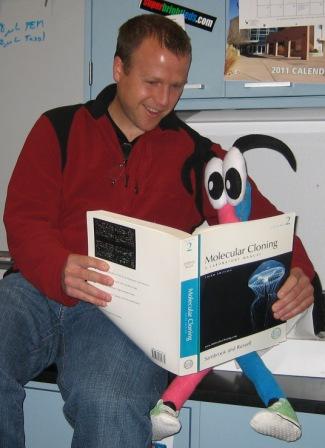 I was raised in Ann Arbor, Michigan, USA, a town that embraces the University of Michigan’s Athletic and Academic programs (in that order probably!). I remain a huge fan of Michigan and, sadly, Detroit professional sports teams. My mom and dad adopted me when I was about two months old and raised my sister and me in this house. My parents were very encouraging of my love of science. I remember many trips with my mom to the bookmobile to get the science books that the driver had found for me in the library. It boggles my mind to think of what I could have learned if I had the internet and Wikipedia around when I was young! My dad was an audiologist and helped me with all my science fair projects and taught me to be a good experimentalist. One project I remember the best was when he brought home an audiometer and I tested the noise reduction capabilities of various ear plugs. He helped me with the title too and “Stick it in your ear!” won my 9th grade science fair. Yes, I am bragging about that.
Mr. Mastie was our earth science teacher in junior high school, but more importantly, he was our leader for Science Olympiad. He had a spectacular amount of energy and enthusiasm for science and launched science careers for quite a few of us, I’d expect. Richard Taylor, my physics teacher in 12th grade was another outstanding teacher that played a huge part in my career.
After high school graduation, I asked my friend Liz if she could ask her dad, Francis Collins, if I could work in his lab that summer. He said yes! So, my first research job at Michigan (where I did my undergraduate degree in physics) was in a genetics lab. I LOVED it and wrote a bit about it in a blog post, Assistant to Robot, Promoted to Robot. I worked in a lab every semester I was at Michigan, working for professors doing genetics (Collins), granular systems (Nori), atomic physics (Bucksbaum), and high energy physics. I also did an internship in non-destructive evaluation with Bill Ellingson at Argonne National Lab – probably the first time I saw my research in a lab produce results that people outside the lab were actually excited about.
Tell us a little more about your career trajectory so far: interesting projects past and present?
After my undergraduate work, I went to the Cornell physics Ph.D. program. Why did I choose Cornell? At the time, Bose-Einstein condensation had recently been achieved. I was accepted at MIT and dying to work in atomic physics with the Ketterle and Pritchard labs. However, my best friend had already decided to go to Cornell for MechE Ph.D. At the time, it was a tough decision, but I finally decided that I was sure it would be fun to be at the same school as my friend, whereas it was less certain that I’d thrive in atomic physics or MIT in general. In retrospect, it’s clear I made the right decision. Nowadays, when I talk with undergraduates who are choosing graduate schools, I make it a point to discuss factors besides the science: distance from family or boyfriends/girlfriends, climate, etc. Cornell did not have any atomic physics, which I was in love with at the time. Even so, it still took me two years to realize that biology is the science I love the most. It’s so obvious in retrospect. But back then, I spent half a year in low temperature physics with Jeevak Parpia. The science and the experiments were very cool. And Jeevak was a terrific advisor. But I eventually realized that biophysics was where I belonged, so I switched to a single-molecule / optical tweezers lab.
What is taking up the most of your time and passion these days? What are your goals?
I have a wonderful five-year-old son and a wonderful three-year-old daughter. One of my goals is to succeed at being a scientist to serve as an example for my kids. Without a doubt, for me it’s a huge challenge to switch mental gears between being a scientist and being a dad. And I can only imagine how much tougher this is for scientist moms. I need to get better at it. Last spring, I coached tee ball, which was surprisingly rewarding (and time-consuming). Before starting, I assumed I just wanted to have fun watching my own son play ball. But it turns out that I really enjoyed it when any of the children learned a new skill. And they were like sponges and got better every game, so it was a ton of fun and I will do it again next spring. If you’re going to click on one link in this interview, check out the photo of my son in the Wikipedia tee ball article. Looks like a great catcher!
The rest of my time is taken up by teaching and managing our research lab and talking science with the students in our lab. I have non-talents that impede my grant writing and paper writing. Definitely I am not passionate about those tasks. I love thinking up experiments, looking at data, thinking of data analysis algorithms, coding, and seeing unexpected and / or new results. So, I still have a strong passion for being an experimentalist. And the lab has really taken off since getting our first big grant a year and a half ago. We are having a lot of fun in the lab, but it also takes more and more time the better the students get at generating and analyzing the data…so it’s a bit crazy, and one of my goals is to survive. 🙂 What are my specific goals? For my lab, I want my students to learn a lot about their talents during their time in the lab. And I want them to succeed after leaving the lab and I want to get vicarious happiness from that. For my family, I want to show my kids that you can succeed while having fun. I will be happy whatever my kids do as long as they strive for excellence.
What’s the worst thing about being a professor?
I don’t like how many jobs I have that I am not good at and how often I have to switch from one task to another. In graduate school, after completing my required courses, I loved being able to focus on a single task for 20 hours straight, and then come right back to it the next day. Especially if it were a computer programming / data analysis problem. Well, those days are gone and now I have to constantly switch from teaching to advising to grant writing to committee work to paper writing to friendfeed to… Yes, I know that’s reality for most of us, I’m just sayin’ I don’t like it. I also don’t like the pressure of having graduate students depend on me obtaining research grants for their livelihood. Not the kind of stress I thrive on.
What’s the best thing about being a professor?
By far it’s being able to interact with students – both in teaching and in the research lab. I’ve been here about four years, and have interacted with hundreds of students. I’d say I know close to a dozen very well and dozens remain in touch. I have one strong talent necessary for teaching / managing students, and that is that I get true enjoyment out of seeing students succeed, both now and later in their careers. I think that’s an essential talent for this career, which I fortunately have. Of course, I get to know the students best when they’re in our research lab. I have been so lucky to have many outstanding students contribute to our lab’s success. We’ve had some students in our lab who are now or soon will be in graduate school elsewhere—Diego Ramallo Pardo (Stanford), Caleb Morse, Pat Jurney (UT Austin), Nas Manole (UNM Med.), Linh Le (UNM), Brandon Beck. Currently we have four graduate students—Andy Maloney, Pranav Rathi, Anthony Salvagno, and Nadia Fernandez-Oropeza—and one undergraduate—Brian Josey. All of these students are carrying out Open Notebook Science, inspired by Jean-Claude Bradley and many others. And, big news: We just graduated our first Ph.D. student, Larry Herskowitz! And he even got a job already!!! The students are what I love the most, and I am continually regretting that I don’t spend enough time with them. Maybe 2011 will be the year I can fix that??? We’ll see…
How does (if it does) blogging figure in your work? How about social networks, e.g., Twitter, FriendFeed and Facebook? Do you find all this online activity to be a net positive (or even a necessity) in what you do?
I think social networking is now a necessity for me and my students. I enjoy blogging but have not been able to keep it up consistently. For the past couple years, FriendFeed has been a wonderful resource—so many clever, dedicated, and supportive people to interact with.
What was the best aspect of ScienceOnline2010 for you?
By far the best part of ScienceOnline2010 was getting to meet in-person many of the people whom I’d only previously known electronically. I had great conversations over lunch, dinner, and at the bar. By the time the conference was over, I had serious insomnia from so many inspiring ideas. At the time I blogged a little about them, along with some resolutions. It’s been over half a year now, and I’m happy to see that I’ve made progress on the resolutions, even if very slowly. I talk with the students in the lab frequently about how we can continue to make our lab notebooks better and easier to manage, and we’re making some progress. I’ve started a collaboration with a new library scientist at UNM, Rob Olendorf. So, hopefully within a year we’ll have figured out a lot about how our library can host our open data. Research in the lab is going really well and we’ve recently submitted two papers to PLoS ONE.
It was so nice to meet you in person and thank you for the interview. I will see you again very soon!
 When I was a kid, I, like all 8-year-old girls, wanted to be a marine biologist and ride around on dolphins. A couple decades later, I’m still into science and nature, but I don’t actually ride wild animals. I’m a freelance science writer and master’s student in the Medical & Science Journalism program at UNC. I like to think it’s as fun as riding dolphins, but probably better for the environment.
  My first science communications piece was an educational booklet on stem cells. Most of the stem cell information available at the time followed either the science community’s party line (embryonic stem cells are more useful than adult stem cells so we should use them) or the conservative/political party line (scientists want to kill babies and we should stop them). Since I was working for a scientific organization, it would have been simple to take the usual tack, but we decided it was really time to go beyond that. I spent a lot of time talking to people ethically opposed to human embryonic stem cell research and tried to craft the booklet so it could reach those folks on their terms, while still being true to the science. Dealing with both the scientific and ethical issues head-on ultimately made it a more useful product for people, and tens of thousands of the booklets found their way into schools and doctors’ offices. It was very rewarding.
  Many people have high school teachers who inspired them, and who they remember forever. I have one memory of my high school chemistry teacher: Occasionally some friends and I would go to the Jai Alai fronton on a Saturday night (This being Connecticut in the ’80s), and we’d bump into our chemistry teacher and she’d give us betting tips.
 Hi Bora. Thank you for asking me. I am a German woman from Bavaria. I live and work in Munich, the Oktoberfest city, famous for its beer, lederhosen and dirndl, King Ludwig’s castles, the Alps and the beautiful lakes in the surroundings. I must say I am a real Bavarian although I don’t have a dirndl. But I appreciate living in this megacity that resembles more of a village. I love bicycling, hiking, skiing, swimming or glider flying and can do it all in or very close to Munich. This is no tourist information. This is the truth.
 My name is Julie Bloss Kelsey. I am a full-time stay-at-home mom and a part-time freelance writer with a background in biology and the environmental sciences. While attending a playgroup when my oldest was a baby, another mom confided to me that she didn’t discuss science with her child because “dads do the science.” I must have looked startled, because she quickly qualified her comment. But that was when it hit me: some people have completed opted out of science. I started my family-friendly science blog,
  My research focuses on the inter-relationships between obesity, physical activity, and chronic disease risk. For example, I have been involved with studies examining the relationship between different fat depots and health risk (abdominal fat is very bad, but leg fat can actually be protective in some situations), as well as studies examining the benefits of exercise with or without weight-loss (your lipid profile and insulin sensitivity almost always improve in response to exercise, while inflammatory markers seem to improve only in response to weight loss). I’ve just begun my PhD, which is looking at the relationship between sedentary time (e.g. sitting) and health risk. For example, if you run for an hour every morning but then spend the next 7 hours sitting in front of a computer, is your metabolic health going to be better or worse than someone who spends all day on their feet but rarely performs vigorous exercise? No one knows just yet, but it’s a very interesting area of study with important public health implications.
 I’m a Charleston, SC native that now resides in NYC — a complete Northern convert that carries an appreciation for Southern plantations and shrimp ‘n grits. As a kid I slogged through marshes to erect an osprey perch, played slippery ‘jelly ball’ (jellyfish) hockey on a shrimp boat and floated an ATV across a river, only now realizing how much science I was experiencing. The physics of ATV floating? The surprising number of jelly balls hoisted aboard a boat when hunting for shrimp? The torturous plotting of perch placement in attracting birds of prey? Science is everywhere, why hadn’t I noticed?
 The geek side of me loves production and organization. Though I like writing, I don’t feel married to my byline — the important thing to me is contributing to something meaningful. I hope to do more entrepreneurial work with both science- and non-science-based efforts, hopefully working with idea geniuses to launch new projects. Of course, I’d expect that whatever I delve in will have some scientific element to it, but hybridizing science with other subjects makes it more tangible to readers. We should always be reaching and trying new things… I could never imagine myself without a side project bubbling in the recesses of my mind.
 I was born in England, raised in New York City, did my undergraduate at Duke University in North Carolina, went back to New York for 10 years, then came back to NC five years ago. I have a master’s degree in animal behavior from Hunter College of the City University of New York, where I did my thesis on the interactions of proboscis monkeys in captivity. My undergraduate degree is in computer science with a minor in Japanese, although I chose my major with the concept of going into science journalism.
 Hello, and many thanks for having me! I’m not sure how best to start this, so I’ll just go from the beginning:
 I’m Jack, a freshman student who went to Science Online 2010. I am one of Miss Baker’s students and I’m from NJ. I go to school at Staten Island Academy. I currently play the piano but I am planning to get a drum set to teach myself drums, too. I love making things whether it be some random contraption built out of paper or a game to be put online. I always liked making things since I built stuff with legos when I was in lower school.
 I think of myself as a scientist who writes, even though I jumped out of research after graduate school. Most of my formal education is in science. I was biology/chemistry major and then studied
  At the University of Hawaii, I studied the ecology of stream algae for my Master’s. After graduating, I worked for the National Park Service on a program to inventory and set up a long-term monitoring plan for Pacific Island park natural resources. I started out working on streams and other freshwater ecosystems, some of which are pretty funky, like anchialine pools. These are brackish systems found in rocky coastal areas in Hawaii, connected to both fresh and salty groundwater through crevices in the basalt substrate. They harbor a unique flora and fauna that can cope with tidal changes in salinity. They’re also culturally hugely important, as the only surface-level freshwater on these incredibly hot, dry coastal lava plains. Unfortunately, they’re also hugely threatened by groundwater pollution, coastal development, and invasive species. So these were some of the key resources that the NPS wanted to protect.
 Hi Bora…thanks for the invitation to connect! Where do I come from? When people meet me they’ll interpret my mongrel accent in many ways assuming that I am from Australia commonly (especially the Canadians) or from England (which is of course the common term for the United Kingdom over here). Well, I am from the UK but I am Welsh, not English. Earlier in life I was going to be a Welsh teacher but it’s been almost 30 years since I had a conversation in Welsh! I grew up in a small village in Wales of less than a hundred people. From there I went to Liverpool University to do a degree in Chemistry. I found Organic Chemistry very easy but really struggled with Physical Chemistry, especially spectroscopy. I found it very challenging but something in my personality, my friends call it a defect, has me prefer a challenge over something that it easy. I tend to take on those things that challenge me and push me rather than those things that are easy. So, naturally, I focused on physical chemistry, specifically spectroscopy, and in my final year of my degree did a summer project on NMR and got hooked. From there I went to London University to do my PhD looking at the effects of High Pressure on Lubricant Related Systems by Nuclear Magnetic Resonance, funded by Shell Oil. I engineered my own High Pressure Vessel made from non-magnetic titanium to stick into a magnet and apply pressures of up to 5kbar to liquids and look at the molecular dynamics under pressure. I was writing software to analyze the data and fit to specific models. Fun times – engineering, chemistry, computing – the type of diversity I like in a project.
 Once
Once  One specific area of interest I have right now is to encourage crowdsourced collaboration in chemistry. My bias at present is to present an environment whereby members of the chemistry community can give/share/contribute/educate/enable/improve chemistry on the internet. In our terms this means allowing them to add their data to the ChemSpider database, annotate what’s already online, validate and curate out the junk. By applying their skills and contributing they can build their own professional profile in the community and bring benefit to other chemists. We are intending to layer on recognition and rewards systems and allow chemists to form connection networks of collaboration. We ourselves are already immersed into the network of Open Notebook Science providing access to services and data allowing others to perform their research. One of our areas of focus right now is


 My passion always has revolved around journalism. When as a scrawny 13-year-old, I failed to make the starting nine on my JV high school baseball team, I was devastated. Rather than wait for my body to catch up to my aspirations, I jumped into journalism, eventually becoming my high school newspaper’s sports editor and editor-in-chief. I loved words and stories and so continued on my writing path through college where I was a columnist and editor for the Yale Daily News. As a senior at Yale, I covered for the Los Angeles Times the pretrial hearings of several Black Panthers accused of murder in New Haven, Conn. After graduation I worked on the city desk of the Times.
 My scientific background is all writing; that is, I’m a writer who has always loved science and scientists, but I never practiced advanced science. I’ve been all about getting the word out from the start. All through school I took every science course I could — geology, astronomy, biology, calculus, physics, chemistry — because I loved the power of science and scientific thinking and understanding, but I never doubted I’d major, as I did, in literature. Writing was what I wanted to do.
 Amazingly, for the first time ever, I haven’t just walked away from the topic I’ve finished a book on. There seems to be so much more to talk about in the systems I’ve spent the last years learning about that I’m not quite ready to be done. To that end I’ve spent the last month doing a video project for the city of Raleigh about its brand-new water plant opening May 12 and hoping to do more of the same. That said, I am and will remain a generalist — you never know what the next project will be.
 I was born and I live in


 Thanks for asking! I was born in Israel, came to the U.S. with my parents when I was two years old, and grew up mainly in suburban Long Island, New York. I went to graduate school at the University of Virginia in Charlottesville, where I learned to say y’all and met my wonderful husband. He and I have lived, worked, and played in the Washington, DC, area for the past 21 years–first in Maryland and now in Virginia.
 It’s been more of a meander than a trajectory. After getting laid off from my first job in publishing and making lots of cold calls to network, I managed to convince some folks at the National Institutes of Health that I could write about science for the general public. As a science writer and public information officer for the National Institute of Arthritis and Musculoskeletal and Skin Diseases (NIAMS), one of the smallest NIH institutes with one of the longest names, I learned a great deal about science and health communications.

 It’s a pleasure and a privilege to be interviewed, Bora.
 By the time I discovered science blogs I knew my career goals were changing. I’d already been lucky enough to audit a science writing course at Princeton taught by Mike Lemonick from TIME, and thought that maybe science writing was a good choice for me. After reading chemistry blogs for a while I realized “Hey, I can do this!” and started my own blog,
  Hi Bora. Thanks for your interest, and for all that you do.
 I’m a journalist by trade and a thrill seeker by nature. There’s nothing more thrilling to me than Eureka! moments, my own and those of others. That’s why I chose to study journalism instead of biochemistry, why I left Germany to come to the U.S., why I enjoy reporting more than writing. Writing keeps me sane, but finding out stuff I didn’t know keeps me going. In the more than 20 years I worked for newspapers, I covered just about everything: Crime (too emotionally draining), politics (too much hot air), business (too much granularity, not enough color) and science. I got stuck on science about 10 years ago after moving


 I am an evolutionary biologist interested in how organisms invent new functions. In particular I am interested in what causes differences in this “evolvability” between organisms. Or, in other words, the evolution of evolvability. I study this mostly in microbes, because, well, microbes rock.
 I was born and raised in Pittsburgh, PA. I bleed black and gold (though I wish the Steelers’ current quarterback weren’t such an asshat).
 I’m Ed, I talk to people about science and I do it in three main ways. I write a science blog called
  From the UW science writing program, I got my first job in the UW Medical Center News Office as assistant director. After that, I took science writing jobs at the University of Rhode Island, MIT, Caltech, Cornell, and ended up at Duke as the Director of the Office of Research Communication. I was known as the DORC of Duke. Always pay attention to the acronym before you take the job! My most interesting project was the research news site
  I live in White Plains, a suburb of New York. I have a Ph.D. in cell biology but was not particularly well suited to lab work. My thesis advisor suggested that writing might better play to my strengths. I had my first baby the week after I defended my thesis, and I have been writing on a freelance basis since then. I was pretty much doing the stay-at-home mom thing, writing when the babies were sleeping for my own mental stimulation and to try to keep my foot in the door. I am very grateful to the feminist movement (and my husband’s salary) because I always knew that my staying at home was a choice, not a given; any day I woke up and decided I wanted to get a job, I could try to do so. I very much enjoyed being home with my little ones, but I view it as just one chapter in my life, and it is ending now that my youngest went off to school in September. This precipitated a minor identity crisis: I really thought about how I perceive myself, and not just what do I want to do but who do I want to be? After much introspection I decided to try to be a full time freelance science writer.
 I left medicine in 1999, but I had been committing journalism since I



 A Blog Around The Clock