
A very cool new post on the Scientific American Guest Blog today!
David Orr wrote How to name a dinosaur which you should save to have handy in case you serendipitously discover one! Go ahead, read, comment, share.
A very cool new post on the Scientific American Guest Blog today!
David Orr wrote How to name a dinosaur which you should save to have handy in case you serendipitously discover one! Go ahead, read, comment, share.
Comments Off on New post on the SciAm Guest Blog
Posted in SciAm
While you are digesting….
Continue reading
Comments Off on Quick Links
Posted in Uncategorized

Continuing with the introductions to the attendees/participants of ScienceOnline2011. You can find them all on the list, but it may help if you get them in smaller chunks, focusing on a few at a time.
Robin Lloyd is the Online News Editor at Scientific American. She tweets as @robinlloyd99.
Jonathan Eisen is a Professor at UC Davis and Academic Editor in Chief of PLoS Biology. He blogs at The Tree of Life and tweets as @phylogenomics
Austin Luton is the Content Support Editor for Physics and Math at WebAssign at NCSU. He tweets as @Austinopterix.
Jason Heinz is the Digital Production Manager at Morehead Planetarium & Science Center where he is also one of the bloggers.
Ernie Hood is a Freelance Science Writer, Editor, & Podcaster, and the current president of SCONC (Science Communicators of North Carolina). He runs the local Radio InVivo science radio show and tweets as @bkthrough. I interviewed Ernie in April.
Douglas White is a Research Associate at the University of Delaware. He blogs at Ocean Bytes and tweets as @cpuguru
Brian Krueger is a student in Molecular Genetics and Microbiology at University of Florida, Gainesville. He is the founder and manager of LabSpaces.net and its science blogging network where he also blogs at H2SO4Hurts. He tweets as @labspaces and @h2so4hurts. I interviewed Brian in October.
Paolo Mangiafico is the Director of Digital Information Strategy at Duke University. He tweets as @paoloman.
Barrie Hayes is the Bioinformatics and Translational Sciences Librarian at University of North Carolina – Chapel Hill. She tweets as @hayesb13.
Jonathan Pishney is the Communications Director at the NC Museum of Natural Sciences in Raleigh.
Comments Off on ScienceOnline2011 – introducing the participants
Posted in SO'11, Uncategorized
Have a great long weekend:
Continue reading
Comments Off on Quick Links
Posted in Uncategorized
Continuing with the introductions to the attendees/participants of ScienceOnline2011. You can find them all on the list, but it may help if you get them in smaller chunks, focusing on a few at a time.
Andrea Novicki is the Academic Technology Consultant at Duke University. She blogs at Duke’s CIT blog and tweets as @andrea1. I interviewed Andrea back in March.
Ferris Jabr is a Freelance writer and science journalist who just graduated from New York University SHERP and, after finishing his internship at Scientific American MIND, is starting his new job at The New Scientist. He blogs at The Mind’s Flight and tweets as @ferrisjabr.
Samuel Dupuis is a student at Dragon Academy. He blogs at Science of Sorts on My Mind . I interviewed Sam last year.
Alberto Roca is the Diversity Consultant and Founder & Editor at MinorityPostdoc.org.
Constance Cummings is the Project Director at The Foundation for Psychocultural Research. She tweets as @thefpr_org.
Roy Campbell is the Director of Exhibits at the NC Museum of Natural Sciences.
Catherine Anderson is a Lecturer at a university and Program Director of a science outreach program for teens. She blogs at Genegeek and tweets as @genegeek.
Steven Bachrach is a Professor and Chair in the Department of Chemistry at Trinity University. He writes the Computational Organic Chemistry blog.
Karyn Hede is a science communicator and educator. She is a news correspondent for the Journal of the National Cancer Institute and Science “Careers”. I interviewed Karyn back in May.
Dan Ferber is a Freelance journalist and author. His latest book is Changing Planet, Changing Health: How the Climate Crisis Threatens Our Health and What We Can Do about It. He tweets as @DanFerber. In 2002, with support from the Fund for Investigative Journalism, he uncovered how the Bush administration had begun stacking science advisory committees to get the answers they wanted—work that helped trigger a Congressional investigation.
Another day, another post on the Scientific American Guest Blog.
Today, Kathryn Clancy is our guest with I don’t have a twenty eight day menstrual cycle, and neither should you. Enjoy, comment, share.
Comments Off on New post on the SciAm Guest Blog
Posted in SciAm
Awesome scientific paper by 8-yr old kids, more on #arseniclife, more on Wikileaks, on science+art, the amazing case of bad journalists aggressively reacting to a piece of good journalism on Lyme Disease, and more:
Continue reading
Comments Off on Quick Links
Posted in Uncategorized

Continuing with the introductions to the attendees/participants of ScienceOnline2011. You can find them all on the list, but it may help if you get them in smaller chunks, focusing on a few at a time.
Chris Rowan is a Postdoctoral Fellow at the University of Chicago. He blogs at Highly Allochthonous and tweets as @Allochthonous
Kendra Snyder is a science writer at Brookhaven National Laboratory. She blogs at Brookhaven Bits & Bytes and tweets as @kendrasnyder.
Catherine Crawley is a Science Writer at the National Institute for Mathematical and Biological Synthesis (NIMBioS) and she tweets as @NIMBioS.
Susanne Bard is the Producer of Science Update at AAAS. She tweets as @Science_Update.
Emily Finke is the Public Education Specialist at the Cincinnati Museum Center and a Student at University of Cincinnati. She tweets as @seelix.
Karl Leif Bates is the Director of Research Communications at Duke University where he also blogs on their Research Blog. He tweets as @klb8s. I interviewed Karl two years ago.
Ashley Yeager is a Science writer and Research Blogger at Duke University. She tweets as @AshleyJYeager.
Liz Jones is the Curator of Educational Events at the NC Museum of Natural Sciences in Raleigh.
Rhianna Wisniewski is the Editor at the Fermilab National Accelerator Laboratory.
Jai Ranganathan is the Center Associate at the National Center for Ecological Analysis and Synthesis. He produces Curiouser and Curiouser podcast at Miller-McCune and tweets as @jranganathan
Kerstin Hoppenhaus is a Freelance Filmmaker. She blogs at More than Honey and tweets as @quinoat. I interviewed Kerstin back in April.
Comments Off on ScienceOnline2011 – introducing the participants
Posted in SO'11
I try to post a piece of bloggy goodness almost every day on the Scientific American Guest Blog.
Today, Jennifer Frazer does it again: Pimp My Virus: Ocean Edition. Enjoy, comment, share.
Comments Off on New post on the SciAm Guest Blog
Posted in SciAm
Continuing with the introductions to the attendees/participants of ScienceOnline2011. You can find them all on the list, but it may help if you get them in smaller chunks, focusing on a few at a time.
Anna Lena Phillips is the Assistant editor of the Scientists’ Bookshelf at the American Scientist
Alicia Roberts is a Freelance writer and editor. She tweets as @aliciawroberts
Peter Genzer is the Manager for Media & Communications at the Brookhaven National Laboratory. He tweets as @PeteGenz.
Jeff Foust is the Editor of The Space Review. He tweets as @jeff_foust.
Tricia Kenny is the Director of Market Development at Invitrogen Life Technologies. She tweets as @everydaycloning.
Lyndell Bade is a MS Student and an Instructor at East Carolina University. She blogs at SaveOurSharks and People, Policy, Planet and tweets as @lyndellmbade.
Tom Swanson is a Research Physicist at the US Naval Observatory. He blogs on Swans on Tea and tweets as @Swansontea
Jennifer Williams is the Senior Scientist at OpenHelix, LLC and blogs at The OpenHelix Blog. She tweets as @openhelix
Jennifer Weston is the Director of Communication in the College of Engineering at North Carolina State University. She tweets as@Tuffysprite.
Julie Meachen-Samuels is a Postdoctoral Associate at NESCent.
Comments Off on ScienceOnline2011 – introducing the participants
Posted in SO'11
My yesterday’s post which got a lot of comments and hundreds of retweets, is now live at Science Progress – the folks who commissioned this article in the first place.
So, if you have missed it yesterday, go now and read it here: The Line Between Science and Journalism is Getting Blurry….Again
Comments Off on My post, republished at Science Progress
Posted in Uncategorized
There is a wonderful new post on the Scientific American Guest Blog today.
Glendon Mellow is thinking out loud about the Scientific accuracy in art. Go there, read, comment, share with your friends.
Comments Off on New post on the SciAm Guest Blog
Posted in SciAm
Gotta start with my first SciAm post again – The line between science and journalism is getting blurry….again – as there are now comments on it.
Continue reading
Comments Off on Quick Links
Posted in Uncategorized
 Human #1: “Hello, nice weather today, isn’t it?”
Human #2: “Ummm…actually not. It’s a gray, cold, windy, rainy kind of day!”
Many a joke depends on confusion about the meaning of language, as in the example above. But understanding the sources of such confusion is important in realms other than stand-up comedy, including in the attempts to convey facts about the world to one’s target audience.
In the example above, Human #1 is using Phatic language, sometimes referred to as ‘small talk‘ and usually exemplified, at least in the British Isles, with the talk about the highly unpredictable weather. (image: by striatic on Flickr)
Phatic language
Phatic discourse is just one of several functions of language. Its role is not to impart any factual information, but to establish a relationship between the people. It conveys things like emotional state, relative social status, alliance, intentions and limits to further conversation (i.e., where the speaker “draws the line”).
 If a stranger rides into a small town, a carefully chosen yet meaningless phrase establishes a state of mind that goes something like this: “I come in peace, mean no harm, I hope you accept me in the same way”. The response of the local conveys how the town looks at strangers riding in, for example: “You are welcome…for a little while – we’ll feed you and put you up for the night, but then we hope you leave”. (image: Clint Eastwood in ‘Fistful of Dollars’ from Squidoo)
An important component of phatic discourse is non-verbal communication, as the tone, volume and pitch of the voice, facial expression and body posture modify the language itself and confirm the emotional and intentional state of the speaker.
It does not seem that linguistics has an official term for the opposite – the language that conveys only pure facts – but the term usually seen in such discussions (including the domain of politics and campaigning) is “Conceptual language” so this is what I will use here. Conceptual language is what Human #2 in the joke above was assuming and using – just the facts, ma’am.
Rise of the earliest science and journalism
For the sake of this article, I will use two simplified definitions of science and journalism.
Journalism is communication of ‘what’s new’. A journalist is anyone who can say “I’m there, you’re not, let me tell you about it.”
Science is communication of ‘how the world works’. A scientist is anyone who can say “I understand something about the world, you don’t, let me explain it to you”.
Neither definition necessitates that what they say is True, just what they know to the best of their ability and understanding.
Note that I wrote “science is communication”. Yes, science is the process of discovery of facts about the way the world works, but the communication of that discovery is the essential last step of the scientific process, and the discoverer is likely to be the person who understands the discovery the best and is thus likely to be the person with the greatest expertise and authority (and hopefully ability) to do the explaining.
For the greatest part of human history, none of those distinctions made any sense. Most of communication contained information about what is new, some information about the way the world works, and a phatic component. Knowing how the world works, knowing what is happening in that world right now, and knowing if you should trust the messenger, were all important for survival.
For the most part, the information was local, and the messengers were local. A sentry runs back into the village alerting that a neighboring tribe, painted with war-paints, is approaching. Is that person a member of your tribe, or a stranger, or the well-known Boy Who Cried Wolf? What do you know about the meaning of war-paint? What do you know about the neighboring tribe? Does all this information fit with your understanding of the world? Is information coming from this person to be taken seriously? How are village elders responding to the news? Is this piece of news something that can aid in your personal survival?
For the longest time, information was exchanged between people who knew each other to some degree – family, neighbors, friends, business-partners. Like in a fishing village, the news about the state of fishing stocks coming from the ships at sea is important information exchanged at the local tavern. But is that fish-catch information ‘journalism’ (what’s new) or ‘science’ (how the world works)? It’s a little bit of both. And you learn which sailors to trust by observing who is trusted by the locals you have already learned to trust. Trust is transitive.
Someone in the “in-group” is trusted more than a stranger – kids learned from parents, the community elders had the authority: the trust was earned through a combination of who you are, how old you are, and how trustworthy you tended to be in the past. New messengers are harder to pin down on all those criteria, so their information is taken with a degree of skepticism. The art of critical thinking (again, not necessarily meaning that you will always pick the Truth) is an ancient one, as it was essential for day-to-day survival. You trust your parents (or priests or teachers) almost uncritically, but you put up your BS filters when hearing a stranger.
Emergence of science and of journalism
 The invention of the printing press precipitated the development of both journalism and science. But that took a very long time – almost two centuries (image: 1851, printing press that produced early issues of Scientific American). After Gutenberg printed the Bible, most of what people printed were political pamphlets, church fliers and what for that time and sensibilities went for porn.
 London Gazette of 1666 is thought to be the first newspaper in the modern sense of the word. (image: from DavidCo) Until then, newspapers were mostly irregular printings by individuals, combining news, opinion, fiction and entertainment. After this, newspapers gradually became regular (daily, weekly, monthly) collections of writings by numerous people writing in the same issue.
 The first English scientific journal was published a year before – the Philosophical Transactions of the Royal Society of London in 1665 (image: Royal Society of London).
Until then, science was communicated by letters – those letters were often read at the meetings of scientists. Those meetings got formalized into scientific societies and the letters read at such meetings started getting printed. The first scientific journals were collections of such letters, which explains why so many journals have the words “Letters”, “Annals” or “Proceedings” in their titles.
Also, before as well as for a quite a long time after the inception of first journals, much of science was communicated via books – a naturalist would spend many years collecting data and ideas before putting it all in long-form, leather-bound form. Those books were then discussed at meetings of other naturalists who would often respond by writing books of their own. Scientists at the time did not think that Darwin’s twenty-year wait to publish The Origin was notable (William Kimler, personal communication) – that was the normal timeline for research and publishing at the time, unusual only to us from a modern perspective of 5-year NIH grants and the ‘publish or perish’ culture.
As previously oral communication gradually moved to print over the centuries, both journalistic and scientific communication occured in formats – printed with ink on paper – very similar to blogging (that link leads to the post that served as a seed from which this article grew). If born today, many of the old writers, like Montaigne, would be Natural Born Bloggers (‘NBBs’ – term coined by protoblogger Dave Winer). A lot of ship captains’ logs were essentially tweets with geolocation tags.
People who wanted to inform other people printed fliers and pamphlets and books. Personal letters and diaries were meant to be public: they were as widely shared as was possible, they were publicly read, saved, then eventually collected and published in book-form (at least posthumously). Just like blogs, tweets and Facebook updates today….
The 18th century ‘Republic of Letters’ (see the amazing visualization of their correspondence) was a social network of intellectual leaders of Europe who exchanged and publicly read their deep philosophical thoughts, scientific ideas, poetry and prose.
Many people during those centuries wrote their letters in duplicate: one copy to send, one to keep for publishing Collected Letters later in life. Charles Darwin did that, for example (well, if I remember correctly, his wife made copies from his illegible originals into something that recipients could actually read), which is why we have such a complete understanding of his work and thought – it is all well preserved and the availability of such voluminouos correspondence gave rise to a small industry of Darwinian historical scholarship.
What is important to note is that, both in journalism and in science, communication could be done by anyone – there was no official seal of approval, or licence, to practice either of the two arts. At the same time, communication in print was limited to those who were literate and who could afford to have a book printed – people who, for the most part, were just the wealthy elites. Entry into that intellectual elite from a lower social class was possible but very difficult and required a lot of hard work and time (see, for example, a biography of Alfred Russell Wallace). Membership in the worlds of arts, science and letters was automatic for those belonging to the small group of literate aristocracy. They had no need to establish formalized gatekeeping as bloodlines, personal sponsorship and money did the gatekeeping job quite well on their own.
As communication has moved from local to global, due to print, trust had to be gained over time – by one’s age, stature in society, track record, and by recommendation – who the people you trust say you should trust. Trust is transitive.
Another thing to note is that each written dispatch contained both ‘what’s new’ and ‘how the world works’ as well as a degree of phatic discourse: “This is what happened. This is what I think it means. And this is who I am so you know why you should trust me.” It is often hard to tell, from today’s perspective, what was scientific communication and what was journalism.
Personal – and thus potentially phatic – communication was a norm in the early scientific publishing. For example, see “A Letter from Mr J. Breintal to Peter Collinfoxl, F. RXS. contairnng an Account of what he felt after being bit by a Rattle-fnake” in Philosophical Transactions, 1747. – a great account of it can be found at Neurotic Physiology. It is a story of a personal interaction with a rattlesnake and the discovery leading from it. It contained “I was there, you were not, let me tell you what happened” and “I understand something, you don’t, let me explain that to you” and “Let me tell you who I am so you can know you can trust me”.
Apparently, quite a lot of scientific literature of old involved exciting narratives of people getting bitten by snakes – see this one from 1852 as well.
The anomalous 20th century – effects of technology
The gradual changes in society – invention of printing, rise of science, rise of capitalism, industrial revolution, mass migration from rural to urban areas, improvements in transportation and communication technologies, to name just a few – led to a very different world in the 20th century.
Technology often leads societal changes. If you were ever on a horse, you understand why armies that used stirrups defeated the armies that rode horses without this nifty invention.
 Earlier, the speed of spreading news was much slower (see image: Maps of rates of travel in the 19th century – click on the link to see bigger and more). By 1860 Telegraph reached to St. Louis. During its short run the Pony Express could go the rest of the way to San Francisco in 10 days. After that, telegraph followed the rails. First transcontinental line was in 1869. Except for semaphores (1794) information before the telegraph (1843) could only travel as fast as a rider or boat (Thanks to John McKay for this brief primer on the history of speed of communication in Northern America. I am assuming that Europe was slightly ahead and the rest of the world somewhat behind).
The 20th century saw invention or improvement of numerous technologies in transportation – cars, fast trains, airplanes, helicopters, space shuttles – and in communication – telephone, radio, and television. Information could now travel almost instantly.
But those new technologies came with a price – literally. While everyone could write letters and send them by stagecoach, very few people could afford to buy, run and serve printing presses, radio stations and television studios. These things needed capital, and increasingly became owned by rich people and corporations.
Each inch of print or minute of broadcast costs serious money. Thus, people were employed to become official filters of information, the gatekeepers – the editors who decided who will get access to that expensive real estate. As the editors liked some people’s work better than others, those people got employed to work in the nascent newsrooms. Journalism became professionalized. Later, universities started journalism programs and codified instruction for new journalists, professionalizing it even more.
Instead of people informing each other, now the few professionals informed everyone else. And the technology did not allow for everyone else to talk back in the same medium.
The broadcast media, a few large corporations employing professional writers informing millions – with no ability for the receivers of information to fact-check, talk back, ask questions, be a part of the conversation – is an exception in history, something that lasted for just a few decades of the 20th century.
The anomalous 20th century – industrialization
Industrial Revolution brought about massive migration of people into big cities. The new type of work required a new type of workforce, one that was literate and more educated. This led to the invention of public schools and foundation of public universities.
In the area of science, many more people became educated enough (and science still not complex and expensive yet) to start their own surveys, experiments and tinkering. The explosion of research led to an explosion of new journals. Those too became expensive to produce and started requiring professional filters – editors. Thus scientific publishing also became professionalized. Not every personal anecdote could make it past the editors any more. Not everyone could call oneself a scientist either – a formal path emerged, ending with a PhD at a university, that ensured that science was done and published by qualified persons only.
By the 1960s, we got a mass adoption of peer-review by scientific journals that was experimentally done by some journals a little earlier. Yes, it is that recent! See for example this letter to Physical Review in 1936:
Dear Sir,
We (Mr. Rosen and I) had sent you our manuscript for publication and had not authorized you to show it to specialists before it is printed. I see no reason to address the — in any case erroneous — comments of your anonymous expert. On the basis of this incident I prefer to publish the paper elsewhere.
Respectfully,
Albert Einstein
Or this one:
John Maddox, former editor of Nature: The Watson and Crick paper was not peer-reviewed by Nature… the paper could not have been refereed: its correctness is self-evident. No referee working in the field … could have kept his mouth shut once he saw the structure…
Migration from small towns into big cities also meant that most people one would meet during the day were strangers. Meeting a stranger was not something extraordinary any more, so emergence and enforcement of proper proscribed conduct in cities replaced the need for one-to-one encounters and sizing up strangers using phatic language. Which is why even today phatic language is much more important and prevalent in rural areas where it aids personal survival than in urban centers where more general rules of behavior among strangers emerged (which may partially explain why phatic language is generally associated with conservative ideology and conceptual language with politicial liberalism, aka, the “reality-based community“).
People moving from small hometowns into big cities also led to breaking up of families and communities of trust. One needed to come up with new methods for figuring out who to trust. One obvious place to go was local media. They were stand-ins for village elders, parents, teachers and priests.
If there were many newspapers in town, one would try them all for a while and settle on one that best fit one’s prior worldview. Or one would just continue reading the paper one’s parents read.
But other people read other newspapers and brought their own worldviews into the conversation. This continuous presence of a plurality of views kept everyone’s BS filters in high gear – it was necessary to constantly question and filter all the incoming information in order to choose what to believe and what to dismiss.
The unease with the exposure to so many strangers with strange ideas also changed our notions of privacy. Suddenly we craved it. Our letters are now meant for one recepient only, with the understanding it will not be shared. Personal diaries now have lockets. After a century of such craving for privacy, we are again returning to a more historically traditional notions, by much more freely sharing our lives with strangers online.
The anomalous 20th century – cleansing of conceptual language in science and journalism
Until the 20th century we did not see the consolidation of media into large conglomerates, and of course, there were no mass radio or TV until mid-20th century. Not until later in the century did we see the monopolization of local media markets by a single newspaper (competitors going belly-up) which, then, had to serve everyone, so it had to invent the fake “objective” HeSaidSheSaid timid style of reporting in order not to lose customers of various ideological stripes and thus lose advertising revenue.
Professionalising of journalism, coupled with the growth of media giants serving very broad audiences, led to institutionalization of a type of writing that was very much limited to “what’s new”.
The “let me explain” component of journalism fell out of favor as there was always a faction of the audience that had a problem with the empirical facts – a faction that the company’s finances could not afford to lose. The personal – including phatic – was carefully eliminated as it was perceived as unobjective and inviting the criticism of bias. The way for a reporter to inject one’s opinion into the article was to find a person who thinks the same in order to get the target quote. A defensive (perhaps cowardly) move that became the norm. And, once the audience caught on, led to the loss of trust in traditional media.
Reduction of local media to a single newspaper, a couple of local radio stations and a handful of broadcast TV channels (that said esentially the same thing), left little choice for the audience. With only one source in town, there was no opportunity to filter among a variety of news sources. Thus, many people started unquestioningly accepting what 20th-century style broadcast media served them.
Just because articles were under the banners of big companies did not make them any more trustworthy by definition, but with no alternative it is still better to be poorly informed than not informed at all. Thus, in the 20th century we gradually lost the ability to read everything critically, awed by the big names like NYT and BBC and CBS and CNN. Those became the new parents, teachers, tribal elders and priests, the authority figures whose words are taken unquestioningly.
In science, explosion in funding not matched by explosion of job positions, led to overproduction of PhDs and a rise of hyper-competitive culture in academia. Writing books became unproductive. The only way to succeed is to keep getting grants and the only way to do that is to publish very frequently. Everything else had to fall by the wayside.
False measures of journal quality – like the infamous Impact Factor – were used to determine who gets a job and tenure and who falls out of the pipeline. The progress of science led inevitably to specialization and to the development of specialized jargon. Proliferation of expensive journals ensured that nobody but people in highest-level research institutions had access to the literature, so scientists started writing only for each other.
Scientific papers became dense, but also narrowed themselves to only “this is how the world works”. The “this is new” became left out as the audience already knew this, and it became obvious that a paper would not be published if it did not produce something new, almost by definition.
And the personal was so carefully excised for the purpose of seeming unbiased by human beings that it sometimes seems like the laboratory equipment did all the experiments of its own volition.
So, at the close of the 20th century, we had a situation in which journalism and science, for the first time in history, completely separated from each other. Journalism covered what’s new without providing the explanation and context for new readers just joining the topic. Science covered only explanation and only to one’s peers.
In order to bridge that gap, a whole new profession needed to arise. As scientists understood the last step of the scientific method – communication – to mean only ‘communication to colleagues’, and as regular press was too scared to put truth-values on any statements of fact, the solution was the invention of the science journalist – someone who can read what scientists write and explain that to the lay audience. With mixed success. Science is hard. It takes years to learn enough to be able to report it well. Only a few science journalists gathered that much expertise over the years of writing (and making mistakes on the way).
So, many science journalists fell back on reporting science as news, leaving the explanation out. Their editors helped in that by severely restricting the space – and good science coverage requires ample space.
A good science story should explain what is known by now (science), what the new study brings that is new (news) and why does that matter to you (phatic discourse). The lack of space usually led to omission of context (science), shortening of what is new (news) and thus leaving only the emotional story intact. Thus, the audience did not learn much, Certainly not enough to be able to evaluate next day’s and next week’s news.
This format also led to the choice of stories. It is easy to report in this way if the news is relevant to the audience anyway, e.g., concerning health (the “relevant” stories). It is also easy to report on misconduct of scientists (the “fishy” stories) – which is not strictly science reporting. But it was hard to report on science that is interesting for its own sake (the “cool” stories).
What did the audience get out of this? Scientists are always up to some mischief. And every week they change the story as to what is good or bad for my health. And it is not very fun, entertaining and exciting. No surprise that science as endeavour slowly started losing trust with the (American) population, and that it was easy for groups with financial, political or religious interests to push anti-science rhetoric on topics from hazards of smoking to stem-cell research to evolution to climate change.
At the end of the 20th century, thus, we had a situation in which journalism and science were completely separate endeavors, and the bridge between them – science journalism – was unfortunately operating under the rules of journalism and not science, messing up the popular trust in both.
Back to the Future
It is 2010. The Internet has been around for 30 years, the World Wide Web for 20. It took some time for the tools to develop and spread, but we are obviously undergoing a revolution in communication. I use the word “revolution” because it is so almost by definition – when the means of production change hands, this is a revolution.
The means of production, in this case the technology for easy, cheap and fast dissemination of information, are now potentially in the hands of everyone. When the people formerly known as the audience employ the press tools they have in their possession to inform one another, we call that ‘citizen journalism.’ And some of those citizens possess much greater expertise on the topics they cover than the journalists that cover that same beat. This applies to science as well.
In other words, after the deviation that was the 20th century, we are going back to the way we have evolved as a species to communicate – one-to-one and few-to-few instead of one-to-many. Apart from technology (software instead of talking/handwriting/printing), speed (microseconds instead of days and weeks by stagecoach, railroad or Pony Express, see image above) and the number of people reached (potentially – but rarely – millions simultaneously instead of one person or small group at a time), blogging, social networking and other forms of online writing are nothing new – this is how people have always communicated. Like Montaigne. And the Republic of Letters in the 18th century. And Charles Darwin in the 19th century.

 All we are doing now is returning to a more natural, straightforward and honest way of sharing information, just using much more efficient ways of doing it. (Images from Cody Brown)
And not even that – where technology is scarce, the analog blogging is live and well (image: Analog blogger, from AfriGadget).

What about trustworthiness of all that online stuff? Some is and some isn’t to be trusted. It’s up to you to figure out your own filters and criteria, and to look for additional sources, just like our grandparents did when they had a choice of dozens of newspapers published in each of their little towns.
With the gradual return of a more natural system of communication, we got to see additional opinions, the regular fact-checks on the media by experts on the topic, and realized that the mainstream media is not to be trusted.
With the return of a more natural system of communication, we will all have to re-learn how to read critically, find second opinions, evaluate sources. Nothing new is there either – that is what people have been doing for millennia – the 20th century is the exception. We will figure out who to trust by trusting the judgment of people we already trust. Trust is transitive.
Return of the phatic language
What does this all mean for the future of journalism, including science journalism?
The growing number of Web-savvy citizens have developed new methods of establishing trustworthiness of the sources. It is actually the old one, pre-20th century method – relying on individuals, not institutions. Instead of treating WaPo, Fox, MSNBC and NPR as the proxies for the father, teacher, preacher and the medicine man, we now once again evaulate individuals.
As nobody enters a news site via the front page and looks around, but we all get to individual articles via links and searches, we are relying on bylines under the titles, not on the logos up on top. Just like we were not born trusting NYTimes but learned to trust it because our parents and neighbors did (and then perhaps we read it for some time), we are also not born knowing which individuals to trust. We use the same method – we start with recommendations from people we already trust, then make our own decisions over time.
If you don’t link to your sources, including to scientific papers, you lose trust. If you quote out of context without providing that context, you lose trust. If you hide who you are and where you are coming from – that is cagey and breeds mistrust. Transparency is the new objectivity.
And transparency is necessarily personal, thus often phatic. It shows who you are as a person, your background, your intentions, your mood, your alliances, your social status.
There are many reasons sciencebloggers are more trusted than journalists covering science.
First, they have the scientific expertise that journalists lack – they really know what they are talking about on the topic of their expertise and the audience understands this.
Second, they link out to more, more diverse and more reliable sources.
Third, being digital natives, they are not familiar with the concept of word-limits. They start writing, they explain it as it needs to be explained and when they are done explaining they end the post. Whatever length it takes to give the subject what it’s due.
Finally, not being trained by j-schools, they never learned not to let their personality shine through their writing. So they gain trust by connecting to their readers – the phatic component of communication.
Much of our communication, both offline and online, is phatic. But that is necessary for building trust. Once the trust is there, the conceptual communication can work. If I follow people I trust on Twitter, I will trust that they trust the sources they link to so I am likely to click on them. Which is why more and more scientists use Twitter to exchage information (PDF). Trust is transitive.
Scientists, becoming journalists
Good science journalists are rare. Cuts in newsrooms, allocation of too little space for science stories, assigning science stories to non-science journalists – all of these factors have resulted in a loss of quantity and quality of science reporting in the mainstream media.
But being a good science journalist is not impossible. People who take the task seriously can become experts on the topic they cover (and get to a position where they can refuse to cover astronomy if their expertise is evolution) over time. They can become temporary experts if they are given sufficient time to study instead of a task of writing ten stories per day.
With the overproduction of PhDs, many scientists are choosing alternative careers, including many of them becoming science writers and journalists, or Press Information Officers. They thus come into the profession with the expertise already there.
There is not much difference between a research scientist who blogs and thus is an expert on the topic s/he blogs about, and a research scientist who leaves the lab in order to write as a full-time job. They both have scientific expertise and they both love to write or they wouldn’t be doing it.
Blog is software. A medium. One of many. No medium has a higher coefficient of trustworthiness than any other. Despite never going to j-school and writing everything on blogs, I consider myself to be a science writer.
Many science journalists, usually younger though some of the old ones caught on quickly and became good at it (generation is mindset, not age), grok the new media ecosystem in which online collaboration between scientists and journalists is becoming a norm.
At the same time, many active scientists are now using the new tools (the means of production) to do their own communication. As is usually the case with novelty, different people get to it at different rates. The conflicts between 20th and 21st style thinking inevitably occur. The traditional scientists wish to communicate the old way – in journals, letters to the editor, at conferences. This is the way of gatekeeping they are used to.
 But there have been a number of prominent cases of such clashes between old and new models of communication, including the infamous Roosevelts on toilets (the study had nothing to do with either US Presidents or toilets, but it is an instructive case – image by Dr.Isis), and several other smaller cases.
The latest one is the Arsenic Bacteria Saga in which the old-timers do not seem to undestand what a ‘blog’ means, and are seemingly completely unaware of the important distinction between ‘blogs’ and ‘scienceblogs’, the former being online spaces by just about anyone, the latter being blogs written by people who actually know their science and are vetted or peer-reviewed in some way e.g., at ResearchBlogging.org or Scienceblogging.org or by virtue of being hand-picked and invited to join one of the science blogging networks (which are often run by traditional media outlets or scientific publishers or societies) or simply by gaining resepect of peers over time.
Case by case, old-time scientists are learning. Note how both in the case of Roosevelts on toilets and the Arsenic bacteria the initially stunned scientists quickly learned and appreciated the new way of communication.
In other words, scientists are slowly starting to get out of the cocoon. Instead of just communicating to their peers behind the closed doors, now they are trying to reach out to the lay audience as well.
As more and more papers are Open Access and can be read by all, they are becoming more readable (as I predicted some years ago). The traditional format of the paper is changing. So they are covering “let me explain” portion better, both in papers and on their own blogs.
They may still be a little clumsy about the “what’s new” part, over-relying on the traditional media to do it for them via press releases and press conferences (see Darwinius and arsenic bacteria for good examples) instead of doing it themselves or taking control of the message (though they do need to rely on MSM to some extent due to the distinction between push and pull strategies as the media brands are still serving for many people as proxies for trustworthy sources).
But most importantly, they are now again adding the phatic aspect to their communication, revealing a lot of their personality on social networks, on blogs, and even some of them venturing into doing it in scientific papers.
By combining all three aspects of good communication, scientists will once again regain the trust of their audience. And what they are starting to do looks more and more like (pre-20th century) journalism.
Journalists, becoming scientists
On the other side of the divide, there is a renewed interest in journalism expanding from just “this is new” to “let me explain how the world works”. There are now efforts to build a future of context, and to design explainers.
If you are not well informed on an issue (perhaps because you are too young to remember when it first began, or the issue just started being relevant to you), following a stream of ‘what is new’ articles will not enlighten you. There is not sufficient information there. There is a lot of tacit knowledge that the writer assumes the readers possess – but many don’t.
There has to be a way for news items to link to some kind of collection of background information – an ‘explainer’. Such an explainer would be a collection of verifiable facts about the topic. A collection of verifiable facts about the way the world works is….scientific information!
With more and more journalists realizing they need to be transparent about where they are coming from, injecting personality into their work in order to build trust, some of that phatic language is starting to seep in, completing the trio of elements of effective communication.
Data Journalism – isn’t this science?
Some of the best journalism of the past – yes, the abominable 20th century – was done when a reporter was given several months to work on a single story requiring sifting through boxes and boxes of documents. The reporter becomes the expert on the topic, starts noticing patterns and writes a story that brings truly new knowledge to the world. That is practically science! Perhaps it is not the hardest of the hard sciences like physics, but as good as well-done social science like cultural anthropology, sociology or ethnography. There is a system and a method very much like the scientific method.
Unfortunately, most reporters are not given such luxury. They have to take shortcuts – interviewing a few sources to quote for the story. The sources are, of course, a very small and very unrepresentative sample of the relevant population – from a rolodex. Call a couple of climate scientists, and a couple of denialists, grab a quote from each and stick them into a formulaic article. That is Bad Science as well as Bad Journalism. And now that the people formerly known as audience, including people with expertise on the topic, have the tools to communicate to the world, they often swiftly point out how poorly such articles represent reality.
But today, most of the information, data and documents are digital, not in boxes. They are likely to be online and can be accessed without travel and without getting special permissions (though one may have to steal them – as Wikileaks operates: a perfect example of the new data journalism). Those reams of data can be analyzed by computers to find patterns, as well as by small armies of journalists (and other experts) for patterns and pieces of information that computer programs miss.
This is what bioinformaticists do (and have already built tools to do it – contact them, steal their tools!).
Data journalism. This is what a number of forward-thinking journalists and media organizations are starting to do.
This is science.
On the other hand, a lot of distributed, crowdsourced scientific research, usually called Citizen Science, is in the business of collecting massive amounts of data for analysis. How does that differ from data journalism? Not much?
Look at this scientific paper – Coding Early Naturalists’ Accounts into Long-Term Fish Community Changes in the Adriatic Sea (1800–2000) – is this science or data journalism? It is both.
The two domains of communicating about what is new and how the world works – journalism and science – have fused again. Both are now starting to get done by teams that involve both professionals and amateurs. Both are now led by personalities who are getting well-known in the public due to their phatic communication in a variety of old and new media.
It is important to be aware of the shortness of our lives and thus natural tendency for historical myopia. Just because we were born in the 20th century does not mean that the way things were done then are the way things were ‘always done’, or the best ways to do things – the pinnacle of cultural and social development. The 20th century was just a strange and deviant blip in the course of history.
As we are leaving the 20th century behind with all of its unusual historical quirks, we are going back to an older model of communicating facts – but with the new tools we can do it much better than ever, including a much broader swath of society – a more democratic system than ever.
By the way, while it’s still cold, the rain has stopped. And that is Metaphorical language…
This article was commissioned by Science Progress and will also appear on their site in 24 hours.
Comments Off on The line between science and journalism is getting blurry….again
Posted in History, History of Science, Information, Media, Open Science, Science Practice, Society, Technology, Workplace
Tagged blogging, communication, history, journalism, language, media
Now that I work at Scientific American, nothing stops me from actually writing and publishing stuff there, right?
So I started today. My very first (and as I tend to do – very long) post is now up: The line between science and journalism is getting blurry….again
I hope you like it, post comments, and share with your friends….
Comments Off on My first post at ScientificAmerican.com
Posted in Uncategorized
Continuing with the introductions to the attendees/participants of ScienceOnline2011. You can find them all on the list, but it may help if you get them in smaller chunks, focusing on a few at a time.
Dennis Meredith is the Editor at Glyphus. He is the author of Explaining Research. He blogs at Research Explainer and tweets as @explainresearch. I interviewed Dennis back in March.
Patric Lane is the Health and Science editor at University of North Carolina at Chapel Hill. He tweets as @patriclane.
Melissa Anley-Mills is the Science Communications officer in the Office of Research & Development at the US Environmental Protection Agency. She blogs on Greenversations and tweets as @EPAresearch.
Jeremy Yoder is a Doctoral candidate in the Department of Biological Sciences at University of Idaho. He blogs at Denim and Tweed and tweets as @JBYoder. I interviewed Jeremy back in May.
Ariel Neff is the Instruction and Science Reference Librarian at Benedictine University. She blogs at The Methods Section and tweets as @arielibrarian.
Katie Mosher is the Communications Director at the North Carolina Sea Grant.
Rebecca Weinberg is a Graduate Student at Penn State University. She tweets as @sciliz.
Tom Linden is the Director of the Medical & Science Journalism Program at the University of North Carolina at Chapel Hill. He blogs at Dr. Tom Linden’s Health Blog and tweets as @tomlinden. I interviewed Tom in May.
Greg Anderson is the Publisher of GenomeWeb
William Hogan is a student in Charlotte NC.
Comments Off on ScienceOnline2011 – introducing the participants
Posted in SO'11
A new post on the Scientific American Guest Blog just went up.
My neighbor here in Raleigh, Daniel Ksepka who discovered and described the giant colorful penguins several months ago, wrote Five Things You Never Knew About Penguins! Enjoy, comment, share….
Comments Off on New post on the SciAm Guest Blog
Posted in SciAm
New real blog post tomorrow. Some links till then….
Continue reading
Posted in Uncategorized
Last week I took a train to NYC. It was a busy two days at the office. Things are moving steadily on the blogging network front. I’ll have more news probably pretty soon.
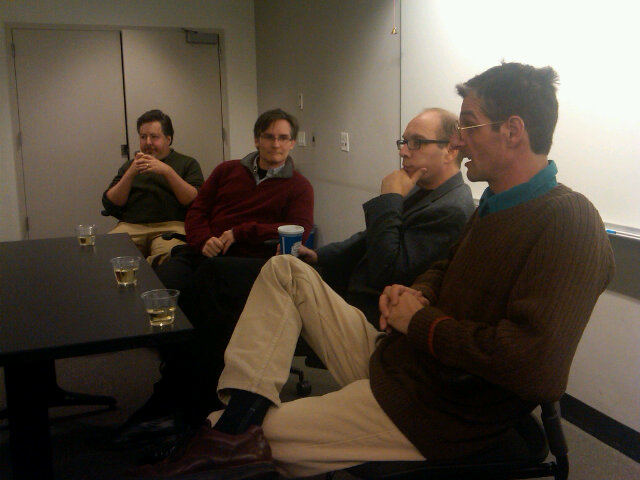
On Tuesday afternoon, I joined the last class of the semester of SHERP (New York University’s Science, Health and Environmental Reporting Program) and then the graduation party for the 28th generation. Both the 28th and the 29th class were there, packing the room, in which five of us discussed the current state of science journalism.
Ivan Oransky took this picture of us, L-R: Dan Fagin, John Rennie, Jay Rosen and me:
Posted in Personal
Continuing with the introductions to the attendees/participants of ScienceOnline2011. You can find them all on the list, but it may help if you get them in smaller chunks, focusing on a few at a time.
Misha Angrist is an Assistant Professor at Duke University Institute for Genome Sciences & Policy. He blogs at Genome Boy and tweets as @mishaangrist. His book, Here is a Human Being: At the Dawn of Personal Genomics, just came out last month. I interviewed Misha for the blog back in March.
Princess Ojiaku is a Graduate Student at North Carolina Central University, a musician, and a blogger at Science with Moxie. She tweets as @artfulaction.
Russ Campbell is the Communications Officer for the Burroughs Wellcome Fund. He blogs at Fishtown University and tweets as @razoobe. I interviewed Russ last year.
Nancy Lamontagne is a Freelance writer, and the Associate Director of Communications at the UNC CHapel Hill School of Nursing. She tweets as @UNCSON.
Benjamin Young Landis is the Outreach/Communications Coordinator at USGS Western Ecological Research Center. He blogs and he tweets as @younglandis.
Kelly Izlar is the 1st year MA in the Medical and Science journalism program at the UNC – Chapel Hill School of Journalism.
Holly Menninger is a Senior Extension Associate at Cornell University and the Co-host and producer of Science Cabaret on Air. She tweets as @DrHolly.
Suzanne Franks is a Scientopia blogger at Thus Spake Zuska. I interviewed Zuska two years ago.
Lisa Gardiner is the Director of Education at NEON, Inc..
Bill Cannon is the Webzine manager and editor of DEIXIS, a U.S. Department of Energy program run by the Krell Institute. He tweets as @ScienceMachines
Comments Off on ScienceOnline2011 – introducing the participants
Posted in SO'11
There is a great new post on the Scientific American Guest Blog today.
Robin Ann Smith wrote The worms within about the possibility that having intestinal parasites has pros, not only cons. Enjoy, comment, share…
Comments Off on New post on the SciAm Guest Blog: The worms within
Posted in SciAm
Back from NYC, busy catching up. Update later. Links for now:
Continue reading
Comments Off on Quick Links
Posted in Uncategorized
Continuing with the introductions to the attendees/participants of ScienceOnline2011. You can find them all on the list, but it may help if you get them in smaller chunks, focusing on a few at a time.
Rick MacPherson is the Conservation Programs Director at the Coral Reef Alliance. He blogs at Deep Sea News and tweets as @rmacpherson. I interviewed Rick two years ago.
Enrico M. Balli is the founder and CEO of Sissa Medialab in Trieste, Italy, producing the next generation of Italian science journalists. He blogs at Oggi Scienza and tweets as @eballi.
Heather Piwowar is a postdoc research associate at UBC, funded by the NSF-funded DataONE cyberinfrastructure project. She is working with the Dryad team at NESCent, studying data sharing and reuse behaviour. Heather blogs at Research Remix and tweets as @researchremix
John Dupuis is the Head of the Steacie Science & Engineering Library, York University, Toronto, ON, Canada. He blogs at Confessions of a Science Librarian and tweets as @dupuisj. I interviewed John two years ago.
Bonnie Swoger is the Science and Technology Librarian at the Milne Library, SUNY Geneseo. She blogs at the Undergraduate Science Librarian and tweets as @bonnieswoger
Adrian J. Ebsary is a Graduate Student at the University of Ottawa and the founder of Peer Review Radio. He tweets as @ajebsary.
Irene Klotz is a journalist for Discovery Channel and Reuters. I think this is her Twitter profile.
Matthew Soniak is a freelance writer in Philadelphia, PA, who blogs on the eponimous blog. He tweets as @flossymatt.
Jamie Vernon is the Assistant Director Biology Labs at the American University. He tweets as @JLVernonPhD. We recently realized that I was his Teaching Assistant at NCSU some years ago.
Michael Taffe is an Associate Professor at The Scripps Research Institute. He tweets as @effatma.
Comments Off on ScienceOnline2011 – introducing the participants
Posted in SO'11
After a brief intermission, the Scientific American Guest Blog is alive again.
Today we have a new post – Waste-to-Energy: a mountain of trash, or a pile of energy?, co-written by Melissa Lott and David Wogan. Enjoy, comment, share….
Comments Off on New post on the SciAm Guest Blog: trash, or energy?
Posted in SciAm
Let’s continue introducing attendees/participants of ScienceOnline2011. You can find them all on the list, but it may help if you get them in smaller chunks, focusing on a few at a time.
Randi Hutter Epstein MD is the Editor at Yale Journal of Medical Humanities. She is the author of Get Me Out: A History of Childbirth from the Garden of Eden to the Sperm Bank and she tweets as @rhutterepstein.
Carl Zimmer is a Contributing editor at Discover where he also blogs at The Loom. He is the author of several popular science books, but the latest one is essentially a textbook – The Tangled Bank: An Introduction to Evolution. He also tweets as @carlzimmer.
Nancy Shute is an independent writer for NPR, National Geographic, Scientific American, US News & World Report. She blogs at US News & World Report, is the current president of NASW and she tweets as @nancyshute.
Jason Thibeault is a Systems Delivery Specialist (IT) and a skeptic. He blogs at Lousy Canuck and tweets as @lousycanuck.
Catherine Clabby is the Associate editor at the American Scientist magazine and tweets as @cathyclabby.
Kari Wouk is the Senior Manager of Presentations and Partnerships at the NC Museum of Natural Sciences in Raleigh.
DeLene Beeland is a Freelance Science & Nature Writer. She blogs at Wild Muse and tweets as @tdelene.
Ana Nelson is the Creator of Dexy. She tweets as @ananelson.
Liz Neeley is the Assistant Director of Science Outreach at COMPASS and she tweets as @LizNeeley.
Colin Schultz is a Freelance journalist. He blogs at CMBR and tweets as @_ColinS_.
Comments Off on ScienceOnline2011 – introducing the participants
Posted in SO'11
As I do every year, I will do a series of posts introducing attendees/participants of ScienceOnline2011. You can find them all on the list, but it may help if you get them in smaller chunks, focusing on a few at a time.
Scott Rosenberg is a Director of MediaBugs.org, a pioneer blogger at Wordyard.com (also at Salon.com). He is a co-founder and was the managing editor of Salon.com. Scott tweets as @scottros and is the author of two excellent books: Say Everything and Dreaming in Code.
Maia Szalavitz is a Freelance neuroscience journalist and writer for TIME. She blogs at Born for Love, tweets as @maiasz and is the co-author of several books including Born for Love: Why Empathy Is Essential–and Endangered.
Stewart Wills is the Editorial Director for Web & New Media at AAAS/Science Magazine. He tweets as @stewartwills
John Timmer is the Science Editor at Ars Technica and he tweets as @j_timmer. I interviewed John back in February.
Emily Willingham is a writer and editor. She blogs at College Biology Blog and The Biology Files. She is the author of The Complete Idiot’s Guide to College Biology and she tweets as @collegebiology and @biolotrix.
Stephanie Soucheray-Grell is a student of Medical Journalism at UNC.
Leigh Krietsch Boerner is a graduate student at Indiana University and a freelance science writer, blogging at Just Another Electron Pusher and tweeting as @LeighJKBoerner/
Allison Bland is a Communication, Culture and Technology student at Georgetown University. She tweets as @blandiloquent.
Diane Kelly is a Senior Research Fellow at the University of Massachusetts, Amherst. She blogs at Science Made Cool. She is the author of children’s books Fossils and Stick Insect.
Robert Reddick is a Blogger and Developer in Mount Holly, near Charlotte NC. He blogs at RobertReddick.com and tweets as @rabbitrock.
Comments Off on ScienceOnline2011 – introducing the participants
Posted in SO'11
In NYC, a busy couple of days. But I collected some links during the train-ride here:
Continue reading
Comments Off on Quick Links
Posted in Uncategorized
Here is another installment of the traditional series of posts introducing attendees/participants of ScienceOnline2011. You can find them all on the list, but it may help if you get them in smaller chunks, focusing on a few at a time.
Vanessa Woods is a Research Scientist at Duke University. She blogs at Your Inner Bonobo and tweets as @bonobohandshake. Her latest book is Bonobo Handshake which I reviewed when it first came out. Vanessa also did a blog interview for me a couple of years ago.
Christina Pikas is a Librarian at JHU/APL. She blogs at Christina’s LIS Rant and tweets as @cpikas. I interviewed her for the blog two years ago.
Andrew Farke is the Curator of Paleontology at the Raymond M. Alf Museum of Paleontology and is one of the people behind The Open Dinosaur Project. He blogs at The Open Source Paleontologist. You can learn more in his blog interview from back in March.
Vivienne Raper is a Freelance writer and editor. She blogs at Outdoor Science on the AGU network and tweets as @vivraper.
Hillary Rosner is a Freelance journalist and the Knight Science Journalism Fellow at MIT. She tweets as @hillaryrosner.
Jim Hutchins is a Professor in the Department of Health Sciences at Weber State University. He tweets as @agileroxy.
Emily Anthes is a Freelance science writer. She blogs on Wonderland at the PLoS network and tweets as @emilyanthes
John Logsdon is an Associate Professor of Biology at the University of Iowa. He blogs at Sex, Genes & Evolution and tweets as @johnlogsdon.
Tim De Chant is a Science Writer and Editor at Northwestern University. He tweets as @tdechant.
Kathleen O’Neil is the Public Information Specialist at the American Geophysical Union. She tweets as @katmoneil
Comments Off on ScienceOnline2011 – introducing the participants
Posted in SO'11
I will be offline tomorrow, in NYC Monday and Tuesday. If you promised me a #scio10 interview or #scienceblogging interview or a post for SciAm Guest Blog, I can process those tonight, tomorrow night, or early next week.
Here – more on arsenic bacteria, WikiLeaks, and more:
Continue reading
Posted in Uncategorized
As I do every year, I will do a series of posts introducing attendees/participants of ScienceOnline2011. You can find them all on the list, but it may help if you get them in smaller chunks, focusing on a few at a time.
Holly Tucker is an Associate Professor of both French and the History of Medicine at Vanderbilt University. She is the author of upcoming book Blood Work. She blogs at Scientia Curiosa and tweets as @history_geek.
Tom Levenson is a Professor of science writing at MIT. His most recent book is Newton and the Counterfeiter: The Unknown Detective Career of the World’s Greatest Scientist. He blogs at The Inverse Square Blog and tweets as @tomlevenson. I interviewed Tom back in 2008.
Joseph Kraus is the Science & Engineering Librarian at the University of Denver. He blogs at Nuthing But.Net and tweets as @jokrausdu.
Elizabeth Boyle is the Production Coordinator for the Delaware Sea Grant and she tweets as @eboylewrites.
Alok Jha is a Science correspondent at The Guardian and the Community Manager of the Guardian Science Blogs, He tweets as @alokjha.
Lisa Tossey is an Outreach Specialist at the University of Delaware. She is on Twitter as @tossey.
David Orr is a Graphic Designer with the love for dinosaurs, art and dinosaur art. He blogs at Love in the Time of Chasmosaurs and tweets as @anatotitan.
Meredith Salisbury is the Editor in Chief of GenomeWeb.
Walter Jessen is the Founder, editor and senior writer at Highlight HEALTH. He blogs at Expressing Scientific Insight and tweets as @wjjessen.
Tyler Dukes is a Freelance Journalist in Raleigh NC. He writes for Science in the Triangle, blogs at Write -30- | Adventures at the End of Journalism. and tweets as @mtdukes.
Comments Off on ScienceOnline2011 – introducing the participants
Posted in SO'11
Robert Krulwich is probably best known to the readers of this blog as the host of the immensely popular Radiolab series of podcasts about science. You probably heard his voice on the radio if you are regular NPR listener, as he is a correspondent for NPR’s Science Desk.
Perhaps you are also aware that he blogs and tweets.
Just about a month ago I was talking at a conference in Greenville, SC where Robert was one of the Keynote Speakers so I got to see him live….and, he rocks! It is awesome that he agreed to come to North Carolina in January as the Keynote Speaker at ScienceOnline2011 so you will get to see him and meet him, too.
Continuing with the series of posts introducing attendees/participants of ScienceOnline2011. You can find them all on the list, but it may help if you get them in smaller chunks, focusing on a few at a time.
Carmen Drahl is a PhD chemist and a Science reporter and blogger at Chemical & Engineering News, where she blogs on Newscripts and The Haystack. She tweets as @carmendrahl. I interviewed Carmen back in April.
Rachel Pepling is the Editor at Chemical & Engineering News (C&EN) Online magazine. She tweets as @rachelpep.
Molly Keener is a veteran of all the ScienceOnline conferences in the past. She is the Scholarly Communication Librarian in the Coy C. Carpenter Library at Wake Forest University School of Medicine and runs their news blog. She is on Twitter as @mollykeener.
Desiree Schell is the Show Host of Skeptically Speaking and tweets as @teh_skeptic.
Ed Yong is a Science writer. He blogs at Not Exactly Rocket Science and at Cancer Research UK and tweets as @Edyong209. I interviewed Ed back in March.
Maria Walters is the Director for Game Operations at Hi-Rez Studios. She blogs at Skepchick.org and tweets as @masalaskeptic
Greg Gbur is a Professor of Physics at UNC Charlotte. He blogs at Skulls in the Stars and tweets as @drskyskull
Jelena Ducic is a biologist and the Primary NFP for the Convention on Biological Diversity in the Ministry of Environment and Spatial Planning of Serbia.
Blake Stacey is a researcher at the New England Complex Systems Institute. He blogs at Science After Sunclipse and tweets as @blakestacey. He is the author of Until Earthset and I interviewed Blake for the blog last year.
Stephanie Levi is the Coordinator at the Student Center for Science Engagement at the Northeastern Illinois University. She blogs at Science is Sexy and tweets as @scienceissexy
Comments Off on ScienceOnline2011 – introducing the participants
Posted in SO'11
I am collecting all the articles and blogs posts about arsenic and bacteria here. Wikileaks – which is related – gets a lot of links today again, and there is much more below.
I love all the parallels between #wikileaks and #arseniclife, especially in how the power-structure position influences views of critics and supporters… When comparing #wikileaks and #arseniclife it is important to compare the attitudes of the MSM – does it align with the rock (state, government, institutions, traditional hierarchy and power-structure, top-down control) or the hard-place (people formerly known as audience, including people with greater expertise on the topic than journalists, bottom-up control, democratization of information, freedom of information)? I am irked by the media focus on Assange – he is irrelevant, #wikileaks is about something bigger: clash of worldviews regarding freedom of information.
Continue reading
Comments Off on Quick Links
Posted in Uncategorized
Continuing with the series of posts introducing attendees/participants of ScienceOnline2011. You can find them all on the list, but it may help if you get them in smaller chunks, focusing on a few at a time.
Holly Bik is a Postdoctoral Researcher at the University of New Hampshire. She blogs at Deep Sea News and tweets as @Dr_Bik.
David Shiffman is a Graduate Student at the College of Charleston. He blogs at Southern Fried Scientist and tweets as @WhySharksMatter
Jeff Ives is the Editorial Manager at the New England Aquarium and he tweets as @neaq and @thejives. I interviewed Jeff back in February.
Jason Robertshaw is the Media and Technology Coordinator at the Mote Marine Laboratory. He blogs at Cephalopodcast and tweets as @cephalopodcast.
Andrew Thaler is a Graduate Student at the Duke University Marine Lab. He blogs at Southern Fried Scientist, managed the Gam science blogging network, and tweets as @sfriedscientist. I interviewed Andrew twice for the blog – in March and again in September.
Craig McClain is the Assistant Director of Science at the National Evolutionary Synthesis Center (NESCent). He blogs at Deep Sea News and tweets as @DrCraigMc. I interviewed Craig last year.
Michael Barton is a student of History of Science. He blogs at The Dispersal of Darwin and tweets as @darwinsbulldog.
Anne Jefferson is an Assistant Professor at UNC Charlotte. She blogs at Highly Allochthonous and tweets as @highlyanne.
Douglas Johnston is an Adjunct Instructor in Distance Learning at the UNC School of Public Health.
Pascale Lane is a Professor of Pediatrics at the University of Nebraska Medical Center. She blogs at Stream of Thought and Whizbang and tweets as @PHLane.
Comments Off on ScienceOnline2011 – introducing the participants
Posted in SO'11
A great new post on the Scientific American Guest Blog today!
Anne-Marie Hodge (blog, old blog, twitter) was wondering how can so many large predators get to little faraway islands and, once there, what do they eat? So she wrote Carnivore crossing: How predator species dominated mammal diversity on the Kuril Islands. Go ahead, read, comment, share….
Comments Off on New post on the SciAm Guest Blog
Posted in SciAm
As I do every year, this is a series of posts introducing attendees/participants of ScienceOnline2011. You can find them all on the list, but it may help if you get them in smaller chunks, focusing on a few at a time.
Jennifer Rohn is a Post-Doctoral Fellow at the University College London. She founded and runs LabLit.com, she blogs at Mind the Gap and tweets as @jennyrohn. Jennifer wrote two books of fiction, both happening in a laboratory setting – Experimental Heart (which I loved) and The Honest Look which I just got in the mail and am looking forward to reading. Jenny was the 2008 editor of Open Laboratory, yet we have not met in real life yet – we will, finally, in January.
Maryn McKenna is a freelance journalist, author and blogger. She blogs at Superbug and tweets as @marynmck. Her latest book is the excellent Superbug.
Val Jones is the CEO of Better Health, LLC, a health education company devoted to providing scientifically accurate health information to consumers. She also blogs at Science-Based Medicine and she tweets as @drval.
Janet Stemwedel is an Associate Professor of Philosophy at San Jose State University. She is one of the few people to come to all five ScienceOnline meetings, and one of only two to actually lead a session or speak every single year! She blogs on Adventures in Ethics and Science and tweets as @docfreeride. I interviewed Janet for the blog a couple of years ago.
Sandra Porter is the President of Digital World Biology. She blogs at Discovering Biology in a Digital World and tweets as @digitalbio
Stephanie Zvan is a science fiction and fantasy writer. She blogs at Almost Diamonds and tweets as @szvan. I interviewed Stephanie for the blog last year.
Maria Droujkova is the Director of Natural Math in Cary, NC and she tweets as @mariadroujkova. Check out her blog interview from a few months ago.
Dave Mosher is a Reporter for Wired Science and he tweets as @davemosher.
Evelyn Lynge is a Geologist and is the Co-President of the Jacksonville branch of The American Association of University Women and one of the people who has been to every one of our conferences so far.
Alexandra Levitt is a student at Duke University and a HASTAC scholar.
Comments Off on ScienceOnline2011 – introducing the participants
Posted in SO'11
Just so I can have all of them in one place:
Mono Lake bacteria build their DNA using arsenic (and no, this isn’t about aliens) and Science gets it (mostly) wrong again: My take on the NASA astrobiology paper and Lots of Ink for a few extremophiles: We’ve been invaded by aliens, Monolakians, from the Duncecap Galaxy and When life gives you arsenic, make arsenate-backboned DNA, non-alien Halomonadaceae!
The Real Scoop on Aliens Oops Arsenic in Old Lakes and Bacteria Use Arsenic As Basic Building Block In A Pinch and Poison Nil: Mono Lake Bacterium Exhibits Exotic Arsenic-Driven Biological Activity and Arsenic and Odd Lace and It’s not an arsenic-based life form.
Arsenic and Old Lakes: NASA Finds Life NOT As We Know It and Arsenic-Eating Bacteria Expands Definition of Life and It Came From Mono Lake and Complete heresy: life based on arsenic instead of phosphorus and Bacteria eat arsenic – and survive!
Arsenic-associated bacteria (NASA’s claims) and Arsenic-permissive bacteria – implications for arsenical cancer chemotherapy and Are there viruses of arsenic-utilizing bacteria? and The ‘Give Me a Job’ Microbe
Of Arsenic and Aliens and NASA’s real news: bacterium on Earth that lives off arsenic! and Close Encounters of the Media Kind and A Life Less Ordinary and Life With Arsenic: Who’d Have Thought? and Medicine! Poison! Arsenic! Life itself!
Why “alien” life, aka arsenic-loving bacteria, embargo fiasco was deja vu for Sun Spaceman Paul Sutherland and Did you know you could have bet on the NASA arsenic-based bacteria find? and On science blogs this week: Alien abductions and Nasa dismisses criticism of ‘arsenic bacteria’ research
Arsenic-Eating Bacteria May Not Redefine Life, But Could They Be Useful in Oil Spill Cleanup? and A new life form? Not so fast and Arsenic and Old Lace and Arsenic-Based Life
The Wrong Stuff: NASA Dismisses Arsenic Critique Because Critical Priest Not Standing on Altar and NASA: science shouldn’t be debated in media and blogs?! and Not getting it and “This Paper Should Not Have Been Published”: Scientists see fatal flaws in the NASA study of arsenic-based life.
Unquestioning dogma: the gatekeepers of science and Death for “Arsenic-Based Life”? and My summary of NASA’s arsenic-thriving bacteria story and Arsenic and Bacteria: “nothing in that paper is going into my biochemistry textbook” and Why was #PLoS ONE blamed for the media hype about the Darwinius and Red Sea papers, but when it comes to the latest overblown #Science paper, it is #NASA that’s blamed for the hype? (same applies to Venter’s synthetic life: Venter gets the blame not Science) and Heavy Metal
And the skeptics keep chiming in…George Cody on arsenic life and NASA discovers life on Earth and Extraordinary claims attract extraordinary blogging and The Value of Blogs and Ordinary evidence would do
[guest post: Alex Bradley, PhD] Arsenate-based DNA: a big idea with big holes and On how science happens – Case Study: NASA, Arsenic, and Controversy and Is That Arsenic-Loving Bug — Formerly an Alien — a Dog?
Hat die NASA Aliens gefunden? (natürlich nicht) and Die Arsen-Bakterien: Doch ein lohnendes Forschungsobjekt? and Science Is Sexy: Why Do NASA’s New Arsenic Bacteria Matter? and NASA’s arsenic microbe science slammed and Inside scoop from the NASA man who was way ahead of the rest of NASA on those Mono microbes with arsenic in their genes.
NASA’s new life form: Underwhelming? and Did NASA really find new life? and NASA’s Arsenic-Eating “Alien” Bacteria Is More Like Science-Fiction and Was NASA’s big announcement a big mistake? and NASA’s Arsenic-Loving Bacteria Don’t Love Arsenic After All, Critics Say.
An arsenic bacteria postmortem: NASA responds, tries to pit blogs vs. “credible media organizations” and The Right Place for Scientific Debate?: Scientists snub media as controversy over arsenic-eating microbes rolls on and Hey, NASA: this is what peer review actually looks like.
The dubious arsenic bacterium and Life on Arsenic? and NASA arsenic story – let’s lay off the personal attacks on all sides and Scientific dissention: shouldn’t we all be nice? and Arsenic about face and My Letter to Science and DNA, Phosphorus, and Arsenic and NASA can’t have it both ways.
Wolfe-Simon et al Comment: 08 December 2010 and Scientists: NASA’s claim of microbe that can live on arsenic is ‘flawed’ and Did NASA follow its own code of conduct in announcing the arsenic bacteria study? (Hint: No) and Post-publication peer review in public: poison or progress?
Of arsenic and aliens: What the critics said and Falsehoods associated with the arsenic-thriving bacteria story: What it is and what it isn’t and Critics raise doubts on NASA’s arsenic bacteria and Three Tales of Arsenic Tolerant Bacteria
Robert Sheldon, ID proponent, defending the arsenic bacteria paper? Oh dear God. and Arsenic Bacteria Breed Backlash and Don’t Like Arsenic Bacteria? Put Your Experiment Where Your Mouth Is! and GFAJ-1: Get Fighting And Jousting! and Albert Eschenmoser and I Had Arsenic for Lunch
Arsenic bacteria – a post-mortem, a review, and some navel-gazing and Of Arsenic, Slime Molds, and Life on Other Worlds and On science blogs this week: Arsenic bugging and Science Weekly: The arsenic bacterium that could help find life in outer space
Aliens, arsenic and alternative peer-review: Has science publishing become too conservative? and Arsenic up for Review and Arsenate redux and No-one cuts deeper than a Science Blogger. and Your daily dose of arsenic: On the Madeleine Brand Show on KPCC
The Agency That Cried “Awesome!” and Arsenic and Primordial Ooze: A History Lesson and Poisoned Debate Encircles a Microbe Study’s Result and How to harness distributed discussion of research papers and Molecular evolution of an arsenate detoxification pathway by DNA shuffling
Science Weekly: The great arsenic bacteria backlash and Good Science or good publicity? and Arsenic And Peer Review and Communication – it’s not just for cells and MEDIA ADVISORY: M10-167 and Ambitions of an Early Career Scientist? and Scientific knowledge – getting closer to the right answer
Where can we find arsenic in a DNA structure? and Not Exactly Rocket Science etc -The Great Monolakian Arsenic Issue and its quick rise to fame and flame and The Arsenic Chronicles and In Search of Life: SETI has come a long way over the years, but is the search really important? and Just to be clear: Ed Yong does read the primary literature
Calling Dr. Kane and A new kind of life? and Response required and More on Arsenic Bugs – Nature responds to the blogosphere
The arsenic post I never wrote and What Alien Bacteria Can Teach Us About Health PR and Response to Questions Concerning the Science Article, A Bacterium That Can Grow by Using Arsenic Instead of Phosphorous (PDF) and Real science – warts and all
Arsenic bacteria study authors respond to critics and Using the ‘arsenic bacteria’ story as a teaching moment for undergraduates
A Funny Arsenic Smell Upstream — What questions is it fair to ask about squishy science? and Comments on Dr. Wolfe-Simon’s Response and Yet another reason why the Wolfe-Simon conclusion is so improbable and Arsenic and Old Wounds
Scientists and the News Media: Arsenic-Based Life Forms a Case Study? and Arsenic Bacteria 4: The Quest for Peace and Confused about Arsenic
Exclusive Interview: Discoverer of Arsenic Bacteria, in the Eye of the Storm and #ArsenicLife #Fail: A teachable moment and Response to the critics.
Phosphorus beats arsenic…by a factor of seventeen powers of ten and An arsenic-laced bad-news letter: Who is the audience for online post-publication peer review?
Added four months later:
Arsenic life, four months later: pay no attention to the internet and Arsenic life, four months (and a bit) later: Reviewers with shovels and Comment posted on Rosen paper and Response from Drs. McDermott and Rosen about their arsenic paper and Arsenic Author Dumps Peer Review, Takes Case to TED and Felisa Wolfe-Simon (of arsenic infamy) is no more convincing in person than in print
And another couple of months later:
Science Publishes “Arsenic is Life” Critiques. Game On., Arsenic, RNA, and the unpleasant aftertaste of hype, The Discovery of Arsenic-Based Twitter, “The Center of Gravity Has Shifted.” Carl Zimmer on the Arsenic Paper, Critics weigh in on arsenic life.
Arseniclife: The formal critiques and the authors’ responses, Wolfe-Simon et al.’s responses to my comments, How to test the arsenic-DNA claims, How might a bacterium evolve to use arsenic in place of phosphorus?.
Arsenic-based bacteria: Fact or fiction?, Critics take aim at NASA ‘arsenic life’ study, Debate over arsenic-based life enters a new chapter, Science Publishes Multiple Critiques of Arsenic Bacterium Paper
#arseniclife, peer review, and the scientific process, High Impact Science in a Hyperactive Media Environment, Arsenic life – more criticism, formally published, Post publication peer review – a new way of doing science?.
Were my original #arseniclife criticisms overly personal?, Examples of good astrobiology please, Further panning of the arsenic life claims, Minding the As and P: Can Arsenic Substitute for Phosphorus or Not?.
What the Coburn report has in common with arsenic life, Finding the truth is a waste of time, scientists say, Does Arsenic Really Exist in the DNA from GFAJ-1?, The Arsenic Paper is out, along with eight critiques.
Return of the Arsenic Bacterium, Felisa Wolfe-Simon Does NOT Get It, Arsenic-based life debate continues, Follow arsenic life science “live”.
From the shadows to the spotlight to the dustbin – the rise and fall of GFAJ-1, Arsenic bacteria have changed science…science education that is.
Just in case I do decide to test the #arseniclife …, Working safely with arsenic (what I’d need to know), Guest post about #arseniclife, Starting to work with GFAJ-1!, They’re here!, Counting the GFAJ-1 cells, Vitamins are for wusses (#arseniclife), Why would GFAJ-1 grow much better on agar than in liquid?, Maybe it’s the water? Or the tubes?
It’s not the water, nor the tubes, nor the parafilm…, No excuses… , More detailed plans, GFAJ-1 (no real progress to report), Life and death of GFAJ-1.
Posted in Uncategorized
New post for the SciAm Guest Blog – will have something later (or in the morning) – still in the editing/formatting stage….
Below, lots more on the Arsenic-gate and WikiLeaks-gate and other gates:
Continue reading
Comments Off on Quick Links
Posted in Uncategorized
As I do every year, I will do a series of posts introducing attendees/participants of ScienceOnline2011. You can find them all on the list, but it may help if you get them in smaller chunks, focusing on a few at a time.
Brian Switek is a freelance science writer and a paleontology research associate at the New Jersey State Museum. He has written articles on paleontology for a variety of popular and academic publications – from the London Times to Evolution: Education and Outreach – and he presently blogs at WIRED Science’s Laelaps and Smithsonian magazine’s Dinosaur Tracking. His first book – Written in Stone: Evolution, the Fossil Record, and Our Place in Nature – has just been published by Bellevue Literary Press. I interviewed Brian twice: in 2008 and just last month so you can see how much his life has changed in the meantime.
Martin Robbins is a scientist and writer. He blogs at The Guardian, runs The Lay Science group blog and he tweets as @mjrobbins. And I interviewed him recently.
Kaitlin Thaney, formerly of Science Commons, is the Manager of External Partnerships at Macmillan. She blogs at Kay and tweets as @kaythaney.
Danica Radovanovic is a Social Web researcher and practitioner based in Oxford, UK. She can be found blogging at Digital Serendipities and tweeting as @DanicaR. I interviewed Danica last year.
Lou Woodley is the Product Manager at the Nature Publishing Group which means she runs the Nature.com blogs and the Nature Network Blogs where she blogs at Of Schemes and Memes. On Twitter, she is @LouWoodley.
Tatjana Jovanovic-Grove is a scientist and artist in Winston Salem, NC. She teaches biology at Forsyth Technical Community College. See my interview with Tanja here.
Djordje Jeremic, Tatjana’s son, is also an artist. He is a student at North Forsyth High School and he blogs at Paper Disciple’s Blog. I interviewed Djordje last year.
James Hrynyshyn is a Freelance Consultant and journalist in Saluda, NC. He blogs on Class M and tweets as @hrynyshyn. James did a Q&A for my blog back in 2008.
Ivan Oransky is the Executive Editor at Reuters Health and teaches medical journalism at New York University’s Science, Health, and Environmental Reporting Program. He writes on two blogs – Embargo Watch and Retraction Watch – and tweets as @ivanoransky. Read Ivan’s blog interview here.
Comments Off on ScienceOnline2011 – introducing the participants
Posted in Scio10 Interviews
Another week, another series of awesome posts on the SciAm Guest Blog.
We are starting today with How to stop a hurricane (good luck, by the way) by Casey Rentz (Twitter). Enjoy, comment, share….
Comments Off on Stopping a hurricane…or not, at Scientific American Guest Blog
Posted in SciAm
Much more on WikiLeaks, arsenic-using bacteria etc. – if you missed the older articles on these topics, previous QuickLinks posts have more.
Continue reading
Posted in Uncategorized
As you all probably know, Miss Baker from Staten Island Academy is coming to ScienceOnline2011 and will, for the third year in a row, bring eight high school students with her to do a panel. As a part of their preparation for the event, the students are interviewing some of the participants who will attend ScienceOnline 2011. The first student to do so was Naseem who interviewed me. Go and read the interview now, post comments and support the students! I was floored at the quality of questions Naseem asked – she made me sweat and think hard about each question. I answered the last one quite briefly as I am assuming Miss Baker would appreciate me not inserting too much political opinion into her science classroom blog.
Posted in SO'11
Apparently I did not pay for my online access, hope to have that resolved over the next few days, will get online for a few hours per day at La Vita Dolce cafe, will be offline at nights. Ugh – that will hurt! Bu I may get caught up on book reading….
I spent the day yesterday at the W.M.Keck Center for Behavioral Biology Alumni Symposium at NCSU. It was great to see again my colleagues from grad school days, see what they are up to these days. Many are now postdocs or faculty, doing interesting research. Others are doing other science-related activities, from science education experts to pharma sales-representatives to NIH grant officers. They all love Open Access and PLoS but most need a Big Update on the Web and blogging and social networking etc., and perhaps I can help them in the future in some way as I am local. I may also ask some of them to write something up for the SciAm Guest Post soon.
Comments Off on Brief update
Posted in Uncategorized
Out and offline all day, but I still have an hour to do this. I usually nominate a whole bunch of blogs in various categories for the annual and prestigious Edublog Awards. This time, especially as I am doing this under the wire, I will nominate only one – in the category of the best class blog. Who? Of course: Stacy Baker’s Extreme Biology. That is how the classroom blogging is done!
Comments Off on Edublog Awards
Posted in Uncategorized
As I do every year, I will do a series of posts introducing attendees/participants of ScienceOnline2011. You can find them all on the list, but it may help if you get them in smaller chunks, focusing on a few at a time.
John Hawks is a Professor of Anthropology at University of Wisconsin-Madison. He blogs and tweets.
Miriam Goldstein is a Graduate Student at the Scripps Institution of Oceanography, UCSD. She blogs on Deep Sea News and tweets. Miriam did a Q&A for my blog back in 2009.
Carin Bondar is a Freelance Writer, Biologist, Mother, Filmmaker, Science Loving Gal, blogger and Twitterer.
Taylor Dobbs is a Student of Journalism at Northeastern University. He blogs and tweets.
Kiyomi Deards is an Assistant Professor of Library and Information Science at University of Nebraska, Lincoln. She blogs and tweets.
Eric Michael Johnson is a PhD Student in history of science at the University of British Columbia (after getting a Masters in Evolutionary Anthropology at Duke). He blogs everywhere and is on Twitter.
Arikia Millikan is the Community Manager at Wired Science Blogs and Haiti Rewired (after doing the same at Scienceblogs.com and Psychology Today Blogs). She is also a research assistant for Nate Silver, founder of FiveThirtyEight. She blogs and tweets. I interviewed Arikia in 2009.
Martin Fenner is a Clinical Fellow at Hannover Medical School in Germany. He blogs at Gobbledygook and tweets.
Alice Bell is a senior teaching fellow in the Science Communication Group at Imperial College, London as well as a visiting academic at Warwick’s Department of Sociology. And she blogs (occasionally also here and here) and tweets.
Joshua Rosenau is the Projects and Policy Director at the National Center for Science Education. He blogs on Thoughts From Kansas and tweets.
Comments Off on ScienceOnline2011 – introducing the participants
Posted in SO'11
Here is a treat for you at the Scientific American Guest Blog. Today’s contribution is by Brian Switek – check out Breaking Our Link to the March of Progress. Read, enjoy, comment (at the registration the system suggests that you need a confirmation e-mail – you don’t, just log in and start posting).
Comments Off on A Missing Link Found (and subsequently Lost) at the SciAm Guest Blog
Posted in Evolution, History of Science, Paleontology, SciAm
I’ll be offline all day tomorrow. I hope that stuff I scheduled for automatic posting tomorrow turns out OK, both here and on SciAm Guest Blog….
Continue reading
Comments Off on Quick Links
Posted in Uncategorized
Continuing with the tradition from last two years, I occasionally post interviews with some of the participants of the ScienceOnline2010 conference that was held in the Research Triangle Park, NC back in January. As the next one – ScienceOnline2011 – is quickly approaching, I hope you enjoy these Q&As with past participants. See all the interviews in this series here. You can check out previous years’ interviews as well: 2008 and 2009.
Today, I asked Kelly Chi to answer a few questions.
Welcome to A Blog Around The Clock. Would you, please, tell my readers a little bit more about yourself? Where are you coming from (both geographically and philosophically)? What is your (scientific) background?
 I’m a freelance science writer based in Cary, North Carolina, but I spent most of my life thinking that I would one day become a scientist. It turns out that I am terrible at experiments. Although I realized this during my first year of graduate school, I kept going – for three years on the PhD track, stubbornly – with the thought that one day it wouldn’t matter that my hands shake during rat brain surgery. And I could be a professor, think of new experiments, write papers and teach.
During graduate school, I started writing for the college newspaper and realized that I loved writing about science. Short-term deadlines fit me perfectly, I also learned. So I left my PhD, got a master’s and started the science and medical journalism program at UNC-Chapel Hill in 2006.
Leaving my PhD was really difficult for me, not only because I hate the idea of quitting but because it seemed risky to pursue an entirely new career path. But since that time, I’ve learned that there are a whole bunch of writers and editors out there who are also just like me.
Tell us a little more about your career trajectory so far: interesting projects past and present?
I wish that freelancing offered more of a career trajectory, but in the past several years I have focused on getting (and keeping) clients and trying different sorts of writing and editing.
While pursuing a master’s at UNC, for example, I worked with the Morehead Planetarium and Science Center on an exhibit for kids called Zoom In, which tackled diverse topics like cystic fibrosis and outer space. The best part of this project was working with a team of educators and designers. We got paid to talk about mucus– who wouldn’t love that?
Last year, I got my first long-ish feature, ‘Disappearing before Dawn,’ published in The Scientist magazine. That became one of the most popular articles on the website in 2009, and that’s probably because you linked to it, Bora. In 2009, I also wrote a small book that I refuse to call a booklet for London-based NGO International Institute for Environment and Development that appeared at the 2009 United Nations Climate Change Conference in Copenhagen.
What is taking up the most of your time and passion these days? What are your goals?
Besides the usual freelancing, I’ve been taken a position at Medscape Medical Students as a freelance clinical editor. My goal, for the next six months, will be to help build the website’s blogs, columns and discussions. This content will, I hope, help medical students survive rotations and choose their specialties.
I also manage editorial content for the Amgen Scholars Program website. It’s funded by the Amgen Foundation, and the program gives undergraduates the chance to do scientific research at one of more than 10 host universities across the U.S. and Europe. As part of this work, which is through my client Faculty of 1000, I encourage students to blog about their research experiences in the Program’s private online community. I’ve been able to meet and interact with some really bright and talented undergraduates. These kids are great. They sometimes make me feel old, but that’s okay.
What aspect of science communication and/or particular use of the Web in science interests you the most?
Like many of my writer friends and colleagues, I care about making science accessible to people. Most of my work is geared for somewhat specialized audiences, like physicians or scientists or students, but these folks are everyday people in many ways. I try to assume that they won’t have the time or willpower to unpack a mess of jargon. That said, I like knowledge for its own sake, so sometimes jargon will nerdily make its way into my writing. I’m lucky to have patient editors who remind me to fish it out.
Related to the Amgen Scholars and Medscape Medical Students work I’m doing, I am also deeply interested in building online communities and helping make them better somehow. With this goal in mind, I plan to attend ScienceOnline 2011 and absorb as much as I can. Because building communities is not easy, and I need all the help I can get.
How does (if it does) blogging figure in your work? How about social networks, e.g., Twitter, FriendFeed and Facebook? Do you find all this online activity to be a net positive (or even a necessity) in what you do?
I have to admit that I spend more time finding and encouraging others to blog than I do blogging. Motivated by my own hypocrisy, I started a website and attached a blog to it. Besides posting and linking to my own articles, I hope to find time to write about science and health tidbits that interest me. Luckily, no one reads my blog yet (except for my mother and my friend Penny), so no pressure.
I do use Twitter and Facebook, but I find myself posting for different audiences. On Facebook, it’s my family and friends. On Twitter, it’s my colleagues and people who are too interesting to ignore. Most of this online activity is a net positive, I’d say, because it has given me story ideas and the ability to procrastinate in the most productive way possible.
What was the best aspect of ScienceOnline2010 for you? Any suggestions for next year? Is there anything that happened at this Conference – a session, something someone said or did or wrote – that will change the way you think about science communication, or something that you will take with you to your job, blog-reading and blog-writing?
I’m a bit embarrassed to admit this, because it makes me feel technologically challenged, but for me the coolest part about the conference was the undercurrent of chatter on the #scio10 Twitter feed. Attendees used Twitter to sum up the presentations, ask questions, make wisecracks and agree or disagree with the presenters. All in real time. I have to admit that before this conference I avoided Twitter because I thought of it as a giant time suck. Now I think of it as not only not a time suck but, at least in a conference setting, as a way to understand the same presentation through someone else’s more experienced eyes — like internet-o-vision. The experience was kind of a revelation for me. Twitter’s also great for networking: when I started tuning into the conference-related tweets, I got introduced to many attendees in a short amount of time.
It was so nice to see you again and thank you for the interview. And I’ll see you in January!
Posted in Scio10 Interviews
As I do every year, I will do a series of posts introducing attendees/participants of ScienceOnline2011. You can find them all on the list, but it may help if you get them in smaller chunks, focusing on a few at a time.
Glendon Mellow is a freelance artist and illustrator. He blogs at The Flying Trilobite and administers the ArtEvolved blog network. He is also on Twitter.
Psi Wavefunction is the online pseudonym of an Undergraduate Research Assistant and aspiring protistologist and artist at the University of British Columbia who blogs at Skeptic Wonder and tweets as @psiwavefunction.
Jason Priem is a PhD student in the School of Information and Library Science at the University of North Carolina-Chapel Hill, studying science communication – from scientific publishing to spread of science information on online social networks. He blogs and tweets.
Darlene Cavalier is a writer for the Discover Magazine, founder of Science Cheerleader and Science For Citizens where she also blogs, and is on Twitter as @scicheer.
Sara Wood is the Director of Product Strategy at the Public Library of Science and she tweets.
Kevin Zelnio is a PhD student at UNC Wilmington and Research Assistant/Lecturer in the Center for Marine Science there. He blogs at Deep Sea News and The Online Laboratory of Kevin Zelnio and is active on Twitter.
Sheril Kirshenbaum is a writer and a Research Associate at the University of Texas at Austin. She is the co-author of Unscientific America and the author of forthcoming The Science of Kissing. She blogs at The Intersection and tweets.
Kristi Holmes is a Bioinformaticist at the Washington University School of Medicine and the National Outreach Coordinator for VIVO. And she is on Twitter.
Marie-Claire Shanahan is an Assistant Professor of Science Education at University of Alberta in Edmonton, Canada. She blogs and tweets.
Steve Silberman is a freelance science writer and journalist in California. He is one of the new PLoS Bloggers at Neurotribes and he tweets as @stevesilberman.
Comments Off on ScienceOnline2011 – introducing the participants
Posted in SO'11
Today’s post on the Guest Blog at Scientific American is Texas “Tea” becomes the Texas “E”? by Melissa Lott – on how the structure of the current power grid affects the ability to add new sources of energy.
Comments Off on New SciAm guest post!
Posted in SciAm
 | Bora Zivkovic on Morning at Triton |
 | Angie Lindsay Ma on Morning at Triton |
 | Linda chamblee on Morning at Triton |
| Jekyll » Blog… on The Big Announcement, this tim… | |
 | Mike H on The Big Announcement, this tim… |
Buy the 2009 Science Blogging Anthology:

Buy the 2008 Science Blogging Anthology:

Buy the 2007 Science Blogging Anthology:

Buy the 2006 Science Blogging Anthology:




 A Blog Around The Clock