Brian was ably assisted by a team of PLoS staffers, including Sara Wood, Pete Binfield, Liz Allen and Richard Cave, among others (yup, I left a few fingerprints around the site as well).
The network has two parts. The PLoS Blogs are editorial blogs you are already familiar with from before: the official PLoS Blog, everyONE (PLoS ONE community blog) and Speaking of Medicine (PLoS Medicine community blog).
The other part, the new part, is The PLoS Blogosphere, a collection of independent science bloggers who have moved (or started new) blogs on the network today.
While media organizations have stable-fulls of professional writers and may tend to want to enlist scientists to write their blogs in a different tone from the rest of their fare, or as scientific societies may like to enlist professional writers to do the blogging for them, PLoS wanted to do something different: have scientist-bloggers and science-journalist-bloggers writing side by side.
PLoS possesses a huge database of excellent scientific research in their seven journals. But scientific papers tend to be written for other researchers in the same field and can be difficult to read – they need translation. On the other end, PLoS has an excellent social media presence and great ongoing relationship with bloggers elsewhere. What this network does is provide the stuff in-between – a translation of research and other science news targeted at educated lay audience interested in science.
Continuing with the tradition from last two years, I will occasionally post interviews with some of the participants of the ScienceOnline2010 conference that was held in the Research Triangle Park, NC back in January. See all the interviews in this series here. You can check out previous years’ interviews as well: 2008 and 2009.
Today, I asked Jennifer Williams to answer a few questions.
Welcome to A Blog Around The Clock. Would you, please, tell my readers a little bit more about yourself? Where are you coming from (both geographically and philosophically)? What is your (scientific) background?
Hi Bora, thanks for including me in the ScienceOnline2010 interviews. I am jazzed to hear that plans for 2011 are already in full swing! I definitely want to attend again next year (it will be my 4th year) so I’ll keep the date reserved. Attending is pretty easy for me since I live in the North Carolina Triad. I work & blog for the online company OpenHelix. My PhD and post-doc were in yeast disease research, but for about the last 10 years I have worked virtually either curating for bioscience databases, or creating tutorials on them for OpenHelix.
Tell us a little more about your career trajectory so far: interesting projects past and present?
To paraphrase Blanch Du Bois, in my career “I have always relied on the encouragement of colleagues” – and it has led me to wonderful jobs that have allowed me to move with my husband’s career, to be both a mother and a scientist, and to accomplish many other professional and personal goals.
What is taking up the most of your time and passion these days? What are your goals?
Of course my job takes up large amounts of time and it is one that I am passionate about – teaching researchers how to efficiently and effectively use the public databases and other bioscience resources that are freely available online. We just got a paper published on sources (many free) for informal learning in bioinformatics, entitled “OpenHelix: bioinformatics education outside of a different box”. I am passionate about education outside of work as well, and volunteer some of my efforts to the Early College at Guilford College, and try to give career talks whenever and wherever I am invited to do so. As a goal I’d like to be able to promote alternative careers in science, such as those I’ve been involved with.
My main focus and experience is with online work for stay-at-home parents. However I really enjoy learning about any ‘oddball’ ways to be a scientist. Being a tenure-track professor at a research institution just isn’t the best way for everyone to be a scientist: not only aren’t there enough jobs, but it just ISN’T in everyone’s temperament or life-style goals. And science is SUCH a COOL thing to do! I truly believe there is some version of a science career that is absolutely perfect for just about anyone even half way considering it – it is just a matter of finding the perfectly fitting ‘oddball science career’ (Hey, could that be the beginnings of a title for a session? Hmm I wonder…)
What aspect of science communication and/or particular use of the Web in science interests you the most?
That’s easy – learning to be better at it! I really related to your interview with Andrea Novicki when she said “As a confirmed introvert, I find blogging difficult.”! I blog as part of my job at OpenHelix & my blog partners, Mary & Trey, are great! They allow me to contribute tips, and other posts when I get the bug, but they are absolute pros at it (Mary has been chosen for inclusion in The Open Laboratory 2008) & I am learning from them. I (of course) also learn new stuff every year at the ScienceOnline conference & I think I may be sowing the seeds of interest (with Mary’s help) in my offspring.
What was the best aspect of ScienceOnline2010 for you? Any suggestions for next year? Is there anything that happened at this Conference – a session, something someone said or did or wrote – that will change the way you think about science communication, or something that you will take with you to your job, blog-reading and blog-writing?
I ended up getting value from every ScienceOnline event that I attended last year, from the Friday night Gala at the RTP headquarters thru the “Connections with mathematics and programming through modeling” session Sunday morning. The thing that I find so remarkable about the conference is how often I refer to it in casual conversations, even 7 months later – there were SO many topics and conversations that were noteworthy both scientifically, and just for life in general. And it is not just last year’s sessions. I’ve been attending for the last 3 years now and I’m still growing & learning based on some of my conversations in years past. I am very much looking forward to ScienceOnline2011!
It was so nice to see you again and thank you for the interview.
The Duke Center for Science Education, a multi-disciplinary effort to “bring science education resources and outreach to the university and the community” is hosting its first-ever Science Education Showcase on Sept. 20.
Ira Flatow, science journalist and host of NPR’s “Science Friday” show will be the keynote speaker at 1:30 p.m. in Love Auditorium, Levine Science Research Center (LSRC). Before and after the talk, students, faculty and staff will be sharing hands-on activities and demos that they’ve developed with CSE. Some of these exhibits will also be making an appearance at the first-ever USA Science and Engineering Festival in Washington Oct. 23 and 24. More on that in a later post.
You’ll need a ticket to see Flatow. They’re free, but you gotta have one. And you’d better hurry. Try the Bryan Center Box Office or online: http://www.tickets.duke.edu/
The science blogging ecosystem is rapidly reorganizing, with bloggers moving from one URL to another at a breath-taking pace, e.g., Terra Sigillata has moved!.
And all of that needs to be organized in some way – thus we put together a website that can help you get your daily snapshots of the science blogosphere: Drumroll, please! Introducing: Scienceblogging.org.
Posted onAugust 31, 2010byBora Zivkovic|Comments Off on Evolutionary and Developmental Precursors for the Human Mathematical Mind
Now that summer is starting to fade, here is something else to look forward to: The 2010-2011 American Scientist Pizza Lunch speaker series returns next month.
Join us at noon, Tuesday, Sept. 21 here at Sigma Xi to hear Duke University cognitive psychologist Elizabeth Brannon give a talk entitled: “Evolutionary and Developmental Precursors for the Human Mathematical Mind.” In other words, Brannon studies what we all take for granted: our ability to do the numbers. She does it, in part, with studies of human babies and other primates.
Thanks to a grant from the N.C. Biotechnology Center, American Scientist Pizza Lunch is free and open to science journalists and science communicators of all stripes. Feel free to forward this message to anyone who might want to attend. RSVPs are required (for the slice count) to cclabby@amsci.org
The summer is almost over, but we can try to remain in the summery mood just a little bit longer. Perhaps we can go to a medical conference held at a luscious tropical island resort, listen to presentations, chat in the hallways, and then have great fun at the bar in the evenings. And call it Grand Rounds. No coats and ties allowed – this meeting is supposed to be fun!
Diane Meier at The John A. Hartford Foundation blog wrote a review and summary of a blockbuster study on palliative care and quality (and length!) of life: Palliative Care: We Still Have a Lot to Learn.
How to Cope with Pain reviews exciting, new, non-invasive and non-medication treatments for pain, in Brain Re-training To Decrease Pain.
Will Meek, PhD is working through human psychology, one post at a time. The latest installment is Romantic vs Committed Love.
Dinah at Shrink Rap, differentiating normal moods from those associated with mental illness: Emotion versus Mental Illness.
Day 1 – hallway conversations: Practice, Patients, Nursing and Cases
Katrina Racial Violence is a poignant recollection of treating a Katrina survivor, who had been threatened with violence, by Toni Brayer, MD at EverythingHealth.
‘Nancy Nurse, RN, MD’ on the Muse, RN is a post motivated by the phrase “If she’s so smart, why isn’t she a doctor?”. Its a little dicey…but Nurses need some dice every once in a while.
Medical Resident, from A Medical Resident’s Journey responds to a recent blog post in the New York Times by Pauline Chen on medical errors: On Medical Mistakes…. And another post on the same topic, at Supporting Safer Healthcare – I Care For You; I Am Your Doctor – focuses on the fact that, unfortunately, communication can break down at this most crucial time.
Physician Quality Report Cards, Part II on Kent Bottles Private Views is a post about a physician’s resistance to administrative review and patient feedback. Doctor report cards, NFL football, teachers, controversy, and nasty comments. What more could you want in a blog post?
Fizzy, last week’s host of Grand Rounds over on Mothers in Medicine, starts with a cartoon and writes about looking too young to be a doctor: Get confident, stupid!
Waterworks at Other things amanzi is a great story by Bongi about a joke he played on a not-so-hard-working urologist.
From Kimberly Manning, FACP at ACP Hospitalist, Life at Grady: Black and white, a story about a patient questioning his doctor’s race.
When do medical students start learning to practice medicine defensively? It didn’t take long for this one to encounter the opening lesson: Defensive Medicine 101… it starts now, at The Notwithstanding Blog.
Livetweeting surgery is becoming all the rage these days. Ramona of Suture for a Living writes about the latest case: Double Hand Transplant on Twitter.
In Doctors Not Using Email Like It’s 2010 It’s 2010, Elaine Schattner, MD at Medical Lessons considers physicians’ selective use of email, a no-longer-new technology that might, if embraced, facilitate communication between doctors and patients.
Michelle R. Wood of Occam Practice Management looks at some Famous Last Words in regard to technology, and how those words turned out…including the worries about the “paperless” Health Information Technology.
Day 2 – afternoon session: History of Medicine
Delia O’Hara at Birth Story introduces us to a historical figure of Alexis Carrel, who pioneered vascular surgery and transplant surgery.
At From the Hands of Quacks, Jaipreet Virdi gives us a glimpse of quirky medicine from the past, in How to Avoid Deafness and for those who want to know more, there is a Reading List.
The Poetry Contest at The Examining Room of Dr.Charles ends tonight. Many great health/medical poems were submitted and some of them were posted there. Here is Thirteen Ways of Seeing, a poem (in 13 parts) by Aidel Moodnick.
And with this, the tropical island resort conference ends. Have a great trip home! We’ll see you all again next week at the Grand Rounds hosted by Musings of a Dinosaur.
Early this morning, The Guardian launched their brand new science blogging network, adding another shiny new island to the growing archipelago of the science blogging universe.
You would not know it from general media coverage but, on the web, science is alive with remarkable debate. According to the Pew Research Centre, science accounts for 10% of all stories on blogs but only 1% of the stories in mainstream media coverage. (The Pew Research Center’s Project for Excellence in Journalism looked at a year’s news coverage starting from January 2009.)
On the web, thousands of scientists, journalists, hobbyists and numerous other interested folk write about and create lively discussions around palaeontology, astronomy, viruses and other bugs, chemistry, pharmaceuticals, evolutionary biology, extraterrestrial life or bad science. For regular swimmers in this fast-flowing river of words, it can be a rewarding (and sometimes maddening) experience. For the uninitiated, it can be overwhelming.
The Guardian’s science blogs network is an attempt to bring some of the expertise and these discussions to our readers. Our four bloggers will bring you their untrammeled thoughts on the the latest in evolution and ecology, politics and campaigns, skepticism (with a dollop of righteous anger) and particle physics (I’ll let them make their own introductions).
Note: if you have recently moved your blog, please e-mail me the corrected URLs for your entries
The list is growing fast – check the submissions to date and get inspired to submit something of your own – an essay, a poem, a cartoon or original art.
The Submission form is here so you can get started. Under the fold are entries so far, as well as buttons and the bookmarklet. The instructions for submitting are here.
You can buy the last four annual collections here. You can read Prefaces and Introductions to older editions here.
The next edition (Vol. 6 No. 49) of Grand Rounds, the medical blog carnival, will be hosted by me, right here at A Blog Around the Clock. I have hosted it a couple of times early on, but have not done so in a few years. Time to get back to it!
So send me all your posts that have something to do with medicine: fun and quirky stuff, personal stuff, biomedical science, healthcare policy, nursing, patients and cases and medical practice and Medicine2.0 and everything you can think of that is related to medicine and health.
The deadline for submission is August 30th by midnight Eastern time. The carnival will be posted some time in the morning of August 31st.
Send you entries to: nick AT blogborygmi DOT com (though it would be nice if you could also CC it to me at Coturnix AT gmail DOT com if you can remember).
My friend David Kroll, better known online as Abel PharmBoy, has found a new home for his blog Terra Sigillata after leaving scienceblogs.com a few weeks ago.
Note: if you have recently moved your blog, please e-mail me the corrected URLs for your entries
The list is growing fast – check the submissions to date and get inspired to submit something of your own – an essay, a poem, a cartoon or original art.
The Submission form is here so you can get started. Under the fold are entries so far, as well as buttons and the bookmarklet. The instructions for submitting are here.
You can buy the last four annual collections here. You can read Prefaces and Introductions to older editions here.
In this lecture, as well as in the previous two, I tackle areas of Biology where I am really weak: origin of life, diversity of life, and taxonomy/systematics. The course is (somewhat intentionally) anthropo- and mammalo-centric, for adult non-science majors, but they do have to give talks about the biology of a plant and an animal later in the course. These are also areas where there has been a lot of change recently (often not yet incorporated into textbooks), and I am unlikely to be up-to-date, so please help me bring these lectures up to standards….
In this lecture, as well as in the previous one and the next one, I tackle areas of Biology where I am really weak: origin of life, diversity of life, and taxonomy/systematics. These are also areas where there has been a lot of change recently (often not yet incorporated into textbooks), and I am unlikely to be up-to-date, so please help me bring these lectures up to standards….
Today, and in the following two lectures, I tackle areas of Biology where I am really weak: origin of life, diversity of life, and taxonomy/systematics. These are also areas where there has been a lot of change recently (often not yet incorporated into textbooks), and I am unlikely to be up-to-date, so please help me bring these lectures up to standards….
What? Yet another science blogging network? No, no, no! This is even better. Let me explain.
For four years, Scienceblogs.com was the biggest, most popular, most visible and most high-trafficked science blogging network in the world. A couple of other networks existed, known mostly to the connoisseurs. And thousands of independent bloggers, with a couple of early-adopter exceptions, were almost invisible except for the most devout readers.
For many people, The Last 24 Hours page at Scienceblogs.com was their browser’s homepage. They would start their day by checking the page out, to see what is new in the world of science. That page was a one-stop-shopping page for all things science-bloggy.
But over the last month or two, the world of science blogging changed. Scienceblogs.com is there, big and good, but not as dominant as it once was. Other existing networks suddenly became more interesting and more visible. They started growing. New networks got started and are still being built at an alarming rate of approximately one per week. This is a good thing – many more blogs are now enjoying increased visibility, traffic and influence.
But there is a problem for the reader – how to track all those networks and all those blogs? They are scattered all over the place. It takes time to go through all the bookmarks and feeds in order to catch everything.
So, Anton Zuiker, Dave Munger and myself decided to do something about it – make a one-stop-shopping place for all things science-bloggy.
Now we hope that you will set Scienceblogging.org as your homepage in your browser and start your day there, checking out what’s new in the world of science.
The page will aggregate RSS feeds from all the major (and some minor) science blogging networks, group blogs, aggregators and services. As the site develops further, it will also encompass other online (and offline) science communication efforts, including Twitter feeds, links to major scientific journals and magazines, ScienceOnline annual conference, and the Open Laboratory annual anthology of the best writing on science, nature and medical blogs.
If you look around, you will see feeds for all the networks, several major group blogs, press services (like Futurity), aggregators (like ResearchBlogging.org), blog carnivals, etc.
If you are the owner/manager of one of these (or other) sites, and there is something you want to change, let us know – we want the community input as to how to improve the site.
Perhaps you have multiple blogs on your site/network but no common feed. We may have included only a feed for one of your blogs instead of all, or used FriendFeed as a temporary solution. You can fix that – make a common feed and send us the URL so we can switch it.
You may like the way a pretty logo appears next to the names of various networks, but do not like the ugly red Y of Yahoo next to yours. You can fix that as well – switch from Yahoo pipes to a better feed (RSS or Atom) and your logo will show up as well.
Is your network missing? Let us know. Are you building a new network? As soon as it goes live, let us know and send us your feed.
If you have (or intend to post) images on Flickr with science themes, please tag them with #scienceblogging and they will also appear on the site.
We need your help – we want to include independent bloggers as well. But how do we go about it? There are thousands of them! We cannot include all of those feeds. If we fuse them all into a single feed, that would be a firehose moving at the speed of light. There must be a better system!
Of course, indy bloggers will occasionally show up there – when they host carnivals, do guest-posts on networks, or have their posts aggregated on ResearchBlogging.org, but there must be other ways as well – let us know your ideas.
We also intend to include some Twitter feeds. For example, just before, during and after major conferences, like Science Online London, or ScienceOnline2011, we will put widgets on the sidebar showcasing tweets with the associated hashtags. But what other feeds? Twitter Lists are limited to 500 accounts – which 3-5 Lists combined cover pretty much all the important science twitterers? Let us know.
Likewise for FriendFeed rooms. Any other services we should include (YouTube, perhaps)?
What is missing from the Blogroll on the sidebar of the blog?
We are also putting together a common feed for all the sciencey blog carnivals and will try to keep the feed up to date. Are any carnivals missing from this list? If so, do they have RSS feeds? If not, can you make one?
Finally, check out the blog. For now, we have posts there like Welcome to Scienceblogging, Some thoughts about science blog aggregation, Blog Carnivals: what, how and why? and Just one way. We will use the blog to update you on the news about the site, as well as the news about the science blogging community and its endeavors, including meetings like ScienceOnline and the annual anthology – Open Laboratory. I will do a Q&A with founders, owners and managers of all the networks and other sites we cover so you can learn more about each one of them. We will try to highlight some of the independent bloggers who are not on any networks. And we will likely have some guest bloggers in the future. We appreciate all the other ideas you may have. And we welcome all kinds of feedback: criticisms, suggestions, praise.
I hope you help us spread the word about Scienceblogging.org, link to it from your sites, save it as your browser’s homepage, bookmark it and visit it often. And help us make it better over time.
Update:
The reaction was overwhelming and overwhelmingly positive. Hundreds of tweets, several blog posts, several new suggestions/applications fo =r getting added to the site. etc. Thank you all so much!
As our posts on Scienceblogging.org blog, including the latest – Adding more blogs to Scienceblogging.org – suggest, we are just getting started and are asking the community for helping out with ideas, and technical know-how for future development, especially considering the need to include independent bloggers without overhwelming the system with thousands of feeds (or a feed containing a thousand blogs).
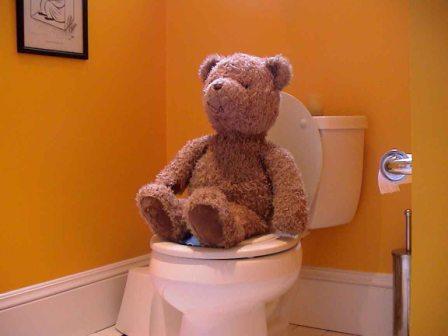
It is a good thing that transmission of smells over the Web has not been worked out yet, as this carnival would unlikely be smelling of roses… This month’s topic of the Carnal Carnival is, as you may already have heard, poop. Yes, excretion, defecation, elimination and the resulting products. All things colonic.
The response by the blogosphere was amazing so the carnival is quite big. So fix yourself some coffee (and you may learn how and if that will affect your stool once you read some of these posts), relax (that is also important for the process) and enjoy (yes, it is supposed to be pleasure)!
DeLene Beeland, of Wild Muse, knows how informative animal poop is to ecologists when they play nature detectives: Divining the secrets of scat.
While DeLene focuses on exctracting DNA from poop, Michelle, of C6-H12-O6, takes a look at another important piece of information that both field and lab biologists can get from the dark stuff that wildlife leaves around: On detecting stress endocrines in hamster poop.
And sometimes, the poop animals leave around is not just tiny little droppings…. Just ask Alistair Dove, of Deep Type Flow – he took this picture: If you have to go, go big!
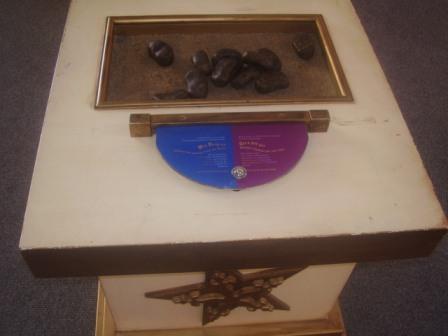
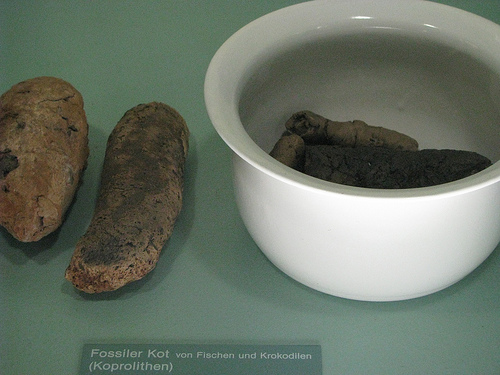
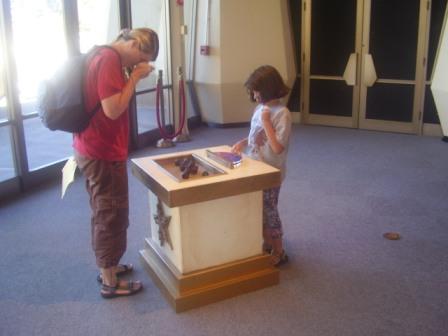
Coprolites! The fossilized poop hard as a rock (fortunately, after deposition). David Bressan, of History of geology, gives us a history of the scientific study of coprolites: Geology history in caricatures: A Coprolitic Vision.
And if that is not enough, can you imagine how much one can learn by combining the study of coprolites and coprophagy?! Brian Switek, of Laelaps, describes one case just like that: Unique Fossils Record the Dining Habits of Ancient Sharks
Some ingenuity, some clever bioengineering, and you can get your poop all colorful! Peggy Kolm, of Everyday Biology, explains how and why: E. chromi and The Scatalog
It means some poo is soft and some poo is hard! Scicurious, of Neurotic Physiology, dissects a study that looked at various foods and drinks and how they affect the hardness (or liquidity) of one’s stool but got something very important wrong in their methodology: So, how would you say your poop FEELS today?
One can learn quite a lot about an animal, including about the physiology of its digestive system, by analyzing its poop. Zen Faulkes, of NeuroDojo, provides an excellent example: Nothing but the finest…feces.
Why do certain species of caterpillar fling their poop far and wide? I know you always wanted to know the answer to that question. The wait is over – Meera Lee Sethi, of Inkling Magazine, tells it all: Projectile Poop: Why Some Caterpillars Go Ballistic.
The Science Pundit starts out slowly, but builds up tension in a powerful crescendo of ever-increasing levels of disgust: More poop Mommy; I’m hungry!
Many people read books while sitting on the toilet. But some do the opposite! Christina Pikas, of Christina’s LIS Rant, collects librarians’ tall tales about their customers and what they do: Craptacular: stories of poop in the library!
And as books and toilets appear to have a deep historical connection, it is not surprising that there are also books about poop. And some bloggers decided to review them. Alice Bell reviews a few of them in Poo Books.
One animal’s poop may be food, or home, for another organism, for example a carnivorous plant. Grant Jacob, of Code of Life, describes one such case: Aww, crap.
Sanitation is a big problem in many parts of the world. Diseases are often spread via feces deposited in open pits. Liz Borkowski, of The Pump Handle, describes an effective strategy to help: In Praise of Toilets.
Human poo is not the only potential source of disease. Birds can also play their part, including at the beaches. S. E. Gould, of Lab Rat, thus decided to take a look at the Seagull Poo.
Let’s finish on a musical note. Kevin Zelnio of Deep Sea News wrote and recorded a song: Everything Poops:
That’s it for this month. I hope you have enjoyed this and learned something and got inspired! Next edition of the Carnal Carnival will be in September 2010, hosted by Carin Bondar – Biologist With a Twist – the theme will be barf. Follow the carnival on Twitter for updates.
For one thing, rabbits eat grass. Usually animals that eat grass are large and have complex multi-chamber stomachs (think of cows) and very long intestines (sheep), or a very large cecum (horses). Cellulose is difficult to digest, and herbivores use some help from intestinal bacteria. The bacteria are slow, though, so the food usually remains in these large fermentation chambers for a long time.
But rabbits are small. They have a single small stomach, and as much intestines as they can pack into their small bodies, and as large a cecum as they can get. But that is not enough – the food, half digested, passes through them too fast. What a waste of energy!
So they have to do something that you and I may find distasteful, but rabbits apparently enjoy – coprophagy! Yes, they eat their own feces.
But there is a trick to it. Food goes through the rabbit twice. Not once, not three or four times, just twice. How do the rabbits accomplish that?
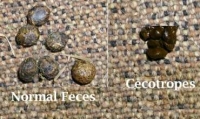
The droppings that passed through the rabbit only once – caecotrophs – are small and soft and clumped up like grapes. They are apparently yummy to rabbits and get eaten. Droppings that made the passage through the rabbit twice are larger, separate from each other, and dry.
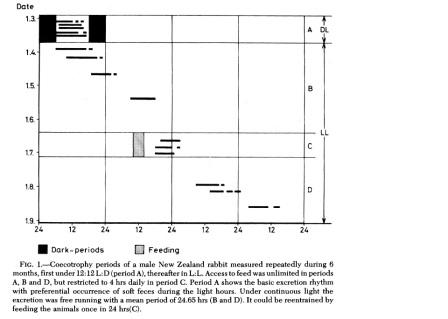
Interestingly, they mostly defecate dry droppings in the morning, and soft droppings in the evening.
And the timing of excretion of these two types of feces is under the control of the circadian clock – the rhythm (and the separation between timing of soft and dry pellets) persists in constant darkness, can be entrained by light-dark cycles, and can be entrained by feeding cycles (Refs, 1, 4, 5, 6).
It is interesting to me that much of this research was done a long time ago – in the 1940s for the feces composition and the 1970s for the circadian rhythms (including comparative studies in other animals, e.g., rodents that have a similar system, Refs. 2-3). I guess it would be hard to get funding for this kind of research in today’s climate. Though, understanding that the food passes through the rabbits twice, and the temporal dynamics of the process, is important for studies like this one – monitoring the spread of radioactivity from a spill site by monitoring the radioactivity in rabbit pellets in the countryside.
References:
1. Bellier R, Gidenne T, Vernay M, & Colin M (1995). In vivo study of circadian variations of the cecal fermentation pattern in postweaned and adult rabbits. Journal of animal science, 73 (1), 128-35 PMID: 7601725
2. Kenagy, G., & Hoyt, D. (1979). Reingestion of feces in rodents and its daily rhythmicity Oecologia, 44 (3), 403-409 DOI: 10.1007/BF00545245
3. Kenagy GJ, Veloso C, & Bozinovic F (1999). Daily rhythms of food intake and feces reingestion in the degu, an herbivorous Chilean rodent: optimizing digestion through coprophagy. Physiological and biochemical zoology : PBZ, 72 (1), 78-86 PMID: 9882606
4. Hörnicke H, Ruoff G, Vogt B, Clauss W, & Ehrlein HJ (1984). Phase relationship of the circadian rhythms of feed intake, caecal motility and production of soft and hard faeces in domestic rabbits. Laboratory animals, 18 (2), 169-72 PMID: 6748594
5. Pairet M, Bouyssou T, & Ruckebusch Y (1986). Colonic formation of soft feces in rabbits: a role for endogenous prostaglandins. The American journal of physiology, 250 (3 Pt 1) PMID: 3456721
6. Hörnicke, H., Batsch, F., & Hornicke, H. (1977). Coecotrophy in Rabbits: A Circadian Function Journal of Mammalogy, 58 (2) DOI: 10.2307/1379586
Rebooting The News, the cannot-miss weekly podcast about the current state and the future of media, hosted by Dave Winer and Jay Rosen, will have special guests this coming Monday at 10am EDT – Arikia Millikan and myself. The topic will be the current state of science blogging and science journalism. I hope you tune in on Monday at 10, and if you miss it, the podcasts are recorded and will be available shortly after at the homepage.






















 A Blog Around The Clock